CM Bhajan Lal Calls for Child-Labour-Free Society on June 12
Synopsis
Rajasthan Chief Minister Bhajan Lal Sharma marked World Day Against Child Labour on 12 June 2026 by urging citizens to pledge a child-labour-free society, reaffirming every child's right to education, safety and a better future amid India's ongoing enforcement and rehabilitation efforts.
Key Takeaways
Bhajan Lal Sharma posted a pledge on 12 June 2026 — World Day Against Child Labour — calling for a society free from child labour.
He declared that every child has a right to education, safety and a better future and described child labour as a 'social evil' requiring collective effort to eradicate.
India's Child Labour (Prohibition and Regulation) Amendment Act, 2016 bans employment of children under 14 in all occupations.
The National Child Labour Project Scheme , running since 1988 , rehabilitates withdrawn child labourers through bridge education and special training centres.
Rajasthan has documented child labour in agriculture, mining and the informal sector, and has conducted periodic rescue operations in high-risk districts.
Global SDG 8.7 target to end all child labour by 2025 was broadly missed, increasing pressure on state governments to escalate action.
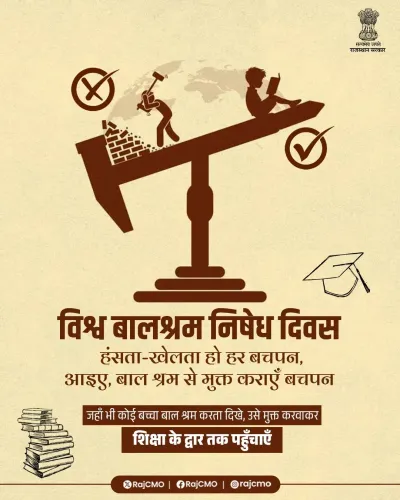
Rajasthan Chief Minister Bhajan Lal Sharma on Friday, 12 June 2026, marked World Day Against Child Labour by calling on all citizens to pledge the creation of a society free from child labour, asserting that every child has an inherent right to education, safety and a better future.
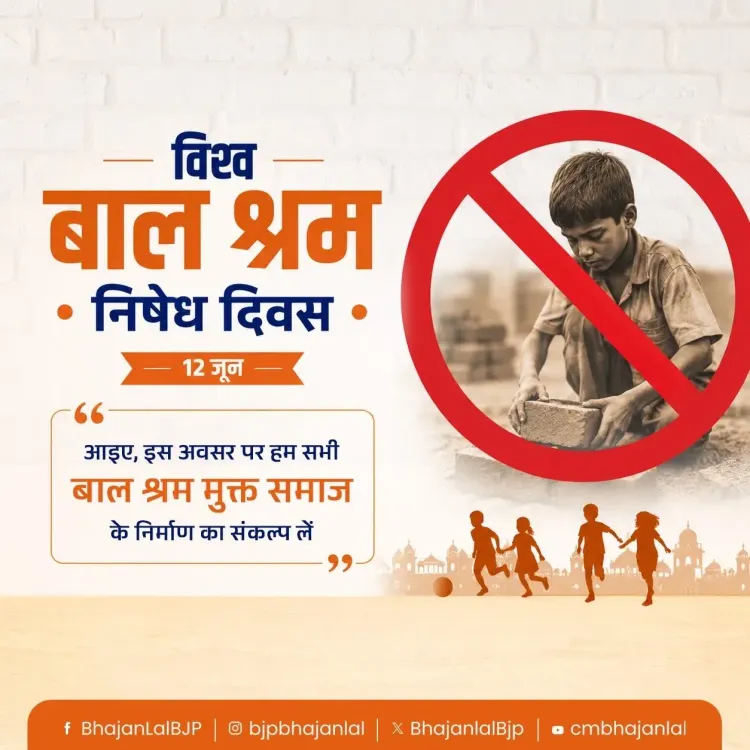
In a post on X, the Chief Minister wrote: 'विश्व बाल श्रम निषेध दिवस के अवसर पर आइए, हम सभी बाल श्रम मुक्त समाज के निर्माण का संकल्प लें' — 'On the occasion of World Day Against Child Labour, let us all resolve to build a society free from child labour.' He further called awareness-building and collective effort to eradicate what he termed a 'social evil' a shared responsibility of all.
Context
World Day Against Child Labour, observed every year on 12 June, was established by the International Labour Organization (ILO) to focus global attention on the scale of child labour and the steps needed to eliminate it. In 2026, the day carries particular weight as governments track progress against Sustainable Development Goal 8.7, which calls for an end to all forms of child labour by 2025 — a target the world has broadly missed, renewing pressure on national and state administrations to intensify action.
Rajasthan is among the Indian states with documented child labour prevalence in agriculture, mining and the informal sector. State authorities have periodically conducted rescue operations and awareness campaigns in high-risk districts as part of broader national commitments.
Policy Backdrop
India's legislative framework against child labour rests on several pillars. The Child Labour (Prohibition and Regulation) Amendment Act, 2016 banned the employment of children under 14 in all occupations and hazardous processes for those under 18. Separately, the Right to Education Act, 2009 guarantees free and compulsory education for children aged 6 to 14, treating school enrolment as a structural counter to exploitative labour.
India ratified ILO Convention 182 on the worst forms of child labour in 2016, signalling a commitment to international standards. The National Child Labour Project Scheme, operational since 1988, continues to rehabilitate children withdrawn from labour through special training centres and bridge education programmes that prepare them for mainstreaming into formal schools.
Stakeholders and Impact
The most direct beneficiaries of sustained anti-child-labour action are children engaged in the informal economy — in fields, kilns, quarries and domestic settings — who are denied schooling and exposed to physical and psychological harm. State labour and education departments bear the primary implementation burden, from inspection and rescue to enrolment drives and conditional cash transfers linked to school attendance.
Civil society organisations, panchayati raj institutions and community leaders are also key actors. Sharma's call for 'collective effort' and 'awareness' aligns with the dual-track approach Indian states have pursued: stricter enforcement combined with demand-side incentives that make education more accessible and attractive than early entry into work.
What's Next
Attention will now turn to whether the Rajasthan government follows the symbolic observance with concrete administrative steps — including district-level enforcement drives, expanded coverage under rehabilitation schemes, and increased budget allocations for bridge education. At the national level, the next periodic child labour survey by the Ministry of Labour and Employment will offer fresh data on whether enrolment gains and enforcement have translated into measurable reductions in the number of working children. The gap between political resolve and ground-level outcomes will be the real measure of the day's significance.
Point of View
But it arrives at a moment when India's missed SDG 8.7 deadline has sharpened scrutiny of state-level delivery. For a state like Rajasthan — where informal-sector child labour in agriculture and mining remains a documented concern — the gap between rhetorical commitment and enforcement outcomes is politically significant. The BJP-led state government faces a dual test: maintaining the legislative momentum of central reforms while translating it into measurable district-level reductions. Observers will watch whether the symbolic pledge is accompanied by budget provisions or operational directives in the weeks ahead.
NationPress
24 Sept 2026
Frequently Asked Questions
What is World Day Against Child Labour and when is it observed?
World Day Against Child Labour is an annual observance on 12 June , established by the ILO to highlight the need to eliminate child labour globally and to promote policies and social protection measures to end it.
What did Rajasthan CM Bhajan Lal Sharma say on Child Labour Day 2026?
Bhajan Lal Sharma called on all citizens to pledge the building of a child-labour-free society, stating that every child has a right to education, safety and a better future, and that eradicating child labour is a shared collective responsibility.
What is India's law against child labour?
The Child Labour (Prohibition and Regulation) Amendment Act, 2016 bans employment of children under 14 in all occupations and prohibits hazardous work for those under 18 . The Right to Education Act, 2009 also guarantees free schooling for ages 6-14 as a structural safeguard.
Does Rajasthan have a child labour problem?
Yes, Rajasthan has documented child labour prevalence in agriculture, mining and the informal sector. State authorities have conducted periodic rescue operations and awareness drives in high-risk districts as part of national SDG commitments.
What is the National Child Labour Project Scheme?
The National Child Labour Project Scheme , operational since 1988 , is a central government programme that rehabilitates children withdrawn from labour through special training centres and bridge education to help them re-enter formal schooling.