Gujarat CMO marks World Population Day, urges balanced growth
Synopsis
On World Population Day, 11 July 2026, Gujarat's Chief Minister's Office called for population awareness, urging citizens to convert demographic numbers into people-power and fulfil the 'Viksit Gujarat to Viksit Bharat' vision through responsible citizenship and balanced population growth.
Key Takeaways
The Chief Minister's Office of Gujarat posted a World Population Day message on 11 July 2026 .
The post frames population not as a burden but as the 'most important human resource for national progress.' Citizens are urged to embrace population awareness and act as responsible contributors to national development.
The message explicitly links state-level demographic goals to the national Viksit Bharat vision championed by PM Narendra Modi .
India's National Population Policy 2000 and Gujarat's own family welfare missions form the long-standing policy backdrop to this appeal.
World Population Day has been observed annually on 11 July since 1989 .
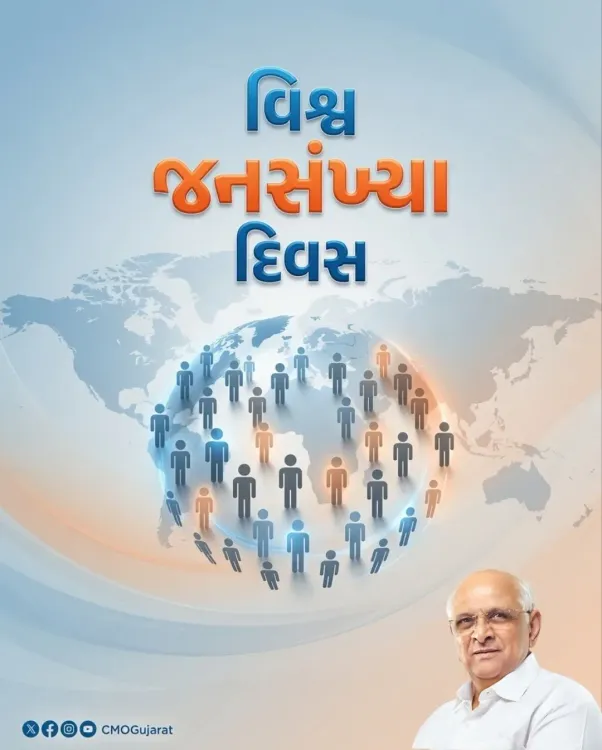
The Chief Minister's Office of Gujarat on Saturday, 11 July 2026 marked World Population Day with a call for population awareness, urging citizens to treat a balanced population as the foundation of a prosperous Gujarat and a developed India.
Context
The post, written in Gujarati, opens with the phrase 'સંતુલિત વસ્તી, સુખી-સમૃદ્ધ ગુજરાત' ('Balanced population, happy and prosperous Gujarat'), framing demographic balance as a prerequisite for genuine development. It states that 'population is not merely a number but the most important human resource for the nation's progress.' The message was shared on the occasion of World Population Day, observed every year on 11 July since 1989 to highlight global demographic challenges.
The CMO's post calls on citizens to 'become aware about population control' and to transform 'જનસંખ્યા' (population) into 'જનશક્તિ' (people-power), linking this aspiration to the national goal of 'વિકસિત ગુજરાતથી વિકસિત ભારત' — 'Viksit Gujarat to Viksit Bharat' (Developed Gujarat to Developed India).
Policy Backdrop
India's National Population Policy 2000 set out a framework for reproductive health services and population stabilisation, with a long-term target horizon of 2045. Gujarat has run state-level family planning and reproductive health missions since the early 2000s, consistently aligning them with central government welfare programmes.
The Viksit Bharat vision, articulated by Prime Minister Narendra Modi from 2023 onward, frames a balanced, skilled population as human capital rather than a burden — a shift in official rhetoric that Gujarat's messaging directly echoes. The CMO's appeal to citizens to act as 'responsible citizens who become the foundation of the nation's progress' reflects this reframing.
Stakeholders and Impact
The message is directed primarily at Gujarat's families, youth, and working-age population. Annual World Population Day communications from state governments serve as recurring platforms to reinforce family welfare awareness without announcing new policy instruments.
Demographic dividend considerations are especially relevant for Gujarat, one of India's more economically active states. Channelling a young, growing workforce into productive employment remains central to both state and national development planning under Chief Minister Bhupendra Patel.
What's Next
Observers will watch for the release of updated Sample Registration System fertility data for Gujarat, which would provide a measurable backdrop to the state's population messaging. Any fresh state government orders on family welfare targets or incentive structures would indicate whether today's awareness appeal is followed by concrete policy action.
With the Viksit Bharat 2047 deadline providing a long-range policy anchor, Gujarat's alignment of state-level demographic goals with the national vision is expected to intensify in the coming years.
Point of View
The CMO's office threads a careful needle: acknowledging fertility management without the politically charged overtones of earlier decades. The explicit 'Viksit Gujarat to Viksit Bharat' linkage signals that Chief Minister Bhupendra Patel's administration is consciously tethering state welfare communication to Prime Minister Modi's 2047 development arc. Whether this messaging translates into new state-level policy instruments or remains symbolic awareness-raising will be the key test of its seriousness.
NationPress
9 Oct 2026
Frequently Asked Questions
Why did the Gujarat CMO post about World Population Day?
The Chief Minister's Office of Gujarat marked World Population Day on 11 July 2026 to raise awareness about balanced population growth and its role in achieving the Viksit Bharat vision of a developed India by 2047.
What is World Population Day and when is it observed?
World Population Day is an annual observance held on 11 July every year since 1989, established to highlight global population issues, reproductive health, and sustainable development challenges.
What does 'Viksit Gujarat to Viksit Bharat' mean?
'Viksit Gujarat to Viksit Bharat' means 'Developed Gujarat to Developed India,' a slogan linking Gujarat's state-level progress to Prime Minister Narendra Modi's national vision of a fully developed India by 2047.
What is India's National Population Policy?
India's National Population Policy 2000 is a framework that targets reproductive health services, fertility reduction, and population stabilisation, with a long-term goal horizon extending to 2045.
Who is the Chief Minister of Gujarat?
Bhupendra Patel has been the Chief Minister of Gujarat since 2021, overseeing the state's development, welfare, and human resource initiatives.