CM Bhupendra Patel Unveils Viksit Gujarat @2047 Roadmap
Synopsis
Gujarat Chief Minister Bhupendra Patel unveiled the 'Viksit Gujarat @2047' roadmap at Gandhinagar on 1 July 2026, jointly prepared by GRIT and the General Administration Department. The plan covers 26 departments, approximately 900 action steps, 11 core themes, 120 macro goals, and 55 key thrust areas, aligned with PM Modi's national Viksit Bharat @2047 vision.
Key Takeaways
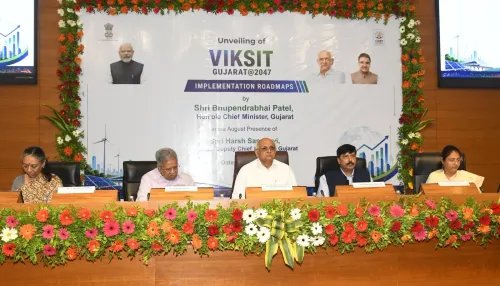
Gujarat CM Bhupendra Patel unveiled the 'Viksit Gujarat @2047' roadmap at Gandhinagar on 1 July 2026 .
The roadmap was jointly prepared by GRIT (Gujarat State Institute of Transformation) and the Planning Division of the General Administration Department .
It covers 26 state government departments with approximately 900 defined action steps , each with assigned responsibility and timelines.
The framework is built around 11 core themes , 120 macro goals , and 55 key thrust areas under the mantra 'Living Well, Earning Well' .
The roadmap is explicitly aligned with Prime Minister Narendra Modi 's national Viksit Bharat @2047 vision articulated in 2023.
The exercise is positioned as the state government's step toward on-ground execution of its long-term development vision for Gujarat's citizens.
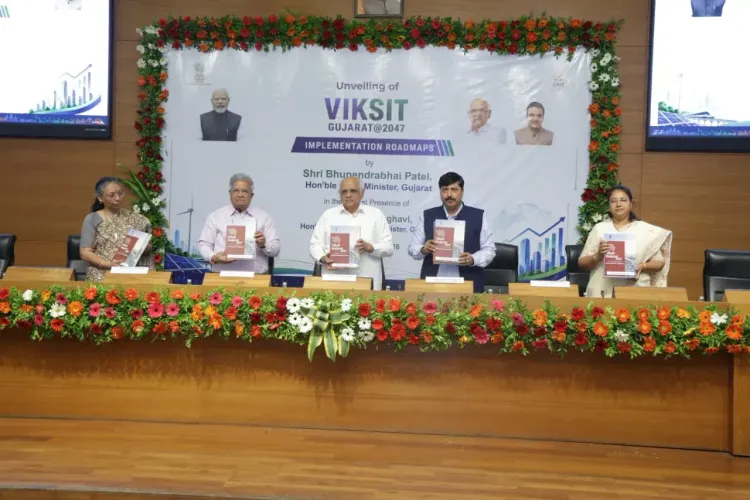
Gujarat Chief Minister Bhupendra Patel on Wednesday, 1 July 2026 unveiled a comprehensive development roadmap titled 'Viksit Gujarat @ 2047' ('Developed Gujarat @ 2047') at Gandhinagar, in the presence of Cabinet colleagues. The roadmap, jointly prepared by the Gujarat State Institute of Transformation (GRIT) and the Planning Division of the General Administration Department, charts a long-term course for the state's transformation over the next two decades.
Context
Posting on X, Chief Minister Patel described the document as a state-level response to Prime Minister Narendra Modi's national 'Viksit Bharat @ 2047' vision, which envisions India becoming a fully developed nation by the centenary of its independence. 'This roadmap has been prepared in alignment with the 'Viksit Bharat @ 2047' vision given by the Honourable Prime Minister,' Patel wrote, framing the exercise as Gujarat's concrete contribution to that broader national ambition.
The unveiling marks a significant administrative milestone: the translation of a high-level vision into department-wise, time-bound action steps. The Chief Minister described it as 'an important step by the state government towards on-ground execution of the Viksit Gujarat vision.'
Policy Backdrop
Prime Minister Narendra Modi articulated the Viksit Bharat @ 2047 vision in 2023, setting a national framework for long-term development targets across sectors. Gujarat, which has historically maintained structured economic and administrative planning, is among the states now developing localised roadmaps that mirror this national goal while addressing state-specific priorities.
The roadmap is structured around a governing mantra of 'Living Well, Earning Well' and encompasses 11 core themes, 120 macro goals, and 55 key thrust areas. Across 26 state government departments, approximately 900 action steps have been defined, each with clarity on the responsible agency and the applicable timeline.
GRIT — the Gujarat State Institute of Transformation — was established to support governance reforms and policy execution, and its joint authorship of this document signals its growing role as a central planning body within the state architecture.
Stakeholders and Impact
The roadmap directly concerns all 26 departments of the Gujarat state government, which have each set goals that feed into the overarching framework. Citizens across the state stand as the primary intended beneficiaries, with the document promising improvements in livelihood quality, infrastructure, and inclusive development.
According to the Chief Minister's post, the roadmap will clarify 'what steps need to be taken, what projects are to be executed, by whom, and within what timeframe' — a level of specificity intended to drive accountability at the departmental level. The 'Living Well, Earning Well' framing suggests a dual focus on social welfare and economic productivity rather than infrastructure alone.
The exercise also reflects a broader pattern among BJP-led states of developing parallel state-level 2047 visions that complement the Centre's national framework, allowing for both political alignment and administrative ownership at the state level.
What's Next
The immediate test for the roadmap will be its operationalisation: whether the 900 identified steps across departments are integrated into the state's budget cycles and reviewed through structured mechanisms. Analysts and governance observers are likely to watch for progress tracking frameworks in upcoming state budget sessions and departmental review meetings. The degree to which the roadmap's macro goals are translated into measurable outcomes will determine whether the 'Viksit Gujarat @ 2047' exercise becomes a durable planning instrument or remains a high-level aspirational document.
Point of View
Demonstrating alignment between the state BJP leadership and PM Modi's signature national vision ahead of future electoral cycles. By anchoring the document in 900 granular steps across 26 departments, the Patel administration is attempting to shift the conversation from aspirational sloganeering to administrative accountability — a move that raises the stakes for measurable delivery. The involvement of GRIT as a co-author signals the state's intent to institutionalise long-term planning rather than treat it as a one-off exercise. Whether the roadmap translates into verifiable outcomes will be the defining test of its credibility.
NationPress
30 Sept 2026
Frequently Asked Questions
What is the Viksit Gujarat @2047 roadmap?
The Viksit Gujarat @2047 roadmap is a long-term development plan unveiled by Gujarat Chief Minister Bhupendra Patel on 1 July 2026, outlining approximately 900 action steps across 26 state departments, structured around 11 themes, 120 macro goals, and 55 key thrust areas to develop Gujarat by 2047.
Who prepared the Viksit Gujarat 2047 roadmap?
The roadmap was jointly prepared by the Gujarat State Institute of Transformation (GRIT) and the Planning Division of the General Administration Department of the Gujarat government.
How is Viksit Gujarat @2047 related to Viksit Bharat @2047?
The Viksit Gujarat @2047 roadmap is explicitly aligned with Prime Minister Narendra Modi's national Viksit Bharat @2047 vision, which envisions India becoming a fully developed nation by the centenary of its independence in 2047. Gujarat's plan serves as the state-level execution framework for that broader national goal.
What does 'Living Well, Earning Well' mean in the Gujarat 2047 plan?
'Living Well, Earning Well' is the governing mantra of the Viksit Gujarat @2047 roadmap, reflecting a dual focus on improving citizens' quality of life through better livelihoods, stronger infrastructure, and inclusive development alongside economic productivity.
What is GRIT in Gujarat government?
GRIT stands for Gujarat State Institute of Transformation, a state-level body established to support governance reforms and policy execution. It co-authored the Viksit Gujarat @2047 roadmap alongside the Planning Division of the General Administration Department.