Bihar CM Samrat Choudhary marks World Population Day
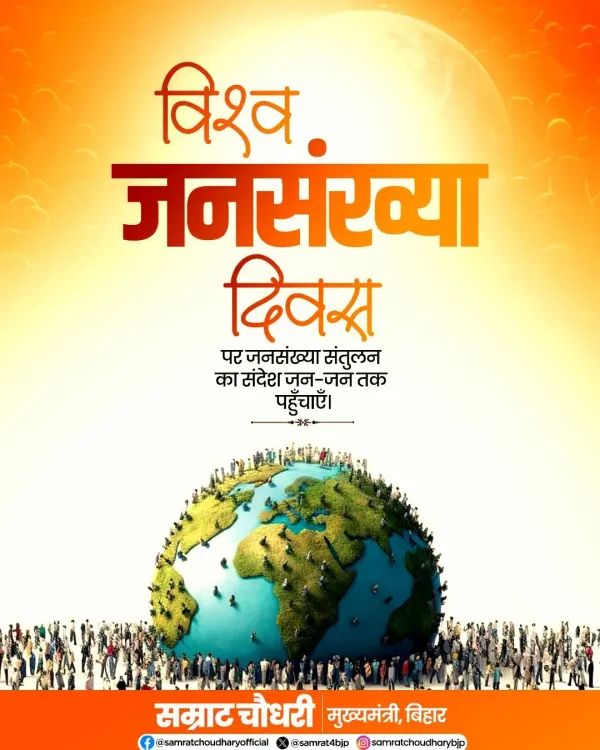
Synopsis
Bihar Chief Minister Samrat Choudhary marked World Population Day on 11 July 2026 by urging citizens to spread awareness on balanced population, responsible citizenship, and sustainable development, linking the observance to India's goal of becoming a healthy and prosperous nation.
Key Takeaways
Bihar Chief Minister Samrat Choudhary issued a World Population Day message on 11 July 2026 .
He called on citizens to spread awareness about balanced population , aware citizenship, and sustainable development .
World Population Day was established by the United Nations in 1989 to highlight population and development linkages.
India's National Population Policy 2000 targets population stabilisation by 2045 through voluntary, awareness-led measures.
Bihar , as one of India's most populous states, is a key focus area for national demographic management efforts.
The message aligns with a broader pattern of Indian leaders linking population awareness to health, education, and resource planning.
Bihar Chief Minister Samrat Choudhary on Friday, 11 July 2026 marked World Population Day by calling on citizens to spread awareness about balanced population growth, responsible citizenship, and sustainable development, urging every Indian to contribute actively to building a healthy and prosperous nation.
In his message posted on X, the senior BJP leader wrote: 'Vishwa Jansankhya Divas hamein santulit jansankhya, jagruk nagrikta aur satat vikas ke prati apni jimmedariyon ka smaran karata hai.' ['World Population Day reminds us of our responsibilities towards balanced population, aware citizenship, and sustainable development.'] He urged people to carry the message of awareness to every citizen and contribute to building a 'healthy, prosperous, and developed India.'
Context
World Population Day is observed every year on 11 July, a date established by the United Nations in 1989 to draw global attention to population-related challenges and their links to development. The day serves as an occasion for governments, civil society, and citizens to reflect on the relationship between demographic trends, resource planning, and human welfare.
Bihar, one of India's most populous states, sits at the centre of national conversations on demographic management, with its large and youthful population representing both a challenge and a potential dividend for the country's development trajectory.
Policy Backdrop
India's approach to population management has been shaped by the National Population Policy 2000, which set a goal of population stabilisation by 2045 through voluntary family planning, improved healthcare access, and enhanced education — particularly for women and girls. The policy explicitly rejected coercive measures in favour of awareness-led behaviour change.
Successive governments at both the central and state levels have continued to align public messaging with these principles, emphasising citizen responsibility, maternal and child health, and the role of education in moderating population growth. Bihar's state health and family welfare programmes have been a key arena for implementing these national priorities.
Stakeholders and Impact
The call to action is directed primarily at Indian citizens, with particular relevance for women and youth, who are central to any sustained shift in demographic outcomes. Awareness campaigns tied to World Population Day typically engage schools, community health workers, and local self-government bodies across states.
For a high-population state like Bihar, such messaging reinforces ongoing efforts in maternal health, child nutrition, and family welfare — areas where the state has historically sought to improve its indicators relative to the national average.
What's Next
Observers will watch for any state-level population awareness drives or public health initiatives that the Bihar government may announce in the days following the observance. Any references to forthcoming census exercises or reviews of family welfare programme targets would further signal the administration's policy direction on demographic management.
As India positions itself to harness its demographic dividend, statements like this from state leaders underscore that population awareness remains a live and politically salient issue, particularly in states where development gaps persist.
Point of View
Awareness-first, and deliberately non-coercive, echoing the voluntary framework set by the National Population Policy 2000. For a Chief Minister of Bihar, one of the country's most demographically significant states, the statement carries more than ceremonial weight: it signals continued state-level alignment with the centre's demographic dividend narrative. The framing around 'responsible citizenship' rather than targets or mandates reflects a conscious political choice to avoid the controversy that surrounds population control debates. Whether the rhetoric translates into concrete programme announcements will be the real test of policy intent.
NationPress
11 Jul 2026
Frequently Asked Questions
What did Bihar CM Samrat Choudhary say on World Population Day 2026?
Bihar Chief Minister Samrat Choudhary called on citizens to spread awareness about balanced population growth, responsible citizenship, and sustainable development, urging active contribution to building a healthy and prosperous India.
When is World Population Day observed and why?
World Population Day is observed every year on 11 July. It was established by the United Nations in 1989 to draw attention to global population issues and their connections to development, health, and resource planning.
What is India's national policy on population management?
India's National Population Policy, released in 2000, targets population stabilisation by 2045 through voluntary family planning, improved healthcare, and education, explicitly rejecting coercive measures in favour of awareness-led approaches.
Why is Bihar significant in India's population discussions?
Bihar is one of India's most populous states and features prominently in national debates on demographic management, with its large, youthful population seen as both a developmental challenge and a potential economic dividend.
What is the demographic dividend and how does it relate to Bihar?
The demographic dividend refers to the economic growth potential that arises when a country's working-age population is larger than its dependent population. Bihar, with its young demographic profile, is central to India's efforts to harness this dividend through investment in health and education.