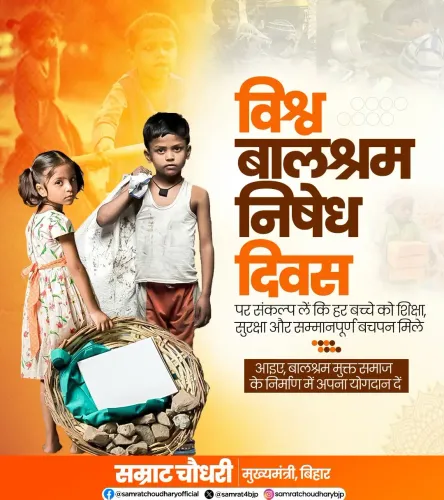
Bihar CM Samrat Choudhary marks World Bicycle Day, urges fitness pledge

Synopsis
Bihar Chief Minister Samrat Choudhary greeted citizens on World Bicycle Day, urging a pledge to cycle regularly for a healthy and green future. The 3 June 2026 post on X tagged Fit India and CyclingForHealth, linking Bihar's leadership to the UN-designated observance and the central government's national fitness campaign launched in 2019.
Key Takeaways
Bihar CM Samrat Choudhary posted a World Bicycle Day greeting on 3 June 2026.
He urged citizens to pledge regular cycling for health and a greener future.
The message used hashtags including #FitIndia and #CyclingForHealth.
World Bicycle Day was designated by the UN General Assembly in 2018.
Fit India Movement was launched by PM Modi on 29 August 2019.
Cycling features in Smart Cities and AMRUT urban mobility programmes.
Bihar Chief Minister Samrat Choudhary on Wednesday, 3 June 2026, extended greetings on World Bicycle Day and called on citizens to commit to regular cycling as a contribution to personal health and a greener environment. The message, posted on X from Patna, aligns the state's leadership with the United Nations-designated observance and the central government's national fitness push.
In his post, the Chief Minister wrote in Hindi, 'Aap sabhi ko Vishwa Cycle Diwas ki hardik shubhkamnayein' ('Hearty greetings to all on World Bicycle Day'), urging followers to 'resolve to cycle regularly and contribute to building a healthy and green future.' He tagged the message with #WorldBicycleDay, #CyclingForHealth, #FitIndia and #HealthyLifestyle, signalling continuity with national wellness messaging.
Context
World Bicycle Day is observed every year on 3 June after the United Nations General Assembly formally designated the date in 2018. The observance highlights the bicycle as a simple, affordable, reliable and environmentally fit means of transport, with particular relevance for developing economies where two-wheeled mobility serves both commuting and recreation needs.
For Samrat Choudhary, who took charge as Bihar Chief Minister in 2024 as part of the NDA arrangement in the state, the message is consistent with the public-health framing he and other senior leaders have used in recent state communications.
Policy backdrop
The Chief Minister's invocation of the #FitIndia tag links his message to the Fit India Movement, launched by Prime Minister Narendra Modi on 29 August 2019 to encourage physical activity and reduce the burden of lifestyle diseases. Since then, the campaign has been folded into school curricula, sports outreach and Independence Day messaging across BJP-ruled states.
Cycling has also featured in broader urban policy. Under the Smart Cities Mission and AMRUT programmes, several Indian cities have piloted dedicated cycle tracks and public bicycle-sharing systems. Bihar's own engagement with cycling has historically been strongest in rural connectivity and student mobility schemes, where bicycles have long been used as a tool of economic and educational access.
Stakeholders and impact
The most immediate audiences for the message are urban residents, students and youth, the demographic groups most likely to take up recreational and commuter cycling. Public-health practitioners have linked sedentary urban lifestyles to rising rates of diabetes, hypertension and obesity, while environmental groups point to short-distance car trips as a significant contributor to local air pollution in Indian cities.
By framing cycling as both a personal-health and climate choice — a 'healthy and green future,' in his words — the Chief Minister echoes the dual narrative that has shaped Indian mobility messaging through the 2020s. The message also dovetails with the BJP's wider effort to project state leadership as participating in nationally branded campaigns.
What's next
Attention will turn to whether the symbolic message is followed by concrete state-level steps, such as expansion of cycling infrastructure in Patna and other Tier-2 cities, integration of cycling promotion with Bihar's school and health departments, or fresh tie-ups with the Fit India ecosystem. State budget allocations and urban development announcements in the coming fiscal year will indicate whether World Bicycle Day 2026 marks a one-day observance or the start of a more structured push.
For now, the Chief Minister's pitch places Bihar firmly within the national fitness and clean-mobility conversation — a low-cost, high-visibility intervention with implications that stretch from public health to climate policy.
Point of View
Samrat Choudhary positions Bihar within both the wellness and climate-mobility conversations that have gained traction since the late 2010s. The real test, however, lies in whether such observances translate into budgetary commitments for cycling lanes and public bicycle systems in Patna and Bihar's growing Tier-2 cities. Until then, the message reads as alignment rather than announcement.
NationPress
17 Oct 2026
Frequently Asked Questions
Why is World Bicycle Day observed on 3 June?
World Bicycle Day is observed on 3 June each year after the United Nations General Assembly officially designated the date in 2018 to recognise the bicycle as a simple, affordable and sustainable means of transport.
What did Bihar CM Samrat Choudhary say on World Bicycle Day 2026?
Samrat Choudhary extended greetings on World Bicycle Day and urged citizens to commit to regular cycling to contribute to a healthy and green future. He shared the message on X with hashtags including #FitIndia and #CyclingForHealth.
What is the Fit India Movement?
The Fit India Movement is a central government initiative launched by Prime Minister Narendra Modi on 29 August 2019. It aims to promote physical activity and healthier lifestyles to reduce the burden of non-communicable diseases.
When did Samrat Choudhary become Chief Minister of Bihar?
Samrat Choudhary assumed office as Chief Minister of Bihar in 2024 as part of the NDA government in the state. He is also a senior leader of the Bharatiya Janata Party.
How does cycling fit into India's urban policy?
Cycling has been promoted under central programmes such as the Smart Cities Mission and AMRUT, which have funded dedicated cycle tracks and public bicycle-sharing pilots in several Indian cities to reduce congestion and emissions.