India-Uzbekistan defence JWG meet in Tashkent: joint training, capacity building on agenda
Synopsis
At their sixth Joint Working Group meeting in Tashkent, India and Uzbekistan moved beyond routine defence dialogue — putting counter-terrorism interoperability, defence manufacturing, and technology exchange on a structured upgrade track. With DUSTLIK exercises already running and ministerial-level backing in place, the partnership is quietly becoming one of India's more operationally active Central Asian defence relationships.
Key Takeaways
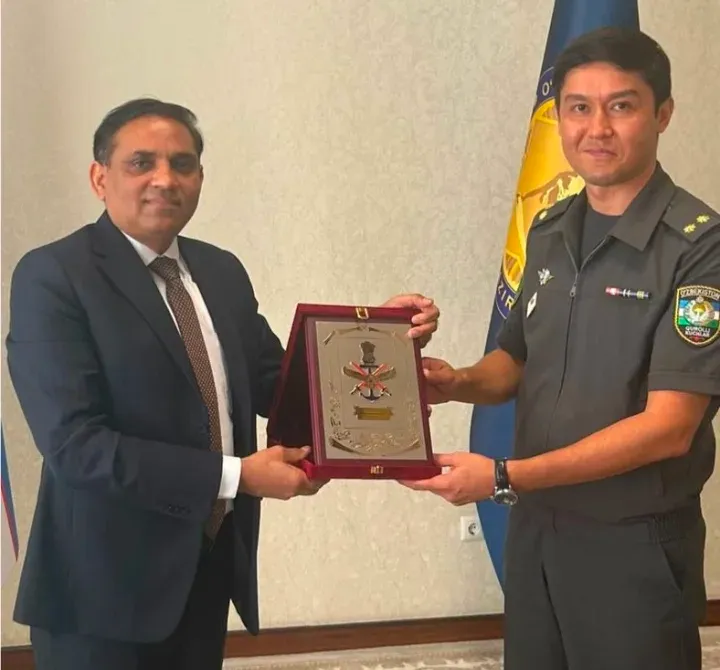
The Sixth Joint Working Group meeting on India-Uzbekistan defence cooperation was held in Tashkent on 5 August .
Co-chaired by Dinesh Kumar (India's Ministry of Defence) and Lt Col Sukhrobjon Sodikjonovich Sirojov (Uzbekistan's Ministry of Defence).
Discussions covered joint training , counter-terrorism operations , capacity building , and defence manufacturing .
The joint DUSTLIK exercise — its seventh edition — was held from 12–25 April 2026 in Namangan, Uzbekistan , with the Mahar Regiment and Indian Air Force participating.
Talks built on earlier discussions between EAM S.
Jaishankar and Uzbekistan's Foreign Minister Bakhtiyor Saidov in New Delhi.
The India-Uzbekistan JWG format has been operational since 2019 .
India and Uzbekistan held their Sixth Joint Working Group (JWG) meeting on defence cooperation in Tashkent on Wednesday, 5 August, covering joint training, capacity building, defence education, and the establishment of defence industries, officials said. The meeting signals a deepening of bilateral security ties that have been steadily expanding since the JWG format was established in 2019.
Who Led the Talks
The meeting was co-chaired by Dinesh Kumar, Joint Secretary in India's Ministry of Defence, and Lieutenant Colonel Sukhrobjon Sodikjonovich Sirojov, Head of the Central Department for International Military Cooperation at Uzbekistan's Ministry of Defence. The Indian delegation also visited the University of Military Security and Defence in Tashkent as part of the engagement.
Key Areas of Discussion
Joint training and exercises were a central focus, with plans for specialised modules emphasising counter-terrorism operations and interoperability. These exercises are set to be conducted in both countries, enabling participants to exchange best practices and tactical strategies.
On capacity building, both sides agreed to review and upgrade ongoing educational programmes and technical assistance arrangements. With India increasingly positioning itself as a defence exporter, discussions also covered technology exchange, equipment maintenance, and cooperation in defence manufacturing — areas that align with New Delhi's push to establish new industries in the sector.
Diplomatic Context
The JWG meeting followed earlier high-level diplomatic engagement between External Affairs Minister S. Jaishankar and Uzbekistan's Foreign Minister Bakhtiyor Saidov in New Delhi, further aligning bilateral security frameworks and critical resource partnerships. This continuity from ministerial-level dialogue to working-group execution reflects the structured depth of the India-Uzbekistan relationship.
DUSTLIK Exercise and Shared Military History
India and Uzbekistan regularly conduct the joint military exercise DUSTLIK, now in its seventh edition, which was held from 12 to 25 April 2026 at the Gurumsaray Field Training Area in Namangan, Uzbekistan. Contingents from the Mahar Regiment and the Indian Air Force participated, practising joint operational skills, tactical coordination, and interoperability in semi-mountainous and semi-urban terrains. Counter-terrorism operations, strike missions, and special operations to neutralise unlawful armed groups were also part of the drills.
What Comes Next
With the seventh DUSTLIK exercise already completed and the sixth JWG meeting concluded, both nations are expected to move toward implementing the upgrades discussed — particularly in defence manufacturing and specialised counter-terrorism training modules. The bilateral defence framework, now over five years old, is steadily broadening its operational and industrial scope.
Point of View
But the steady cadence — six JWG meetings, seven DUSTLIK iterations, and now manufacturing and technology-exchange talks — tells a story of methodical strategic depth in Central Asia. What stands out in this round is the explicit push into defence industry cooperation, which mirrors India's broader 'Make in India' export ambitions rather than just bilateral goodwill. The counter-terrorism interoperability focus is also notable: both nations share concerns about instability emanating from Afghanistan. The real question is whether this framework translates into concrete procurement or co-production deals, or remains at the level of structured dialogue — something many of India's bilateral defence JWGs have historically struggled to move beyond.
NationPress
20 Sept 2026
Frequently Asked Questions
What was discussed at the India-Uzbekistan Joint Working Group meeting in Tashkent?
The Sixth Joint Working Group meeting on defence cooperation, held in Tashkent on 5 August, covered joint training and exercises, counter-terrorism operations, capacity building, defence education, and cooperation in defence manufacturing and technology exchange.
Who represented India and Uzbekistan at the JWG meeting?
India was represented by Dinesh Kumar, Joint Secretary in the Ministry of Defence. Uzbekistan's side was led by Lieutenant Colonel Sukhrobjon Sodikjonovich Sirojov, Head of the Central Department for International Military Cooperation at Uzbekistan's Ministry of Defence.
What is the DUSTLIK exercise between India and Uzbekistan?
DUSTLIK is a joint military exercise conducted annually by India and Uzbekistan. The seventh edition was held from 12 to 25 April 2026 at the Gurumsaray Field Training Area in Namangan, Uzbekistan, focusing on counter-terrorism, interoperability, and operations in semi-mountainous and semi-urban terrain.
How long has India-Uzbekistan defence cooperation been active?
The Joint Working Group format for bilateral defence cooperation was established in 2019. India and Uzbekistan have longstanding ties in the defence sector, which have expanded to include joint exercises, capacity building, and, more recently, defence manufacturing discussions.
How does this JWG meeting connect to broader India-Uzbekistan diplomacy?
The Tashkent talks followed high-level discussions between External Affairs Minister S. Jaishankar and Uzbekistan's Foreign Minister Bakhtiyor Saidov in New Delhi, aligning the defence working group's agenda with broader bilateral security and critical resource partnerships.