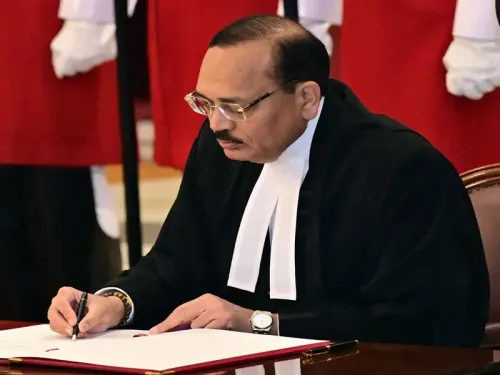
CJI Surya Kant forms panel to assess India's judicial infrastructure needs

Synopsis
CJI Surya Kant has set up a high-level panel to map India's court infrastructure gaps and push for a ₹40,000–50,000 crore government allocation — the most ambitious judicial infrastructure assessment in recent memory, arriving as Parliament itself flags slow fund utilisation and patchy court digitisation across states.
Key Takeaways
CJI Surya Kant has constituted the Judicial Infrastructure Advisory Committee to assess court infrastructure needs across India.
The panel, headed by Justice Aravind Kumar , is expected to seek a government allocation of ₹40,000–50,000 crore for the sector.
An interim report has been directed to be submitted by 31 August .
The Centre has already allocated ₹7,210 crore for Phase-III of the e-Courts Mission Mode Project (2023–2027) .
A Parliamentary Standing Committee chaired by Rajya Sabha MP Brij Lal flagged slow fund utilisation by states under the Centrally Sponsored Scheme for judicial infrastructure.
Chief Justice of India (CJI) Surya Kant has constituted a Judicial Infrastructure Advisory Committee to evaluate the infrastructural requirements of courts across the country, in a significant move aimed at strengthening India's justice delivery system. The committee is expected to make a case for a government allocation of around ₹40,000–50,000 crore for the sector and submit an interim report by 31 August.
Panel Composition and Mandate
The committee is headed by Supreme Court judge Justice Aravind Kumar and includes Justice Debangsu Basak of the Calcutta High Court, Justice Ashwani Kumar Mishra of the Punjab and Haryana High Court, and Justice Somasekhar Sundaresan of the Bombay High Court. The Director General of the Central Public Works Department (CPWD), New Delhi, and the Secretary General of the Supreme Court of India — who will serve as Member Secretary — round out the panel.
The committee has been tasked with mapping infrastructural gaps across courts nationwide and recommending measures to modernise judicial facilities and improve efficiency in the administration of justice.
Key Areas of Focus
The panel's proposed areas of focus include identifying constraints faced by stakeholders in the justice delivery system and suggesting adequate infrastructure for judges, lawyers, litigants, and visitors. It will also recommend technology-driven interventions for faster disposal of cases, examine the computerisation of courts under the e-Courts initiative, and assess citizen-centric digital services and the establishment of modern court complexes.
Improving working conditions for judicial officers and court staff is also on the committee's agenda — an issue that has long been flagged by legal professionals across the country.
e-Courts Mission and Government Push
The development comes amid a broader national push to digitise the judiciary. The Centre has allocated ₹7,210 crore for Phase-III of the e-Courts Mission Mode Project (2023–2027), aimed at transforming Indian courts into digital and paperless institutions. The initiative encompasses the digitisation of legacy records, expansion of video conferencing facilities to courts, jails, and hospitals, universal saturation of e-Sewa Kendras, deployment of artificial intelligence-based tools, and the creation of cloud-based repositories for judicial data.
Parliamentary Concerns Over Fund Utilisation
The formation of this committee assumes added significance in light of concerns raised in March 2025 by the Department-related Parliamentary Standing Committee on Personnel, Public Grievances, Law and Justice. In its 162nd Report on the Demands for Grants (2026–27) of the Department of Justice, the panel chaired by Rajya Sabha MP Brij Lal flagged the slow pace of expenditure and utilisation of funds by several states under the Centrally Sponsored Scheme (CSS) for Development of Infrastructure Facilities for Judiciary.
The parliamentary panel recommended closer monitoring of the scheme to ensure timely completion of projects and effective utilisation of funds. It also flagged deficiencies in digital infrastructure and a lack of adequate network connectivity in courts, recommending that such facilities be uniformly extended to High Courts and subordinate courts across the country.
What Happens Next
With an interim report deadline of 31 August, the Judicial Infrastructure Advisory Committee is expected to deliver a comprehensive picture of the sector's funding and modernisation needs. The findings could shape the government's budgetary priorities for the judiciary in the coming fiscal cycles and accelerate the pace of court digitisation that has lagged in several states.
Point of View
Not incidental. Courts have long operated in conditions that undermine the very efficiency they are meant to deliver — and the ₹40,000–50,000 crore ask, if it materialises, would be a step-change from historical allocations. But the Parliamentary panel's findings on slow fund utilisation by states point to a deeper problem: money alone will not fix a system where absorption capacity is weak and monitoring is lax. The real test for CJI Surya Kant's initiative is whether it produces not just a funding recommendation, but an accountability framework that ensures states actually build what they are paid to build.
NationPress
25 Sept 2026
Frequently Asked Questions
What is the Judicial Infrastructure Advisory Committee set up by CJI Surya Kant?
It is a high-level committee constituted by Chief Justice of India Surya Kant to evaluate the infrastructural requirements of courts across India. Headed by Supreme Court judge Justice Aravind Kumar, it is expected to recommend a government allocation of around ₹40,000–50,000 crore for judicial infrastructure.
Who are the members of the Judicial Infrastructure Advisory Committee?
The panel is headed by Justice Aravind Kumar of the Supreme Court and includes Justice Debangsu Basak of the Calcutta High Court, Justice Ashwani Kumar Mishra of the Punjab and Haryana High Court, and Justice Somasekhar Sundaresan of the Bombay High Court. The Director General of CPWD and the Secretary General of the Supreme Court also form part of the committee.
When is the committee expected to submit its report?
The committee has been directed to submit an interim report by 31 August. Its findings are expected to shape government budgetary priorities for the judiciary in upcoming fiscal cycles.
What is the e-Courts Mission Mode Project and how much has been allocated for it?
The e-Courts Mission Mode Project is a government initiative to transform Indian courts into digital and paperless institutions. The Centre has allocated ₹7,210 crore for Phase-III of the project, covering the period 2023–2027, and includes AI-based tools, video conferencing expansion, and cloud-based judicial data repositories.
Why did Parliament raise concerns about judicial infrastructure funding?
In March 2025, the Department-related Parliamentary Standing Committee chaired by Rajya Sabha MP Brij Lal flagged the slow pace of expenditure and fund utilisation by several states under the Centrally Sponsored Scheme for judicial infrastructure. It recommended closer monitoring and flagged deficiencies in digital infrastructure and network connectivity in courts.