Is Technology the Key to Achieving Transparent and Accessible Justice? CJI Surya Kant Speaks Out

Synopsis
CJI Surya Kant emphasizes the critical role of technology in making justice more transparent and accessible during a foundation-laying ceremony in Patna. He outlines the importance of digitization and modern infrastructure to support vulnerable communities in their pursuit of justice.
Key Takeaways
Technology is essential for a transparent and accessible justice system.
Infrastructure projects will enhance the judiciary's effectiveness.
Digitization of records improves access for marginalized communities.
Healthcare support is critical for judicial personnel.
The Patna High Court plays a key role in upholding constitutional values.
Patna, Jan 3 (NationPress) Highlighting the pivotal role of technology in transforming the justice delivery system, Chief Justice of India (CJI) Surya Kant stated on Saturday that technological advancements are crucial for rendering the judiciary more transparent, accessible, and people-oriented, particularly for individuals residing in remote regions.
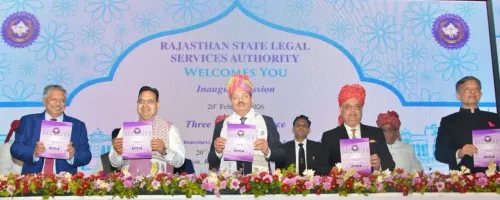
The Chief Justice made these remarks during a ceremony at the Patna High Court, where he initiated seven significant infrastructure projects.
These projects comprise the I-Block building, a hospital facility, a multi-level parking lot, the Advocate General’s office, staff accommodations, an annex building, and other vital structures.
In his address, CJI Surya Kant emphasized that the digitization of judicial records and data would enhance user-friendliness and increase access to justice for the underprivileged, marginalized, and vulnerable groups within society.
He underscored the necessity of closing the digital divide to create an inclusive justice system.
During the event, he also introduced the Electronic Annual Confidential Report (e-ACR) for the Patna High Court, calling it a significant advancement in judicial management.
Reflecting on Bihar’s rich historical background, the Chief Justice remarked that Nalanda University exemplified not just architectural brilliance but also served as a global center for open discussion, rational thought, and the exchange of knowledge.
He noted that the ancient city of Pataliputra represented not only strength but also public welfare and administrative excellence.
Justice Surya Kant commented that the Patna High Court today stands as a robust center for upholding constitutional values, freedom, and judicial rights.
He highlighted the importance of the new auditorium and hospital building, stating that the auditorium will be a crucial venue for judicial discussions and that the hospital signifies that justice is administered by humans, not machines.
He emphasized the need for healthcare support for judges and court personnel who operate under constant stress.
“The genuine essence of justice is about amplifying the voices of the most vulnerable and ensuring timely justice for those in need,” he expressed.
Supreme Court Justice Ahsanuddin Amanullah, addressing the audience, asserted that justice should never be delayed and that infrastructural limitations should not serve as a justification for compromising justice.
He commended the Patna High Court for its ability to provide quality justice despite limited resources.
Justice Rajesh Bindal characterized courts as “temples of justice” and emphasized that robust infrastructure is essential for expediting judicial processes.
He also discussed the positive developments occurring in Bihar.
In his welcoming remarks, Acting Chief Justice of the Patna High Court, Justice Sudhir Kumar Singh, revealed that the total investment for the seven projects is around Rs 320 crore.
He stated that modern infrastructure would enhance the efficiency and speed of the judicial system.
Point of View
It is evident that the advancements announced by CJI Surya Kant signal a significant shift towards a modern judiciary that prioritizes accessibility and transparency. This initiative could bridge gaps in the legal system, particularly for underserved populations, while also enhancing the overall administration of justice across India.
NationPress
6 Oct 2026
Frequently Asked Questions
What did CJI Surya Kant emphasize regarding technology in the judiciary?
CJI Surya Kant highlighted that technological intervention is essential for making the judiciary more transparent and accessible, especially for citizens in remote areas.
What infrastructure projects were announced during the ceremony?
Seven major infrastructure projects were announced, including the I-Block building, a hospital, and a multi-level parking facility.
How will digitization impact access to justice?
Digitization of judicial records is expected to make the system more user-friendly and improve access to justice for marginalized sections of society.
What did CJI Surya Kant say about the importance of healthcare for judges?
He emphasized that healthcare is vital for judges and court staff, who work under significant pressure, highlighting that justice is delivered by humans, not machines.
What is the estimated cost of the infrastructure projects?
The total cost of the seven infrastructure projects is approximately Rs 320 crore.