CJI Urges Graduates: Can Law Become a More Accessible Forum?

Synopsis
In a compelling address at NLU Jodhpur's 18th Convocation Ceremony, CJI Surya Kant urged graduates to embrace law as a dynamic, evolving institution. His insights highlight the importance of making law accessible and relevant to society's needs, emphasizing the role of young lawyers in shaping a more inclusive legal framework.
Key Takeaways
Law is a dynamic institution that must evolve with society.
Legal systems should serve as forums for dialogue and accountability.
The Indian Constitution is a living document that adapts to contemporary realities.
Lawyers have a duty to make law accessible and understandable.
Integrity and clarity should guide legal practice.
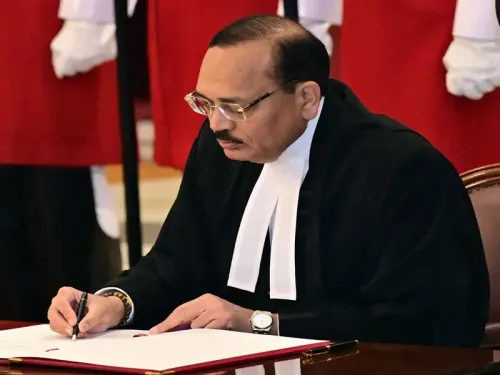
Jaipur, Feb 21 (NationPress) The Chief Justice of India (CJI), Surya Kant, delivered an inspiring address at the 18th Convocation Ceremony of the National Law University (NLU), Jodhpur, encouraging young graduates to perceive law as a dynamic and evolving institution rather than a static entity.
In his speech themed 'From Fortress to Forum – Law in an Unfinished Republic,' the CJI emphasized that law must progress alongside society, serving as a space for dialogue, rights, and accountability.
He compared early legal systems to the renowned Mehrangarh Fort, stating they were constructed like fortifications designed to protect society from disorder.
However, in a modern constitutional democracy, law must shift into a forum where differences can be discussed, rights are expressed, and power is held accountable through reason rather than resistance.
He cautioned graduates against viewing law as a completed product, stressing that, unlike scientific formulas, law grows with human experience.
Quoting Justice Oliver Wendell Holmes Jr., he remarked, “The life of the law has not been logic; it has been experience.”
The CJI pointed out that the Indian Constitution is a living document, interpreted by each generation according to contemporary realities.
He traced the development of legal principles from the Magna Carta (1215) to modern constitutional provisions ensuring equality, dignity, and liberty. He highlighted that Article 14 of the Constitution, which guarantees equality before the law, has transitioned from a formal notion to a mechanism for achieving substantive justice.
CJI Kant cautioned that law risks becoming a “fortress” once more if it grows overly complicated, filled with jargon, and accessible only to the elite.
“Your mission is not to complicate law but to make it clearer; not to restrict the forum, but to expand it,” he advised the graduating class.
He stressed that law is a public trust, and lawyers should prioritize integrity, clarity, and conscience over spectacle and convenience.
He commended NLU Jodhpur for becoming one of India’s premier law schools, noting that its alumni are influential across the judiciary, academia, corporate law, and public service.
He remarked that such institutions have a duty to ensure that legal excellence does not lead to exclusion. In a lighter moment, he reminisced about campus life at NLU Jodhpur, recalling student rivalries, mess hall discussions, and social settings as “forums” where ideas and friendships flourished.
In concluding his speech, he urged graduates to be architects of an open legal forum, rather than guardians of a closed fortress.
“May your advocacy open doors instead of raising walls. May your work make law more accessible, not more distant,” he expressed.
He also extended congratulations to parents, faculty, and the graduating class, wishing them success in their future endeavors.
Point of View
It's clear that Chief Justice Surya Kant's address at NLU Jodhpur is not merely ceremonial; it resonates deeply with pressing societal needs. His call for a more accessible legal system underscores the urgency for future lawyers to prioritize clarity and integrity in their practice, ensuring justice is within everyone's reach. This perspective aligns with the nation's commitment to uphold democratic values.
NationPress
20 Sept 2026
Frequently Asked Questions
What was the main theme of CJI Surya Kant's address?
CJI Surya Kant's address focused on 'From Fortress to Forum – Law in an Unfinished Republic,' encouraging graduates to view law as a dynamic and evolving institution that fosters dialogue and accountability.
How did CJI Kant relate law to the Mehrangarh Fort?
CJI Kant compared early legal systems to the Mehrangarh Fort, emphasizing that they were designed as protective structures, whereas modern law should serve as a forum for open discussion.
What did he say about the Indian Constitution?
He described the Indian Constitution as a living document, interpreted by each generation in light of contemporary realities, highlighting its evolving principles.
What warning did CJI Kant give about the future of law?
He warned that law could revert to being a 'fortress' if it becomes too complex and inaccessible, urging graduates to make it more intelligible and inclusive.
What did he encourage graduates to prioritize?
CJI Kant encouraged graduates to prioritize integrity, clarity, and conscience in their legal practices, viewing law as a public trust.