CM Bhagwant Mann Cites Public Trust at Moga Lok Milni
Synopsis
Chief Minister Bhagwant Mann addressed a Lok Milni at village Charik in Moga on 26 July 2026, asserting that four years of welfare initiatives — free electricity, ₹10 lakh health cover, women's financial aid, canal irrigation and merit recruitment — have earned the Punjab government deep public trust.
Key Takeaways
CM Bhagwant Mann held a Lok Milni at village Charik, Moga on 26 July 2026 , directly engaging rural residents.
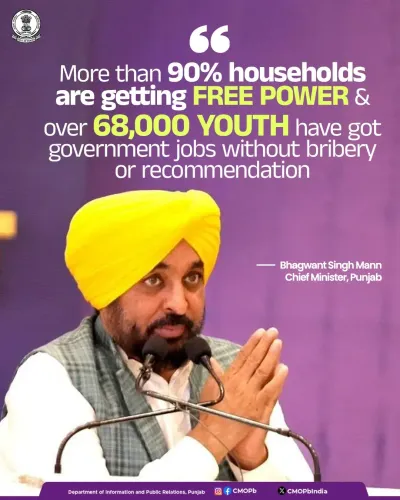
The government claims free electricity benefits 90 per cent of Punjab households through its 300-unit subsidy scheme launched in 2022.
The Mukh Mantri Sehat Yojna offers cashless health insurance of up to ₹10 lakh for eligible families covering secondary and tertiary care.
Financial assistance for women, canal irrigation expansion and merit-based public recruitment were also cited as key achievements of the AAP government's four-year tenure .
Budgetary sustainability and independent coverage data for these schemes will be critical to watch ahead of the 2027 Punjab assembly elections .
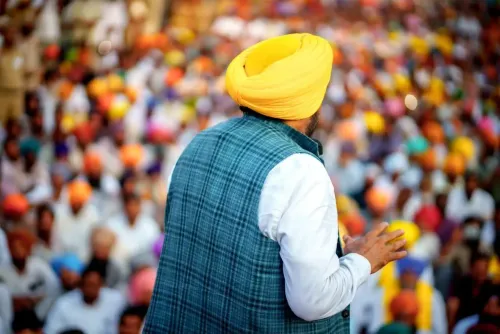
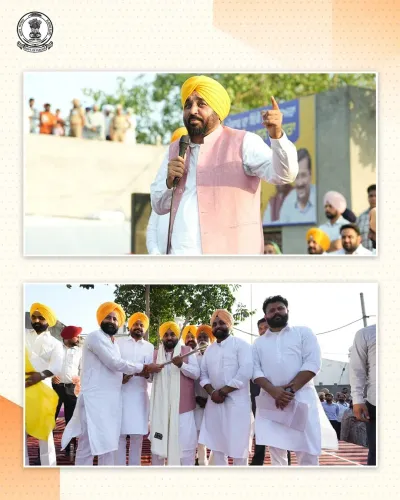
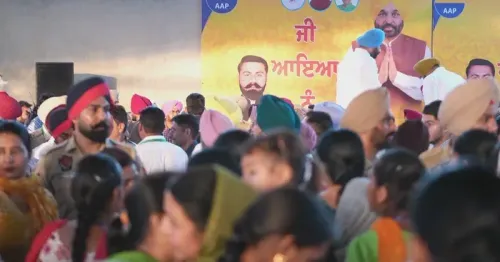
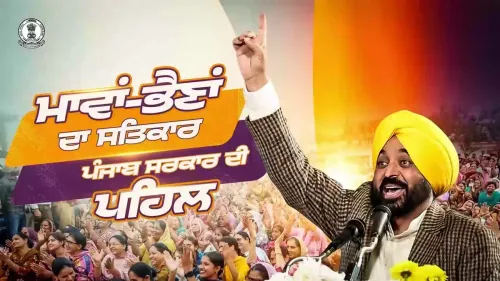
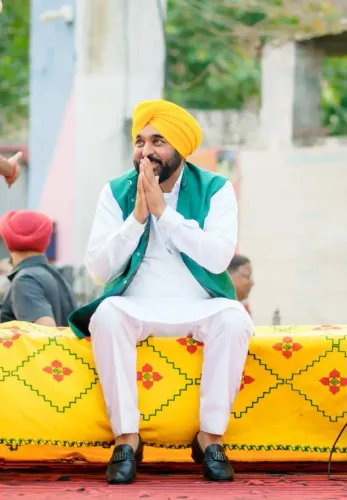
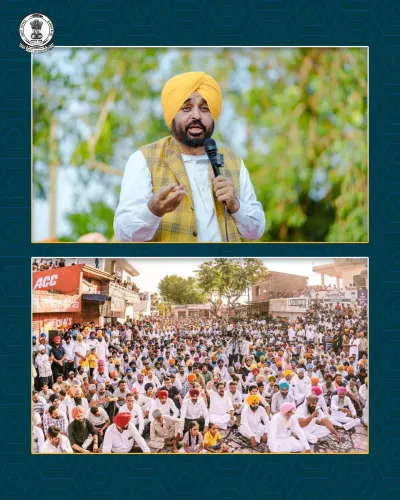
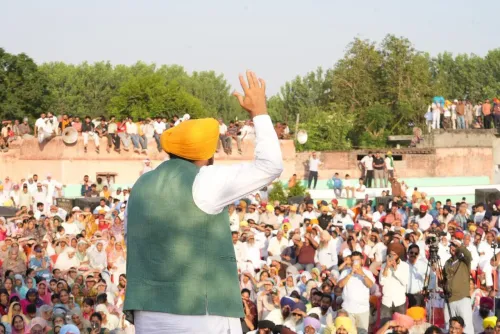
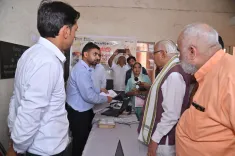
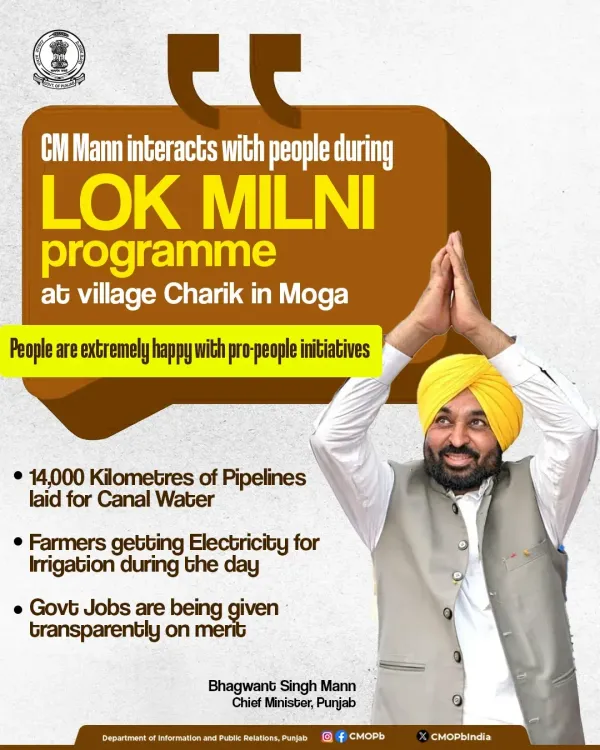
Chief Minister Bhagwant Mann, speaking at a Lok Milni public outreach programme held at village Charik in Moga district on Sunday, 26 July 2026, said the strong public response to his government's initiatives reflects the trust it has built over four years in office. He cited a range of welfare and governance measures as evidence of visible change at the grassroots level.
Context
The Lok Milni is a structured public-interaction format used by the Punjab government to bring the Chief Minister into direct contact with rural residents, allowing citizens to raise grievances and receive on-the-spot responses. The event at Charik in Moga is part of a continuing series of such outreach visits across the state.
Addressing attendees, Mann described the government's record as one of 'transformative initiatives' that have delivered concrete benefits to ordinary households. He specifically highlighted free electricity for 90 per cent of households, the ₹10 lakh Mukh Mantri Sehat Yojna health insurance scheme, financial assistance for women, canal irrigation expansion, merit-based government recruitment, and improvements in public healthcare.
Policy Backdrop
The Aam Aadmi Party government, which took office in March 2022, launched a 300-unit free electricity scheme for domestic consumers as one of its earliest headline measures. The Mukh Mantri Sehat Yojana, also rolled out in 2022, provides cashless health coverage of up to ₹10 lakh for eligible families seeking secondary and tertiary care, modelled broadly on the party's governance approach in Delhi.
Merit-based recruitment in government jobs has been a recurring commitment of the administration, positioned as a departure from alleged irregularities in earlier hiring cycles. Canal irrigation expansion has been framed as a priority for Punjab's farming communities, who remain a critical constituency in the state.
Stakeholders and Impact
The measures cited by Mann span several key demographic groups: rural households benefiting from subsidised power, women receiving direct financial assistance, farmers dependent on irrigation infrastructure, and job aspirants seeking transparent public-sector employment. Together, these groups represent a substantial share of Punjab's electorate.
The health scheme, if functioning at scale, addresses a longstanding gap in cashless medical access for lower-income families in the state. Welfare economists and policy observers have noted that direct-benefit programmes of this kind tend to generate strong recall among beneficiaries, which can translate into political goodwill.
What's Next
With the 2027 Punjab assembly elections on the horizon, the government's ability to sustain budgetary allocations for these schemes will be closely watched. Coverage data, beneficiary numbers, and independent assessments of scheme delivery will be important indicators of whether the ground-level impact matches the claims made at events such as the Moga Lok Milni. The frequency of such public-outreach programmes is also expected to increase as the electoral cycle draws closer.
Point of View
The AAP government is visibly shifting into a narrative-consolidation mode, anchoring its pitch around tangible welfare deliverables rather than ideological positioning. The enumeration of schemes — power, health, women's aid, irrigation, jobs — mirrors the party's playbook from Delhi, where direct-benefit framing proved electorally potent. However, the gap between announced schemes and verified on-ground delivery remains a vulnerability that opposition parties are likely to exploit. Whether public memory of these benefits holds through to polling day will depend heavily on the government's ability to sustain funding and widen beneficiary reach over the next 18 months.
NationPress
26 Jul 2026
Frequently Asked Questions
What is the Mukh Mantri Sehat Yojna in Punjab?
The Mukh Mantri Sehat Yojna is a Punjab government health insurance scheme that provides cashless medical coverage of up to ₹10 lakh per eligible family for secondary and tertiary hospital care. It was launched in 2022 by the Bhagwant Mann -led AAP government.
What did CM Bhagwant Mann say at the Moga Lok Milni?
At the Lok Milni held at village Charik in Moga on 26 July 2026 , CM Bhagwant Mann said the public's overwhelming response to his government's programmes reflects four years of earned trust, citing free electricity, the ₹10 lakh health scheme, women's financial aid, canal irrigation expansion, merit recruitment and improved healthcare.
What is the free electricity scheme in Punjab?
The Punjab government, under CM Bhagwant Mann , provides 300 units of free electricity per month to domestic consumers. The government claims this benefits 90 per cent of households in the state, though independent verification of the exact coverage figure is not publicly established.
What is a Lok Milni programme?
A Lok Milni is a government-organised public-interaction event where the Chief Minister meets residents directly — particularly in rural areas — to hear grievances, announce updates on welfare schemes and demonstrate administrative accountability.
When are the next Punjab assembly elections?
The next Punjab assembly elections are due in 2027 . The current AAP government, led by CM Bhagwant Mann , has been in office since March 2022 and will seek re-election on the basis of its welfare and governance record.