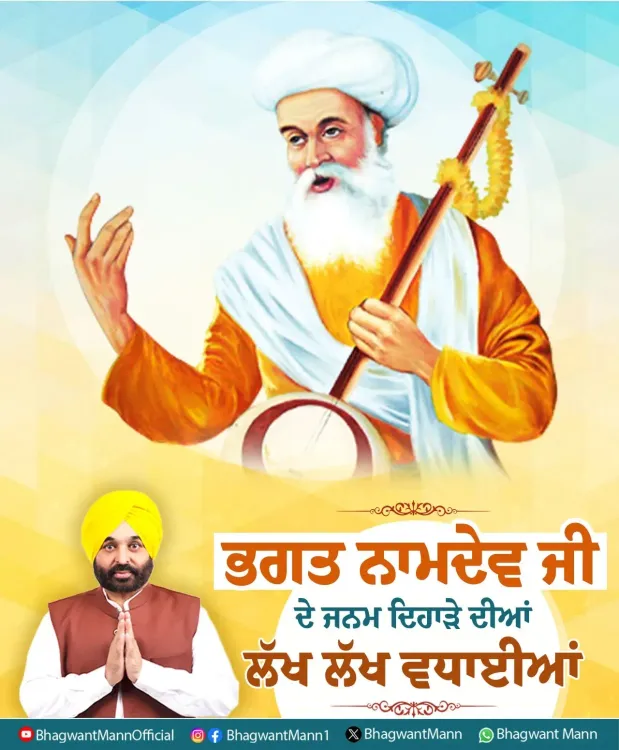
CM Bhagwant Mann greets Punjab on Bhagat Namdev Jayanti
Synopsis
Punjab Chief Minister Bhagwant Mann marked Bhagat Namdev Jayanti on 20 November 2026, calling on people to embrace the 13th-century Bhakti saint's teachings on equality, honest labour, and love for all humanity, and to build a society of solidarity.
Key Takeaways
Punjab CM Bhagwant Mann extended greetings on Bhagat Namdev Jayanti on 20 November 2026 .
Bhagat Namdev Ji was a 13th–14th century Bhakti saint-poet from Maharashtra whose hymns are enshrined in the Guru Granth Sahib .
His core teaching: the Divine resides within every living being, transcending caste and ritual.
Mann called on Punjab to reject caste hierarchy and build a society of barabarta ate saanjhiwalata (equality and solidarity).
The message aligns with AAP's consistent ideological emphasis on social equality since assuming power in March 2022 .
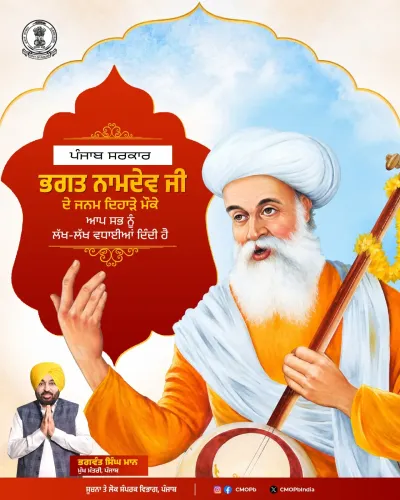
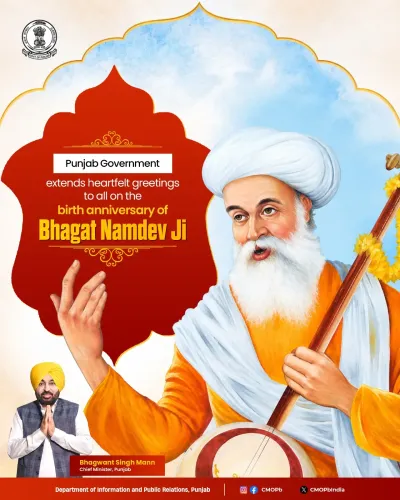
On the birth anniversary of Bhagat Namdev Ji, Punjab Chief Minister Bhagwant Mann extended greetings to the people of Punjab on Friday, 20 November 2026, invoking the saint-poet's timeless teachings on equality, honest labour, and the rejection of caste.
Posting in Punjabi, Mann offered lakh-lakh vadhaiyaan (a hundred thousand congratulations) to all, drawing directly from Bhagat Namdev's sacred verses: 'Bhagat Namdev Ji, through his holy bani, taught us that the Divine resides within every living being.' The message called on people to reject caste distinctions, social hierarchy, and empty ritual — and instead walk the path of true devotion, righteous work, and love for all of humanity.
Who was Bhagat Namdev — and why Punjab remembers him
Bhagat Namdev Ji was a 13th–14th century Bhakti saint-poet born in Maharashtra. A tailor by caste and a weaver of spiritual verse by calling, he preached that God cannot be confined to temples or guarded by priests — the Divine dwells inside every soul, regardless of birth or status. His hymns were so revered that they found a place in the Guru Granth Sahib, making him one of the few non-Sikh saint-poets honoured within the central scripture of Sikhism. That inclusion alone explains the depth of his following across Punjab.
His philosophy cuts to the core of the Bhakti movement's challenge to Brahmanical orthodoxy: no intermediary, no caste gate, no ritual barrier stands between a devotee and the formless Divine. It is a message that resonates as sharply in 2026 as it did seven centuries ago.
Mann's call for a society built on equality and solidarity
The Chief Minister closed his message with a collective appeal — aao, uhnaan de is mahaan updesh nu apne jeevan 'ch dhaaran karke ikk barabarta ate saanjhiwalata wale samaj di sirjana kariye — 'Come, let us imbibe this great teaching in our lives and build a society of equality and solidarity.' The phrase saanjhiwalata, loosely translated as shared belonging or communal fraternity, is a recurring value in Punjabi social thought and carries strong resonance with the Sikh concept of collective welfare, sarbat da bhala.
Punjab's chief ministers have long marked the birth anniversaries of Bhakti and Sikh saints with public greetings, but Mann's framing — centred explicitly on caste rejection and equality — reflects the ideological language that the Aam Aadmi Party government has consistently deployed since taking office in March 2022.
Point of View
AAP continues to position itself as the natural heir to the Bhakti tradition's egalitarian legacy in Punjab. Saint anniversaries in Punjab are never purely devotional moments; they are also low-risk opportunities for political messaging to socially diverse electorates. The explicit invocation of 'equality and shared belonging' mirrors the language AAP used in its 2022 campaign, suggesting the party is working to keep that coalition intact. It is worth watching whether such tributes are accompanied by on-ground events or policy announcements that give the words institutional weight.
NationPress
20 Nov 2026
Frequently Asked Questions
Who was Bhagat Namdev Ji?
Bhagat Namdev Ji was a 13th–14th century Bhakti saint-poet from Maharashtra who preached that God dwells in every soul regardless of caste. His hymns are included in the Guru Granth Sahib, making him deeply revered in Punjab.
Why is Bhagat Namdev important in Sikhism?
His devotional hymns were included in the Guru Granth Sahib by the Sikh Gurus, recognising his spiritual wisdom. He is one of the few non-Sikh Bhakti poets honoured within Sikhism's central scripture.
What did Bhagwant Mann say on Bhagat Namdev Jayanti 2026?
CM Bhagwant Mann greeted Punjab residents on the occasion, citing Namdev's teaching that the Divine lives within every being and calling on people to reject caste and build a society of equality and solidarity.
What is 'saanjhiwalata' in Punjabi culture?
'Saanjhiwalata' means shared belonging or communal solidarity — a value rooted in both Punjabi social thought and the Sikh principle of 'sarbat da bhala' (welfare of all).
What was Bhagat Namdev's main teaching?
Bhagat Namdev taught that the Divine resides within every living being, and rejected caste distinctions, social hierarchy, and empty ritual, advocating instead for true devotion, honest work, and love for all humanity.