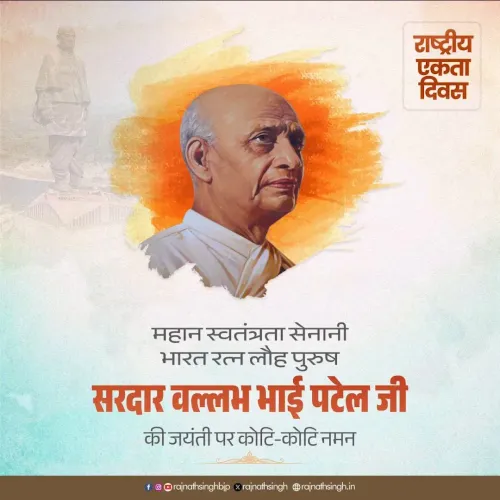
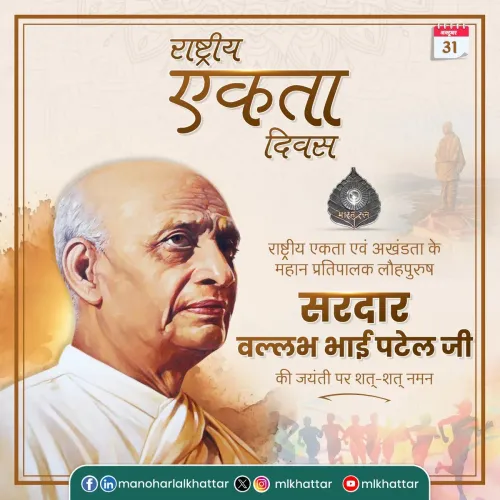
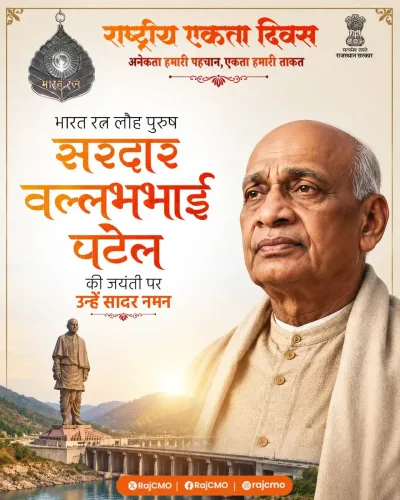
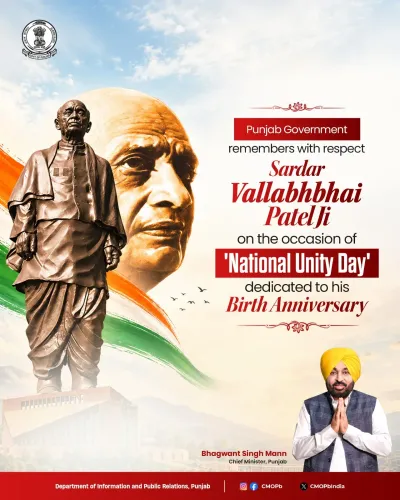
CM Bhagwant Mann pays tribute to Sardar Patel on National Unity Day
Synopsis
Punjab Chief Minister Bhagwant Mann paid homage to Sardar Vallabhbhai Patel on National Unity Day, 31 October 2026, honouring the Iron Man's unification of 565 princely states and urging citizens to renew their pledge to communal harmony.
Key Takeaways
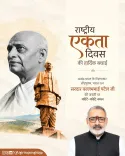
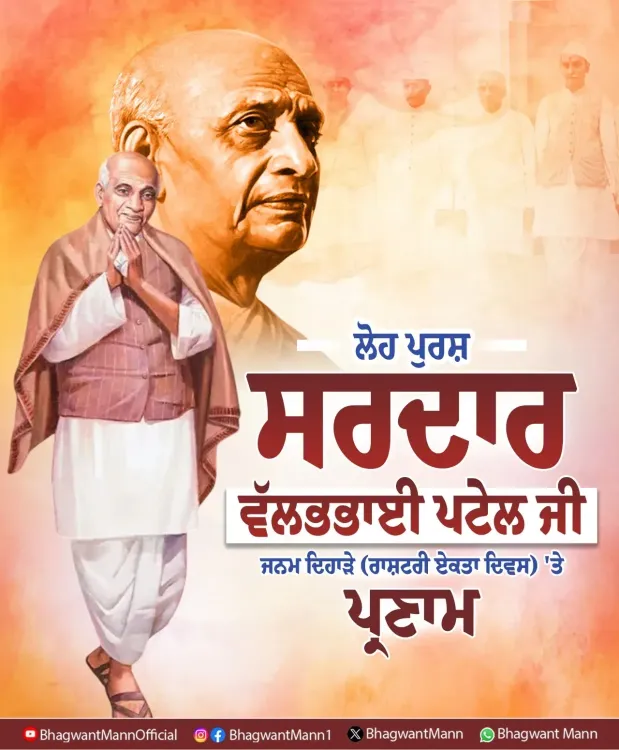
Punjab CM Bhagwant Mann posted a Punjabi-language tribute to Sardar Vallabhbhai Patel on his birth anniversary, 31 October 2026 .
Patel, India's first Deputy Prime Minister and Home Minister, integrated 565 princely states into the Indian Union after 1947 .
Mann invoked Patel's legacy as an eternal inspiration and called on all citizens to strengthen communal harmony on Rashtriya Ekta Diwas .
National Unity Day was instituted by the central government in 2014 to mark Patel's birth anniversary annually on 31 October .
Tributes to Patel on this day span multiple political parties, making it a cross-partisan ritual in Indian public life.
On the birth anniversary of the man who stitched 565 princely states into a single nation, Punjab Chief Minister Bhagwant Mann offered a tribute to Sardar Vallabhbhai Patel on Saturday, 31 October 2026, calling his legacy an eternal source of inspiration for every Indian.
Writing in Punjabi, CM Mann saluted Patel — revered across the country as the 'Loh Purush' (Iron Man) and architect of India's unity — with the words 'koti-koti pranam', meaning a salute from millions. He described Patel's 'great contribution in uniting the country and preserving its integrity' as a guiding light, and called on all citizens to collectively renew their pledge to strengthen communal harmony on Rashtriya Ekta Diwas (National Unity Day).
The Iron Man's unfinished revolution — and why it still resonates
Sardar Vallabhbhai Patel, born on 31 October 1875, served as independent India's first Deputy Prime Minister and Home Minister. In the months immediately after 1947, he oversaw one of history's most audacious feats of statecraft: persuading or pressuring the rulers of 565 princely states — covering roughly 48 per cent of the subcontinent's land area — to accede to the Indian Union. Without that integration, the map of modern India would look unrecognisably fragmented.
His method was a mix of diplomacy, quiet threat, and sheer administrative will, earning him the 'Iron Man' sobriquet that has since transcended party lines. Leaders across the political spectrum invoke his name to reinforce themes of territorial integrity and communal cohesion — particularly potent messaging in a state like Punjab, which shares an international border and carries its own living memory of partition.
Rashtriya Ekta Diwas — from 2014 declaration to annual ritual
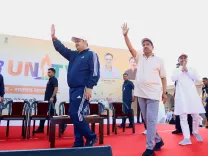
National Unity Day was instituted by the central government in 2014, formally anchoring 31 October as an annual occasion to reflect on Patel's integrationist vision. Since then, the day has become a fixture in the political calendar: state governments organise unity runs, school pledges, and official ceremonies, while public figures from the ruling dispensation to the opposition queue up with tributes.
For CM Mann, posting in Punjabi to his substantial social-media following, the message carries a dual register — honouring a national icon while reinforcing the theme of 'bhaicharak saanjh' (communal brotherhood) that resonates deeply in Punjab's own plural social fabric.
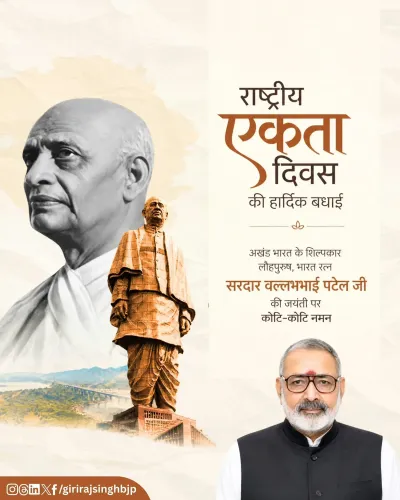
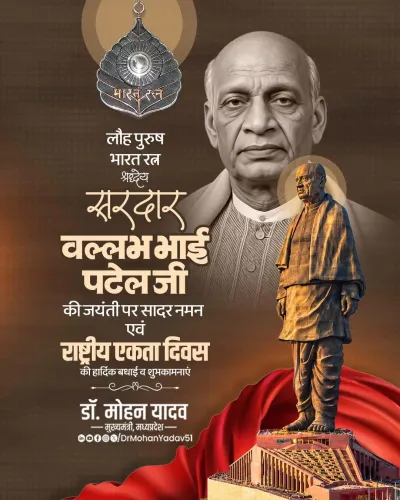
Patel's statue — the Statue of Unity in Kevadia, Gujarat, standing at 182 metres — remains the world's tallest, a physical monument to the integrationist narrative his anniversary renews each year. National Unity Day is now as much about the idea India chooses to project as about the man himself.
Point of View
Governing Punjab since 2022, has an incentive to claim the integrationist narrative rather than cede it to the BJP, which institutionalised National Unity Day in 2014. Paying homage in Punjabi rather than Hindi is a deliberate local-audience choice, reinforcing regional identity while wrapping it in a pan-Indian theme. The broader pattern is clear: Patel has become a shared symbolic resource that no party can afford to ignore on 31 October.
NationPress
31 Oct 2026
Frequently Asked Questions
Why is 31 October celebrated as National Unity Day in India?
31 October is the birth anniversary of Sardar Vallabhbhai Patel , India's first Deputy Prime Minister. The central government designated it Rashtriya Ekta Diwas (National Unity Day) in 2014 to honour his role in integrating 565 princely states into the Indian Union after independence.
What did Bhagwant Mann say about Sardar Patel on National Unity Day 2026?
CM Bhagwant Mann offered koti-koti pranam (salutations from millions) to Patel, calling his contribution to uniting and preserving India's integrity 'an eternal source of inspiration', and urged citizens to pledge to strengthen communal harmony together.
Why is Sardar Vallabhbhai Patel called the Iron Man of India?
Sardar Vallabhbhai Patel earned the 'Iron Man' title for his steely resolve in persuading or pressuring the rulers of 565 princely states to accede to the Indian Union between 1947 and 1950 , preventing the subcontinent from fragmenting after British withdrawal.
When was National Unity Day first observed in India?
National Unity Day was first observed on 31 October 2014 , after the central government instituted it that year to commemorate Sardar Patel's birth anniversary and highlight the theme of national integration.
How many princely states did Sardar Patel integrate into India?
Sardar Vallabhbhai Patel oversaw the integration of 565 princely states into the Indian Union after independence in 1947 , an effort that covered roughly 48 per cent of the subcontinent's land area and is considered one of the greatest feats of modern statecraft.