CM Bhajan Lal: Rajasthan leads manuscript survey under Gyan Bharatam Mission
Synopsis
Rajasthan CM Bhajan Lal Sharma announced that over 16 lakh manuscripts have been surveyed in the state under the Centre's Gyan Bharatam Mission. AI is being used to translate these ancient texts into 13 languages, with Rajasthan said to hold roughly 25 per cent of India's total manuscript wealth in private collections.
Key Takeaways
Rajasthan CM Bhajan Lal Sharma announced the completion of a survey of more than 16 lakh manuscripts in the state.
The effort is part of the Centre's Gyan Bharatam Mission , credited to the guidance of PM Narendra Modi .
Rajasthan is said to hold approximately 25 per cent of India's manuscript wealth in private and family collections.
Artificial intelligence is being deployed to translate ancient texts into 13 languages for wider access.
The initiative aligns with the National Education Policy 2020 's emphasis on Indian Knowledge Systems and builds on the National Mission for Manuscripts launched in 2003.
Manuscript owners, research scholars, and students are the primary stakeholders benefiting from the programme.
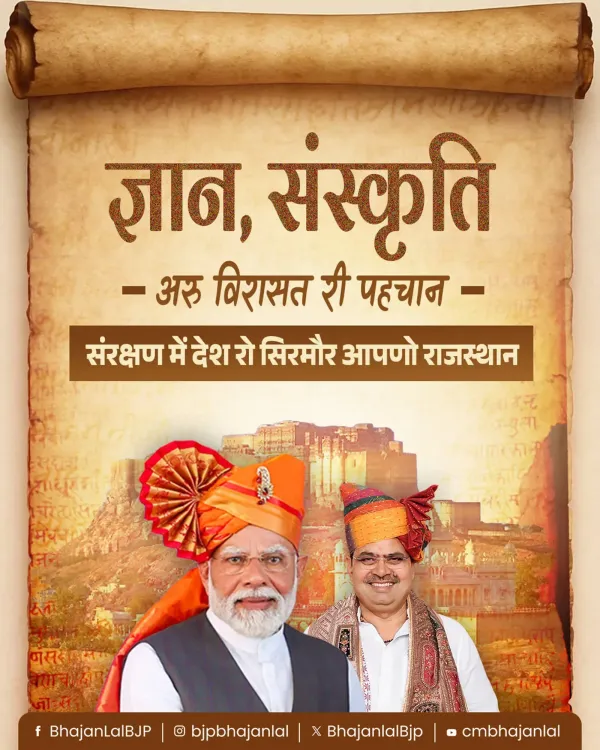
Rajasthan Chief Minister Bhajan Lal Sharma on Tuesday, 16 June 2026 stated that the state has completed a survey of more than 16 lakh manuscripts under the Centre's Gyan Bharatam Mission, and that artificial intelligence is now being used to translate these ancient texts into 13 languages for younger generations.
Context
In his post, CM Sharma credited the initiative to the guidance of Prime Minister Narendra Modi, writing that the government is 'preserving our ancient knowledge tradition through the Gyan Bharatam Mission.' He described it as a matter of pride that approximately 25 per cent of the country's manuscripts are held in private and family collections within Rajasthan. The CM affirmed that the government is 'committed to safeguarding this invaluable heritage.'
Policy Backdrop
The effort builds on a long arc of manuscript conservation policy in India. The National Mission for Manuscripts, launched in 2003 by the Ministry of Culture, laid the groundwork for surveying, digitising, and conserving the country's manuscript wealth. The Gyan Bharatam Mission represents a newer phase of this work, aligning with the broader emphasis on Indian Knowledge Systems embedded in the National Education Policy 2020.
Rajasthan, with its centuries-old tradition of princely patronage for scholarship, holds manuscripts across languages including Sanskrit, Rajasthani, Persian, and Prakrit. The state's private and family-held collections have long been considered among the richest in the country, making it a critical node in any national documentation drive.
Stakeholders and Impact
The survey and translation effort touches several groups. Manuscript owners — many of them families who have preserved these texts across generations — are central to the documentation process, as surveyors must access private holdings. Research scholars stand to gain significantly from AI-assisted cataloguing and translation, which can reduce the time required to make rare texts accessible.
For students and younger audiences, translation into 13 languages is the most immediate point of access — allowing texts that were previously locked behind archaic scripts or regional languages to reach a far wider readership. The use of AI in this context also signals a convergence between heritage policy and the government's broader technology push.
What's Next
The immediate focus will be on expanding the AI-assisted translation pipeline and ensuring surveyed manuscripts are linked to national repositories. Announcements around a centralised digital archive or a public-facing exhibition of Rajasthan's manuscript wealth could follow as the mission scales. Scholars and cultural institutions will be watching whether the translation quality across all 13 languages meets academic standards, particularly for highly specialised philosophical or scientific texts.
As central and state governments deepen their collaboration on heritage digitisation, Rajasthan's model — combining grassroots survey work with modern AI tools — may serve as a template for other manuscript-rich states to follow.
Point of View
Tying Indian Knowledge Systems to the broader Digital India narrative. The scale of private manuscript holdings in Rajasthan also raises a longer-term policy question: how the state will negotiate access, ownership rights, and conservation responsibilities with family custodians as the mission expands.
NationPress
21 Sept 2026
Frequently Asked Questions
What is the Gyan Bharatam Mission?
The Gyan Bharatam Mission is a central government initiative aimed at surveying, preserving, and making accessible India's ancient manuscript heritage, with states like Rajasthan playing a key role in documentation and digitisation.
How many manuscripts have been surveyed in Rajasthan?
According to CM Bhajan Lal Sharma's statement on 16 June 2026, more than 16 lakh manuscripts have been surveyed in Rajasthan under the Gyan Bharatam Mission.
How is AI being used for ancient manuscripts in India?
Artificial intelligence is being used to translate ancient manuscripts into 13 languages, making texts that were previously accessible only to specialists available to a much wider audience, including students and researchers.
Why does Rajasthan have so many manuscripts?
Rajasthan's centuries-long tradition of royal and scholarly patronage led to the accumulation of vast manuscript collections across subjects like philosophy, science, and literature, many of which remain in private and family custody.
What is the National Mission for Manuscripts?
The National Mission for Manuscripts was launched in 2003 by India's Ministry of Culture to survey, digitise, and conserve the country's manuscript heritage, and forms the policy foundation on which newer initiatives like the Gyan Bharatam Mission build.