CM Bhajan Lal Marks 12 Years of Modi Govt Youth Policies
Synopsis
Rajasthan CM Bhajan Lal Sharma marked 12 years of the Modi government on 13 June 2026, crediting Skill India, Startup India, NEP 2020 and Khelo India with turning India's youth into innovation leaders and job creators under the Viksit Bharat vision.
Key Takeaways
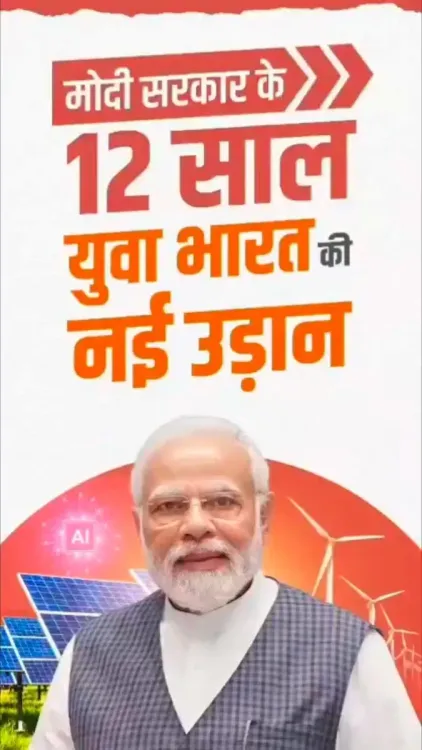
Bhajan Lal Sharma posted on 13 June 2026 marking 12 years of the Modi-led central government with the hashtag #12YearsOfYuvaShakti .
The post credited four flagship programmes: Skill India Mission (2015) , Startup India (2016) , National Education Policy 2020 , and Khelo India (2017) .
Startup India was backed by a Rs 10,000 crore fund-of-funds to support first-generation entrepreneurs.
The NEP 2020 replaced a 1986 framework and introduced a new 5+3+3+4 school structure.
CM Sharma described India's youth as the 'greatest strength' of the Viksit Bharat 2047 Amrit Kaal vision.
The post was accompanied by a video, indicating a coordinated BJP anniversary communication campaign.
Rajasthan Chief Minister Bhajan Lal Sharma on Saturday, 13 June 2026, took to X to mark 12 years of the Narendra Modi-led central government, crediting the period with transforming India's youth from opportunity-seekers into innovation leaders and job creators.
Context
Posting in Hindi, CM Sharma wrote: 'यशस्वी प्रधानमंत्री आदरणीय श्री नरेंद्र मोदी जी के नेतृत्व में बीते 12 वर्षों में भारत की युवा शक्ति ने केवल सपने देखना नहीं, बल्कि उन्हें साकार करना भी सीखा है।' ['Under the leadership of the distinguished Prime Minister Shri Narendra Modi, in the last 12 years, India's youth power has learned not just to dream, but also to realise those dreams.'] He added that young Indians who once wandered in search of opportunities are today leading innovation and generating employment, while the national flag flies at new heights on global stages.
The post carried the hashtag #12YearsOfYuvaShakti and was accompanied by a video, signalling a coordinated BJP communication push marking the anniversary of the party's return to power in May 2014.
Policy Backdrop
The four pillars cited implicitly in the post correspond to well-defined central programmes. The Skill India Mission, launched in 2015, was designed to provide market-relevant vocational training to hundreds of millions of young Indians through short-term certified courses. The Startup India initiative, announced in 2016, offered tax exemptions and a Rs 10,000 crore fund-of-funds to ease business entry for first-generation entrepreneurs.
The National Education Policy 2020, approved by the Union Cabinet in July 2020, replaced a three-decade-old framework and introduced a 5+3+3+4 school structure along with multiple entry-exit options in higher education. The Khelo India scheme, approved in 2017, directed annual budget allocations toward grassroots sports infrastructure, district-level talent identification, and elite athlete scholarships — the programme the post references when speaking of Indian athletes raising the tricolour on global stages.
Stakeholders and Impact
The primary beneficiaries of these schemes are Indian students, vocational trainees, startup founders, and competitive sportspersons. Together they form the demographic dividend the central government has, since 2014, sought to convert into economic and sporting gains. CM Sharma framed this constituency as 'विकसित भारत के अमृतकाल की सबसे बड़ी ताकत' ['the greatest strength of the Amrit Kaal of a developed India'], linking state-level youth outcomes directly to the Viksit Bharat 2047 vision.
For Rajasthan, which adopted several NEP provisions and has its own state startup policy, the post also serves as a signal of alignment between the BJP state government and the central leadership ahead of ongoing policy implementation cycles.
What's Next
Attention will turn to the Department for Promotion of Industry and Internal Trade (DPIIT)'s annual Startup India rankings and unicorn count updates, which will test the narrative of youth-led job creation. State-level NEP adoption progress — including the rollout of the new curricular framework in Rajasthan's government schools — will be a concrete metric by which the claims in the post can be assessed. The BJP's coordinated anniversary messaging suggests further statements from state chief ministers are likely through the week.
Point of View
Where state leaders amplify central government anniversaries to reinforce brand continuity from Delhi to state capitals. By invoking Skill India, Startup India, NEP and Khelo India in a single breath, the post maps the party's youth narrative onto four distinct voter cohorts — trainees, entrepreneurs, students and athletes — ahead of what is likely a broader week-long anniversary campaign. The framing of youth as the 'foundation of Viksit Bharat' is also a forward-looking device, tying the 2014-2026 policy record to the 2047 national goal and insulating the narrative from short-term performance scrutiny. For Rajasthan specifically, the alignment signals that the state BJP government intends to position itself as a faithful executor of central youth policy rather than a distinct regional actor.
NationPress
26 Sept 2026
Frequently Asked Questions
What is #12YearsOfYuvaShakti about?
#12YearsOfYuvaShakti is a BJP hashtag campaign marking 12 years of the Narendra Modi-led central government, highlighting youth-focused schemes such as Skill India, Startup India, NEP 2020 and Khelo India launched between 2014 and 2020.
What did Rajasthan CM Bhajan Lal Sharma say about Modi government youth policies?
CM Bhajan Lal Sharma said that under PM Modi's leadership over 12 years, Indian youth have moved from searching for opportunities to leading innovation and creating jobs, and that new education, skill, startup and sports policies have written new chapters of hope and success for crores of young Indians.
What is the Skill India Mission?
The Skill India Mission is a central government programme launched in 2015 to provide market-relevant vocational training and certification to hundreds of millions of young Indians through short-term courses.
What is the Viksit Bharat 2047 vision mentioned by CM Sharma?
Viksit Bharat 2047 is the central government's long-term goal of making India a developed nation by the centenary of its independence in 2047, with youth identified as the primary driver of that growth.
What is the Khelo India scheme?
Khelo India is a central sports promotion scheme approved in 2017 that funds grassroots sports infrastructure, district-level talent identification competitions, and scholarships for elite young athletes across India.