CM Bhajan Lal inspects SMS Hospital, orders quality care
Synopsis
Rajasthan Chief Minister Bhajan Lal Sharma inspected SMS Hospital in Jaipur on 6 June 2026, reviewed OPD and health services, spoke with patients, and directed officials to ensure quality care and zero compromise on cleanliness.
Key Takeaways
CM Bhajan Lal Sharma conducted a personal inspection of Sawai Man Singh (SMS) Hospital , Rajasthan's largest government tertiary-care facility, on 6 June 2026 .
He reviewed OPD operations and the full range of health services, and held direct conversations with patients and their families.
Officials were directed to ensure every patient receives timely, quality treatment and sensitive service.
The Chief Minister stated that no compromise on cleanliness or medical service quality will be tolerated at any level.
Providing better, accessible and effective health services to Rajasthan's residents was declared the government's top priority.
Follow-up attention will focus on health department audit orders and the next Rajasthan health budget allocation.
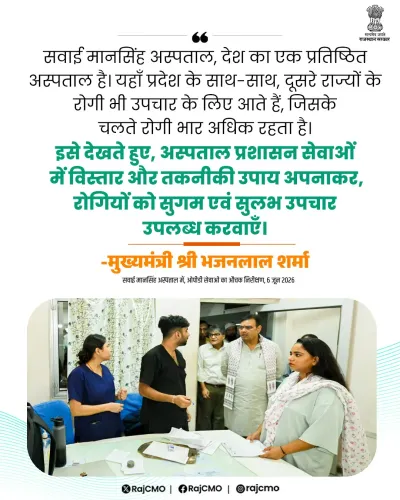
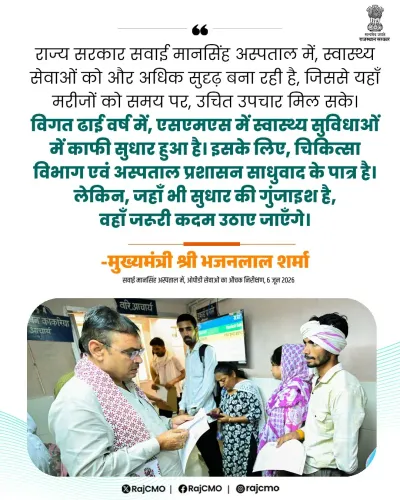
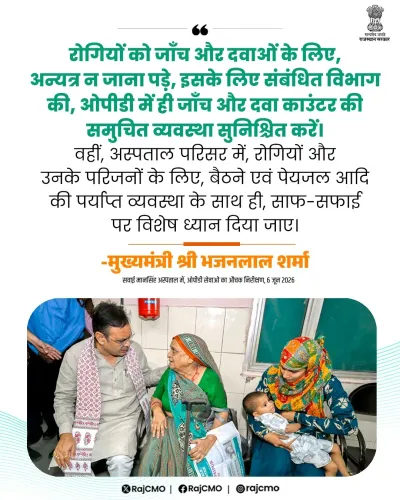
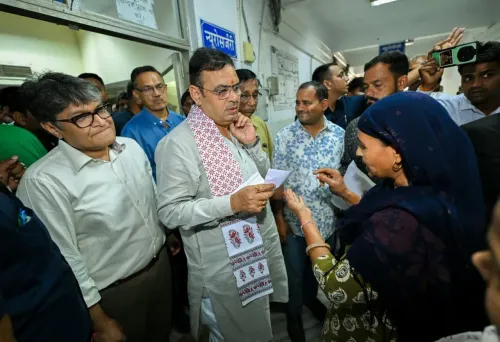
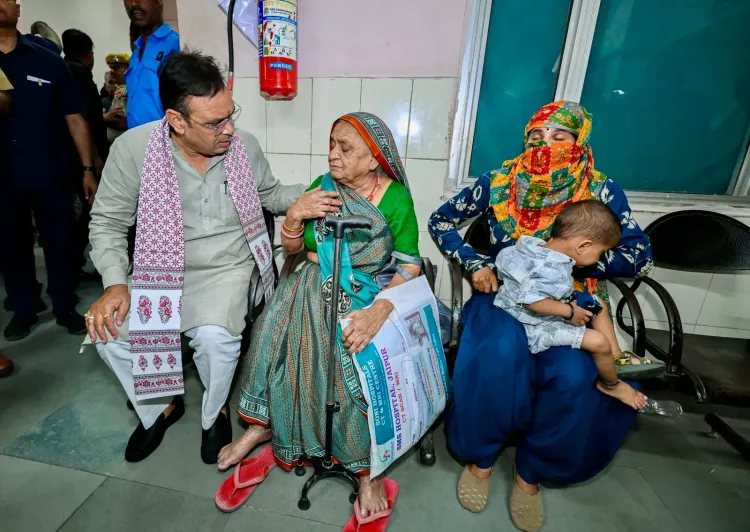
Rajasthan Chief Minister Bhajan Lal Sharma conducted a surprise inspection of Sawai Man Singh (SMS) Hospital in Jaipur on Saturday, 6 June 2026, reviewing outpatient department (OPD) operations and the full range of health services at the state's largest government tertiary-care facility.
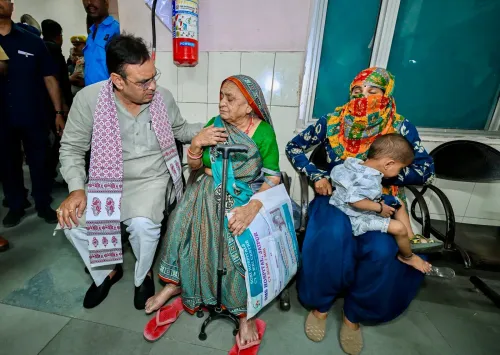
Sharing details of the visit on X, the Chief Minister wrote: 'आज एसएमएस अस्पताल का निरीक्षण कर ओपीडी एवं सभी स्वास्थ्य सेवाओं का जायजा लिया' ('Today I inspected SMS Hospital and took stock of the OPD and all health services'). He added that he interacted directly with patients and their families to gather first-hand feedback on treatment arrangements, available facilities, and hospital management.
Context
SMS Hospital, formally known as Sawai Man Singh Hospital, is Rajasthan's premier state-run medical institution and handles among the highest OPD volumes of any government hospital in the region. The facility serves patients from across the state, making its functioning a barometer of public healthcare delivery in Rajasthan.
During the inspection, Sharma spoke with patients and their attendants, seeking candid assessments of the quality of care, waiting times, and the conduct of hospital staff — a practice that senior administrators say yields unfiltered ground-level feedback that formal reports often miss.
Policy Backdrop
The inspection aligns with the stated priorities of the National Health Policy 2017, which placed quality public healthcare delivery at the centre of state obligations. Rajasthan is also a beneficiary state under Ayushman Bharat Pradhan Mantri Jan Arogya Yojana, the national health coverage scheme launched in 2018 to extend financial protection to low-income households seeking tertiary care.
Chief ministers across party lines have periodically visited flagship government hospitals as part of administrative oversight, but such visits carry added weight when accompanied by direct directives to senior officials. Sharma issued instructions on the spot, warning that 'no compromise on cleanliness and quality of medical services will be accepted at any level' — 'अस्पतालों में स्वच्छता और चिकित्सा सेवाओं की गुणवत्ता से किसी भी स्तर पर समझौता स्वीकार नहीं किया जाएगा'.
Stakeholders and Impact
The most immediate beneficiaries of any corrective action following the inspection are the thousands of patients — many from rural and semi-urban districts — who rely on SMS Hospital as their primary access point for specialist and emergency care. Hospital staff, including doctors, nurses, and administrative personnel, are now on notice that the Chief Minister's office is monitoring service standards directly.
Sharma declared that 'providing better, accessible and effective health services to the people of the state is the highest priority of our government' — 'प्रदेशवासियों को बेहतर, सुलभ एवं प्रभावी स्वास्थ्य सेवाएं उपलब्ध कराना हमारी सरकार की सर्वोच्च प्राधमिकता है'. The statement signals a political commitment that health officials will be expected to translate into measurable outcomes.
What's Next
Attention will now turn to whether the Rajasthan health department issues formal follow-up orders on hospital audits, cleanliness benchmarks, or patient-feedback mechanisms in the coming weeks. The state's next health budget allocation in the Rajasthan Legislative Assembly will also be watched as a test of whether the political priority articulated during the inspection is backed by additional financial commitments.
If the directives issued during the visit translate into a structured inspection calendar covering district and sub-district hospitals, the initiative could mark a broader shift in how the state government monitors frontline healthcare delivery.
Point of View
Like most large states, faces persistent challenges of overcrowding, staff shortages, and uneven service quality. By personally engaging with patients rather than relying solely on official briefings, Sharma is deploying a governance style that projects accessibility and directness. The zero-tolerance language on cleanliness and service quality echoes the broader BJP governance narrative of 'delivery over promise,' but the real test will be whether the visit triggers institutional change or remains a one-time signal. With Rajasthan's health budget and district-level hospital performance under scrutiny, this inspection sets a benchmark against which subsequent policy action — or inaction — will be measured.
NationPress
19 Sept 2026
Frequently Asked Questions
Why did CM Bhajan Lal Sharma visit SMS Hospital?
Chief Minister Bhajan Lal Sharma visited SMS Hospital in Jaipur on 6 June 2026 to personally inspect OPD operations, review available health services, and gather direct feedback from patients and their families on treatment quality and hospital management.
What is SMS Hospital in Jaipur?
SMS Hospital, formally Sawai Man Singh Hospital, is Rajasthan's largest government-run tertiary-care medical facility, located in Jaipur, and handles among the highest OPD patient volumes of any state-run hospital in the region.
What instructions did CM Bhajan Lal give after the hospital inspection?
He directed officials to ensure every patient receives timely, quality treatment and sensitive service, and stated that no compromise on hospital cleanliness or medical service quality would be accepted at any level.
What is Rajasthan's health policy priority under CM Bhajan Lal Sharma?
CM Sharma has stated that providing better, accessible and effective health services to the people of Rajasthan is the highest priority of his government, a commitment underscored by the direct inspection of SMS Hospital.
What happens after a chief minister inspects a government hospital in India?
Such inspections typically prompt the state health department to issue follow-up directives on service standards, cleanliness audits, and patient-feedback systems; budget allocations in the next legislative session often reflect the priorities flagged during such visits.