CM Bhajan Lal: Power changes via ballot, not street crowds
Synopsis
Rajasthan Chief Minister Bhajan Lal Sharma on 16 October 2026 firmly rejected 'regime change' ambitions pursued through street mobilisation, asserting that India's Constitution places the sole power of government change with voters at the ballot box.
Key Takeaways
Bhajan Lal Sharma , Chief Minister of Rajasthan and BJP leader since December 2023 , posted a sharp defence of electoral democracy on 16 October 2026 .
He stated that power in India changes only through the people's right to vote ( matadhikar ), not by gathering crowds on streets.
Sharma acknowledged protest as a democratic right but drew a clear line at attempts to destabilise an elected government through 'anarchy.' He invoked the concept of 'regime change' explicitly, warning those harbouring such ambitions to instead contest elections and win public trust.
The post reflects a recurring constitutional framing used by India's ruling establishments: the ballot mandate is final and cannot be overridden by street pressure or conspiracy.
Opposition reactions and the Rajasthan winter assembly session will be key moments to watch following this statement.
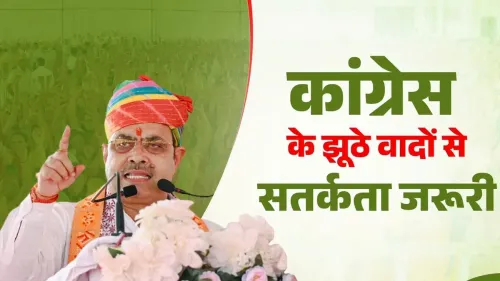
Power in India is not seized on the streets — it is earned at the ballot box. Rajasthan Chief Minister Bhajan Lal Sharma made that point sharply on Friday, 16 October 2026, firing a pointed salvo at what he called 'regime change' dreamers who believe mob pressure can substitute for a democratic mandate.
In a post on X, Sharma wrote in Hindi: 'Regime Change ka divaswapna dekhne walon ko samajh lena chahiye ki Bharat mein satta parivartan sadkon par bheed jutakar nahin, balki janta ke matadhikar se hota hai.' ('Those dreaming of regime change must understand that in India, power transfers not by gathering crowds on the streets, but through the people's right to vote.') The message was unambiguous: democratic dissent is a right; manufacturing anarchy to destabilise an elected government is not.
The constitutional line Sharma drew
Sharma's argument rests on bedrock constitutional principle. The Constitution of India and the Representation of the People Act, 1951 establish elections as the sole legitimate mechanism for forming and changing governments. He leaned into that framework explicitly, stating that anyone restless for a change in power should 'go among the people, win public trust, and prove your strength in elections.'
That is not merely rhetoric — it is a precise legal architecture. Street action, however large, carries no constitutional weight as a mechanism of government formation. The Chief Minister was essentially quoting the republic's own rulebook back at his critics.
A warning against 'anarchy' dressed as opposition
Sharma drew a careful but firm line. 'Opposition is a democratic right,' he acknowledged, but followed immediately with the harder edge: 'Attempting to destabilise an elected government by spreading anarchy cannot be acceptable under any circumstances.' The distinction — between legitimate protest and organised destabilisation — is one India's ruling establishments have invoked repeatedly when facing sustained opposition campaigns.
His closing line carried the most weight: 'Yahan nirnay kewal janta karti hai, unka janadesha karta hai.' ('Here, only the people decide — their mandate decides.') No crowd, no conspiracy, no political ambition can override that verdict. The framing leaves the opposition with a stark choice: win votes or accept the mandate already given.
The recurring ballot-vs-street debate in Indian politics
This is not the first time a sitting government in India has made this argument, and it will not be the last. Whenever sustained street campaigns or opposition mobilisations question an elected administration's legitimacy, the ruling side reaches for the same constitutional anchor: the ballot box is final. What makes Sharma's intervention notable is its directness — he named the concept of 'regime change' explicitly, a term that carries international connotations of externally or extra-constitutionally engineered power shifts.
The specific trigger for his October 2026 post remains unclear, but the political temperature in Rajasthan — where Sharma's BJP government has been in office since December 2023 — will almost certainly sharpen scrutiny of whatever prompted it. Opposition reactions and any related debates in the upcoming winter session of the Rajasthan state assembly will signal how seriously the warning has landed.
India's democracy, Sharma concluded, is not a hostage to anyone's political ambition. That sentence is both a constitutional statement and a campaign-ready challenge — and his opponents will have to decide how to answer it.
Point of View
' with its overtones of foreign-engineered or extra-constitutional power shifts, signals that the BJP in Rajasthan may be anticipating a sustained opposition campaign ahead of the next electoral cycle. The argument is constitutionally sound on its face, but its political utility lies in framing any large-scale protest as inherently anti-democratic — a move that puts opposition parties on the defensive about the means of dissent rather than the content of their critique. How Rajasthan's opposition responds will reveal whether they can reclaim the democratic high ground or find themselves arguing on Sharma's chosen terrain.
NationPress
16 Oct 2026
Frequently Asked Questions
What did Rajasthan CM Bhajan Lal Sharma say about regime change?
Sharma said that those dreaming of regime change must understand that in India, power transfers only through the people's right to vote — not by mobilising crowds on the streets. He called attempts to destabilise an elected government through anarchy unacceptable.
Who is Bhajan Lal Sharma and when did he become Rajasthan CM?
Bhajan Lal Sharma is the Chief Minister of Rajasthan and a BJP leader. He assumed office in December 2023 after the BJP's victory in the state assembly elections.
Is it legal to protest against the government in India?
Yes. The Constitution of India guarantees the right to peaceful protest as part of fundamental rights. Sharma himself acknowledged this in his post, distinguishing between legitimate democratic dissent and actions aimed at destabilising an elected government.
What law governs how governments are formed and changed in India?
The Constitution of India and the Representation of the People Act, 1951 establish elections as the sole legitimate mechanism for forming and changing governments at central and state levels.
Why did Bhajan Lal Sharma post about regime change in October 2026?
The specific trigger for the post has not been publicly confirmed. The statement reflects a broader pattern in which sitting governments invoke constitutional legitimacy when facing sustained opposition campaigns or street-level political mobilisation.