CM Bhajan Lal Sharma: BJP wins prove public backs development
Synopsis
Rajasthan Chief Minister Bhajan Lal Sharma invoked BJP wins in municipal polls to argue that voters consistently reward development and good governance, challenging Congress to introspect rather than blame EVMs, electoral roll revisions, or the Election Commission for its defeats.
Key Takeaways
CM Bhajan Lal Sharma posted on 13 October 2026 citing Rajasthan municipal election results as proof of BJP's public mandate.
He credited PM Narendra Modi's domestic and international popularity to 'visionary leadership and dedication to public service.' Sharma challenged Rahul Gandhi and Congress to introspect on their politics rather than blaming EVMs, electoral roll revisions, or the Election Commission for losses.
He argued that public trust is earned through 'work, development, good governance and accountability' — not false narratives or hollow slogans.
The post was tagged #ShahExposesRahul , indicating a coordinated BJP messaging campaign.
BJP has governed Rajasthan since December 2023 , when Sharma was installed as Chief Minister after the party's assembly election victory.
Municipal polls in Rajasthan have handed Rajasthan Chief Minister Bhajan Lal Sharma a fresh talking point — and on Tuesday, 13 October 2026, he used it to fire a pointed broadside at the Congress, arguing that repeated electoral defeats should prompt the party to look inward rather than blame constitutional institutions.
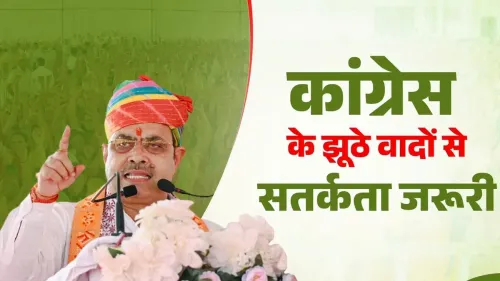
Writing in Hindi, Sharma framed the BJP's growing national support — including in Rajasthan's civic body elections — as direct evidence of voters endorsing development and welfare delivery over what he called 'jhoothe narrative aur khokle nare' ('false narratives and hollow slogans'). 'The public does not want false narratives, illusions and appeasement politics,' he wrote. 'It wants development and good governance that makes their lives easier.'
Modi's popularity as a governing benchmark
Sharma anchored a significant portion of his post around Prime Minister Narendra Modi, citing his domestic and international popularity as proof that leadership which delivers on its promises earns durable public trust. The framing is a well-worn BJP template — but Sharma deployed it with specific local weight: his own government's December 2023 assembly election victory in Rajasthan is the most recent, concrete exhibit he can point to.
That victory ended a five-year Congress tenure under Ashok Gehlot and installed Sharma as Chief Minister — the first time BJP returned to the state after a single term out of power. Every municipal win since has been read, inside BJP circles, as a ratification of that mandate.
The EVM and SIR argument — and Sharma's counter
Sharma's sharpest lines were reserved for a direct challenge to Rahul Gandhi and the Congress. He argued the party has cycled through familiar excuses — electronic voting machines, electoral roll revisions, the Election Commission — each time it loses, rather than examining its political direction. 'Whether elections are held via EVM or ballot paper, whether SIR comes before or after — Congress should learn from its continuous defeats,' he wrote.
The reference to 'SIR' — a process linked to electoral roll revision — sits in disputed territory. Opposition parties have raised concerns about such exercises in BJP-ruled states, alleging selective voter deletions; the BJP rejects those claims as motivated scaremongering. Sharma's post, tagged #ShahExposesRahul, signals this exchange is part of a coordinated party messaging push.
A line drawn between accountability and blame-shifting
The closing argument of Sharma's post distils the BJP's post-2014 electoral thesis into a single formulation: public trust in a democracy is earned through 'work, development, good governance and accountability' — not through narrative management. It is a line the party has used across state after state, and one that tends to land hardest when recent vote counts back it up.
For the Congress, the challenge is structural as much as rhetorical: without a clear counter-record in states where it currently governs, responding to Sharma's charge requires more than a rebuttal — it demands results.
Point of View
And every opposition defeat as the wages of identity politics and institutional blame. The timing — pegged to Rajasthan municipal results — gives the national talking point local, verifiable grounding, making it harder to dismiss. The 'SIR' reference is a live flashpoint: opposition allegations around electoral roll revisions in BJP-ruled states have yet to be definitively adjudicated, and Sharma's pre-emptive counter signals the party expects this to become a major opposition line before the next big electoral cycle. Whether the Congress can pivot from process grievances to a coherent governance counter-narrative will shape the credibility battle heading into the next round of state elections.
NationPress
13 Oct 2026
Frequently Asked Questions
What did Rajasthan CM Bhajan Lal Sharma say about the BJP's municipal election wins?
Sharma said the BJP's support in Rajasthan's municipal elections and across the country is proof of voters' 'unshakeable faith' in development and public welfare, contrasting it with what he described as Congress's appeasement politics and false narratives.
Why did Sharma criticise Rahul Gandhi and Congress in this post?
He argued Congress repeatedly blames constitutional institutions — EVMs, electoral roll revisions, and the Election Commission — for its defeats instead of reflecting on the direction of its own politics, and called on the party to learn from its continuous losses.
What is the 'SIR' controversy Sharma referenced?
SIR refers to a Special Intensive Revision (or similar electoral roll revision exercise). Opposition parties have alleged that such exercises in BJP-governed states lead to the deletion of minority or opposition-leaning voters; the BJP denies these allegations. The specific 2026 context of the SIR reference could not be independently verified.
When did Bhajan Lal Sharma become Chief Minister of Rajasthan?
Bhajan Lal Sharma became Chief Minister of Rajasthan in December 2023 after the BJP won the state legislative assembly elections, ending a five-year Congress government.
What is the hashtag #ShahExposesRahul about?
#ShahExposesRahul is a BJP hashtag indicating a coordinated party campaign, likely led by a senior leader named Shah, targeting Rahul Gandhi on electoral and political credibility grounds. Sharma's post was filed under this tag, placing it within a broader party messaging push.