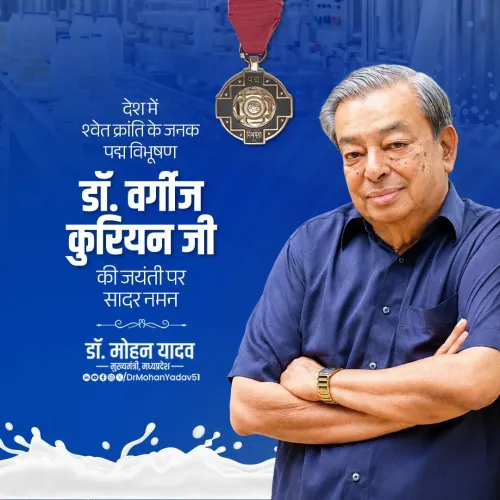
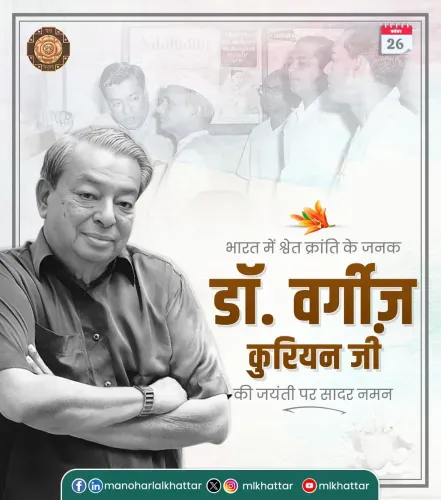
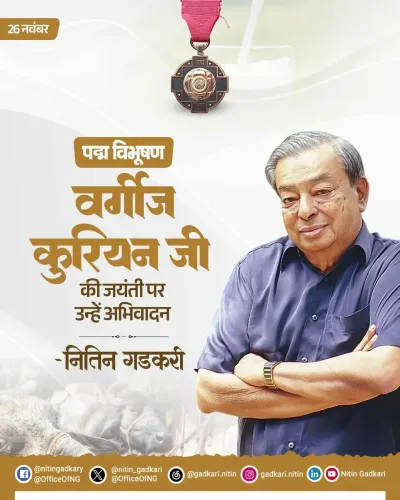
CM Bhajan Lal Sharma honours Verghese Kurien on Jayanti
Synopsis
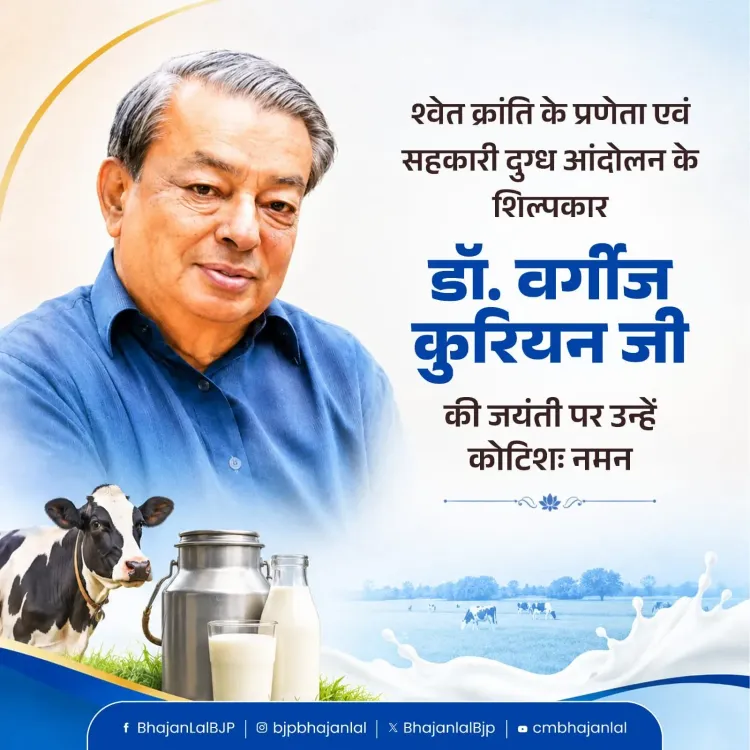
Rajasthan Chief Minister Bhajan Lal Sharma paid tribute to Dr Verghese Kurien on his birth anniversary, praising the White Revolution pioneer for making India a dairy power and millions of milk producers self-reliant through cooperatives.
Key Takeaways
Rajasthan Chief Minister Bhajan Lal Sharma paid tribute to Dr Verghese Kurien on his Jayanti on 26 November 2026.
Sharma called Kurien the pioneer of the White Revolution and architect of the cooperative dairy movement.
Kurien headed the National Dairy Development Board, set up in 1965, and led Operation Flood from 1970.
The Chief Minister said Kurien made millions of livestock keepers and milk producers self-reliant.
He said Kurien's cooperative vision would keep guiding the rural economy and the cooperative sector nationwide.
India's dairy map still carries the imprint of one man, and on his birth anniversary Rajasthan Chief Minister Bhajan Lal Sharma made that debt explicit. Paying kotishah naman (countless tributes) to Dr. Verghese Kurien on 26 November 2026, the Chief Minister credited the Father of the White Revolution with giving India a new identity in milk production and making millions of livestock keepers self-reliant.
In a Hindi post, Sharma called Kurien the pioneer of the White Revolution and the shilpkar (architect) of the cooperative dairy movement. 'His contribution in giving India a new identity in the field of milk production and in making millions of animal keepers and milk producers self-reliant will always be remembered,' he wrote. Kurien's far-sighted idea of strengthening the rural economy through cooperatives, Sharma added, would keep giving new direction to the cooperative sector across the country.
The engineer who built India's milk grid
Dr. Verghese Kurien was born on 26 November 1921. He headed the National Dairy Development Board, the statutory body established in 1965 to replicate the Anand cooperative pattern across India. Operation Flood, launched in 1970 under his leadership, stitched village milk unions into a nationwide procurement and marketing network.
That architecture did not rest on giant industrial farms. It rested on smallholders pouring milk into societies they owned, unions processing it, and brands selling it, with returns flowing back to the village. Amul became the public face of the model. Successive governments have kept citing the same template when they frame rural livelihood and self-reliance programmes.
Why Rajasthan still speaks Kurien's language
Sharma's tribute lands in a state where dairying is a livelihood, not a slogan. Rajasthan's animal keepers sit inside the cooperative logic Kurien exported from Anand. The Chief Minister's stress on sahkarita (cooperatives) and self-reliance for milk producers tracks a larger argument: village economies grow when producers control the value chain, not when they remain price-takers.
The post announced no new scheme and named no procurement project. It was remembrance, and a reminder of the machinery still in use. State moves on dairy cooperative strengthening or fresh milk-collection infrastructure would be the test of whether the homage travels from a timeline into the tankers.
Kurien's Jayanti is a date on the calendar. The cooperative grid he left behind is still the system that decides whether a Rajasthan milk pourer gets a fair price tomorrow.
Point of View
But the language is policy-coded. By tying the White Revolution to self-reliance and rural cooperatives, the Rajasthan Chief Minister aligns dairying's founding story with the contemporary cooperative push. Kurien's NDDB-era model remains the reference point whenever governments talk milk procurement and farmer-owned value chains. The test is whether Rajasthan follows the homage with cooperative or procurement infrastructure, the only measure that would move this from remembrance to programme.
NationPress
26 Nov 2026
Frequently Asked Questions
When is Dr Verghese Kurien's birth anniversary?
Dr Verghese Kurien was born on 26 November 1921, and his Jayanti is observed on that date each year. Rajasthan Chief Minister Bhajan Lal Sharma issued a tribute on 26 November 2026.
Who was Dr Verghese Kurien?
Dr Verghese Kurien, known as the Father of the White Revolution, led the National Dairy Development Board and scaled the Amul cooperative model. He architected Operation Flood, which built India's nationwide dairy cooperative network.
What is the White Revolution or Operation Flood?
The White Revolution, also called Operation Flood, was launched in 1970 by the NDDB under Kurien to create a national grid of dairy cooperatives. It helped India move from milk shortage toward becoming the world's largest milk producer.
What did Bhajan Lal Sharma say on Kurien Jayanti?
Rajasthan Chief Minister Bhajan Lal Sharma paid countless tributes to Kurien and praised his role in milk production and in making livestock keepers self-reliant. He said Kurien's cooperative vision would keep guiding the sector nationwide.
Why is the cooperative dairy model still cited in India?
India's dairy expansion since the 1970s has relied on the cooperative model that lets small producers access markets. Governments still cite this template for rural livelihood and self-reliance programmes.