CM Bhajan Lal Greets Rajasthan Farmers on World Milk Day
Synopsis
On World Milk Day, 1 June 2026, Rajasthan Chief Minister Bhajan Lal Sharma greeted the state's farmers and livestock keepers, reaffirming his government's commitment to boosting milk production, raising livestock incomes, and protecting animal wealth across one of India's top milk-producing states.
Key Takeaways
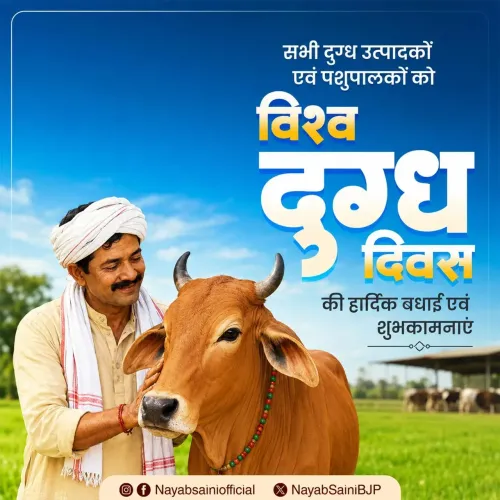
Rajasthan CM Bhajan Lal Sharma posted World Milk Day greetings on 1 June 2026 , addressing farmers and livestock keepers across the state.
He credited dairy farmers' 'dedicated hard work' with empowering the rural economy and strengthening the country's nutritional framework.
The government reaffirmed commitment to three goals: boosting milk production , raising livestock keeper incomes , and animal husbandry protection .
Rajasthan is among India's top five milk-producing states , with the Rajasthan Cooperative Dairy Federation (RCDF) and its Saras brand anchoring the cooperative network since 1977 .
World Milk Day has been observed globally every 1 June since 2001 , established by the FAO to spotlight dairy's role in nutrition and rural livelihoods.
Rajasthan Chief Minister Bhajan Lal Sharma extended greetings to the state's farmers and livestock keepers on World Milk Day, 1 June 2026, reaffirming his government's commitment to boosting milk production, raising livestock keeper incomes, and strengthening animal husbandry across Rajasthan.
Context
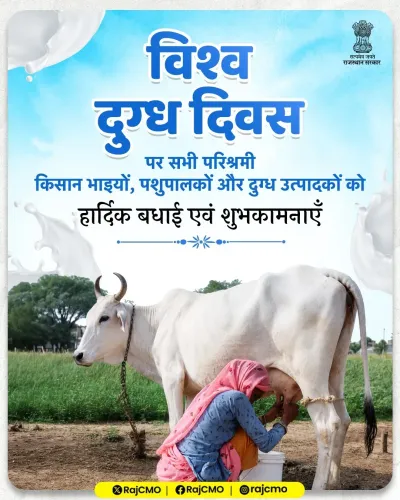
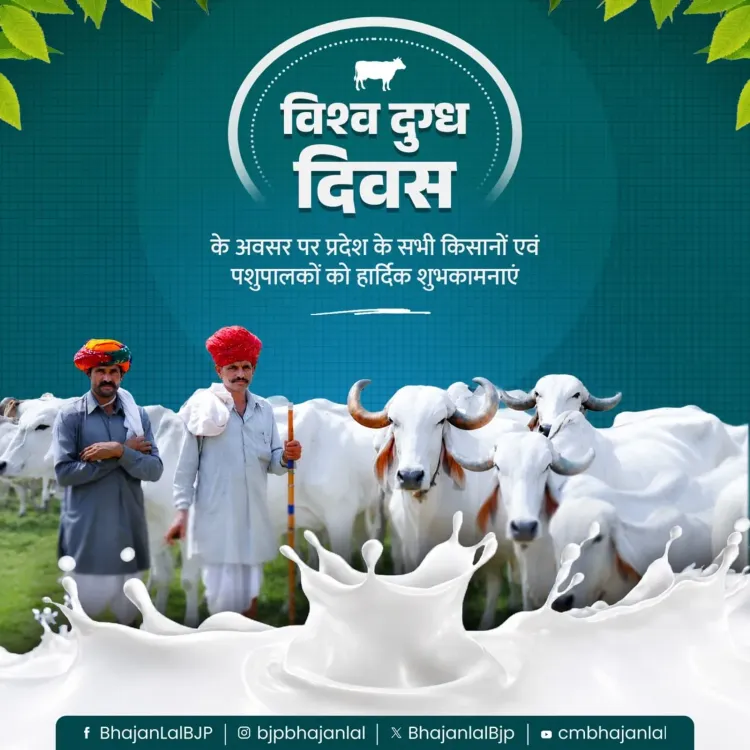
Posting in Hindi on 1 June, CM Sharma wrote: 'विश्व दुग्ध दिवस के अवसर पर प्रदेश के सभी किसानों एवं पशुपालकों को हार्दिक शुभकामनाएं' — 'Heartfelt greetings to all farmers and livestock keepers of the state on the occasion of World Milk Day.' He acknowledged that their 'dedicated hard work is empowering the rural economy and strengthening the country's nutritional framework.'
World Milk Day has been observed every 1 June since 2001, when the Food and Agriculture Organisation (FAO) established it to highlight dairy's contribution to global nutrition and rural livelihoods. It has since become a standard occasion for governments across dairy-producing nations to signal policy intent toward the sector.
Policy Backdrop
India's dairy sector traces its modern cooperative architecture to Operation Flood, launched in 1970 by the National Dairy Development Board (NDDB), which established the cooperative model that made India the world's largest milk producer. Rajasthan joined the National Dairy Plan from 2011-12 onwards, focusing on breed improvement and infrastructure to raise milk productivity across the state.
The Rajasthan Cooperative Dairy Federation (RCDF), formed in 1977, serves as the state's apex dairy body, overseeing milk procurement, cooperative networks, and the well-known Saras brand. Rajasthan consistently ranks among India's top five milk-producing states, with dairy forming a significant share of rural household income, particularly for small and marginal farmers who depend on livestock as a secondary or primary livelihood.
Successive state governments have treated dairy development as a dual instrument — raising farmer earnings while improving nutritional security — channelling both central and state funds into animal husbandry, veterinary services, and cold-chain infrastructure.
Stakeholders and Impact
The message directly addresses dairy farmers and pashupaalaks (livestock keepers) across Rajasthan's predominantly agrarian districts, where cattle and buffalo rearing supplement crop income. For many households in arid and semi-arid zones of the state, milk sales through cooperative channels provide a steady daily cash flow that crop cycles cannot.
CM Sharma, who took office in December 2023 following the BJP's victory in the Rajasthan assembly elections, has framed rural development and livestock welfare as priorities of his administration. The government's stated commitments — boosting milk output, raising livestock keeper incomes, and protecting animal wealth (pashudhan sanrakshan) — align with the broader BJP-led Centre's emphasis on doubling farmer income through allied agricultural activities.
What's Next
Observers will watch state budget allocations for the animal husbandry department and any fresh dairy infrastructure or income-support announcements in the next fiscal cycle as a measure of whether the 1 June commitment translates into concrete policy action. With Rajasthan's rural economy closely tied to livestock, decisions on veterinary services, breed improvement programmes, and cooperative milk pricing will be closely tracked by farming communities across the state.
Point of View
Who has positioned livestock welfare and rural income growth as signature themes since taking office in December 2023, the post serves as a low-cost public signal to a large and politically significant constituency. Rajasthan's dependence on dairy as a household income buffer — particularly in its arid interior districts — means that any gap between such rhetorical commitments and actual budget allocations for animal husbandry will be closely scrutinised. The message's emphasis on 'pashudhan sanrakshan' (animal wealth protection) also carries a cultural resonance within the BJP's core voter base, layering policy intent with ideological framing.
NationPress
16 Sept 2026
Frequently Asked Questions
Why does India celebrate World Milk Day on 1 June?
India observes World Milk Day on 1 June in line with the global date set by the FAO in 2001 to recognise dairy's importance to nutrition and rural economies. As the world's largest milk producer, India uses the occasion to highlight cooperative dairy achievements and announce farmer-welfare initiatives.
What did Rajasthan CM Bhajan Lal Sharma say on World Milk Day 2026?
CM Bhajan Lal Sharma extended greetings to Rajasthan's farmers and livestock keepers, acknowledging their role in strengthening the rural economy and national nutrition, and reaffirmed his government's commitment to boosting milk production, raising incomes, and protecting animal wealth.
Is Rajasthan a major milk-producing state in India?
Yes. Rajasthan consistently ranks among India's top five milk-producing states . The state's dairy sector is anchored by the Rajasthan Cooperative Dairy Federation , established in 1977 , which markets milk under the Saras brand through a network of cooperatives.
What is the Rajasthan Cooperative Dairy Federation?
The Rajasthan Cooperative Dairy Federation (RCDF) is the state's apex dairy body, set up in 1977 . It oversees milk procurement from village cooperatives, processing, and marketing under the Saras brand, providing a stable income channel for thousands of dairy farmers across Rajasthan.
What is Operation Flood and how does it relate to Rajasthan dairy?
Operation Flood , launched in 1970 by the National Dairy Development Board (NDDB) , built India's national cooperative dairy network and made the country the world's largest milk producer. Rajasthan's cooperative dairy infrastructure, including the RCDF and Saras brand, grew out of this framework and was further strengthened under the National Dairy Plan from 2011-12 onwards.