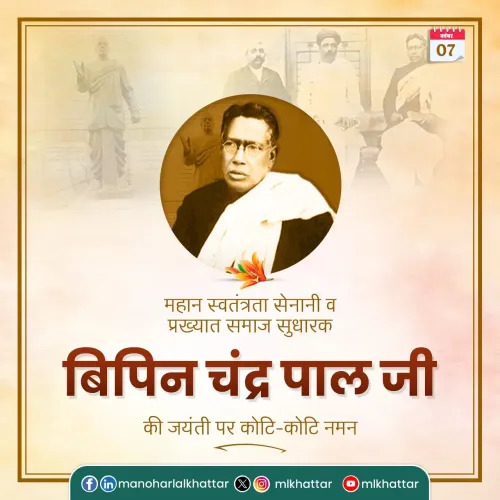
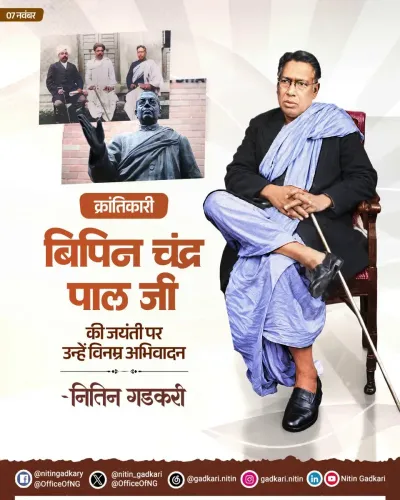
CM Bhajan Lal Sharma Pays Tribute to Bipin Chandra Pal on Jayanti
Synopsis
Rajasthan Chief Minister Bhajan Lal Sharma paid tribute to nationalist leader Bipin Chandra Pal on his birth anniversary, honouring his central role in the Swadeshi movement, the Lal-Bal-Pal trio, and social reform during India's freedom struggle.
Key Takeaways
Rajasthan CM Bhajan Lal Sharma paid tribute to Bipin Chandra Pal on his birth anniversary on 7 November 2026 .
Pal ( 1858–1932 ) was a journalist, orator, and nationalist who championed the Swadeshi movement and Purna Swaraj .
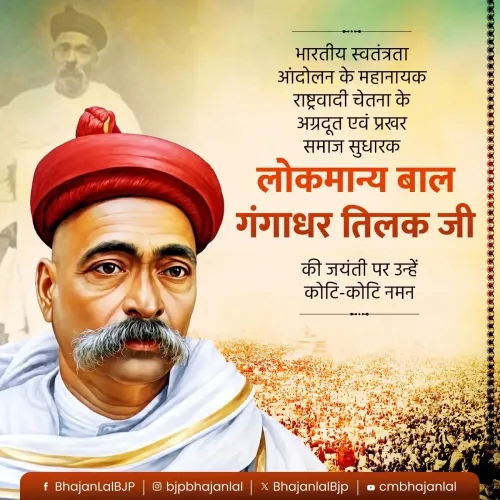
He formed one-third of the legendary Lal-Bal-Pal trio alongside Lala Lajpat Rai and Bal Gangadhar Tilak .
The trio led the 'extremist' faction of the Indian National Congress in the early 1900s , pushing for mass agitation over petitioning.
Pal was also recognised as a social reformer who worked against entrenched social evils of his era.
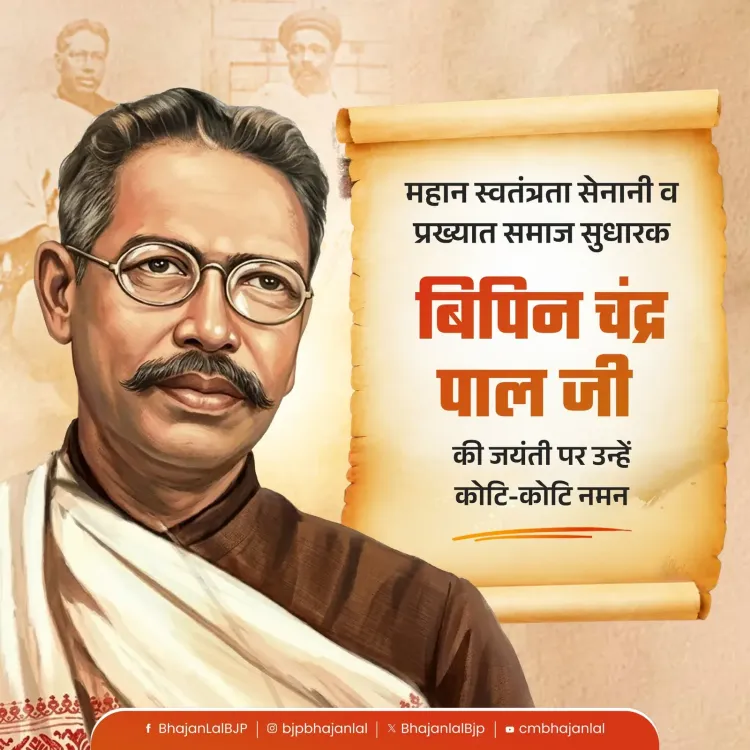
On the birth anniversary of one of India's most fearless freedom fighters, Rajasthan Chief Minister Bhajan Lal Sharma paid tribute to Bipin Chandra Pal on 7 November 2026, saluting the revolutionary leader's role in igniting the Swadeshi movement and the demand for complete independence from British rule.
In his post, CM Sharma wrote: 'Koti-koti naman' — a boundless salute — to Pal, calling him an 'immortal hero of India's freedom struggle, a passionate nationalist thinker and a distinguished social reformer.' He specifically invoked the iconic Lal-Bal-Pal trio, describing Pal as an 'inseparable pillar of that revolutionary triumvirate' who carried the resolve of Swadeshi and Purna Swaraj (complete self-rule) to every citizen.
Who Was Bipin Chandra Pal — and Why Lal-Bal-Pal Still Resonates
Bipin Chandra Pal (1858–1932) was a journalist, orator, and firebrand nationalist who helped push the Indian National Congress away from moderate petitioning and toward mass agitation. Alongside Lala Lajpat Rai and Bal Gangadhar Tilak, he formed the 'extremist' faction that believed freedom could not be begged — it had to be demanded. The three men, known collectively as Lal-Bal-Pal, popularised the boycott of British goods and the embrace of Indian-made alternatives as a political weapon.
Pal was also a vocal social reformer, speaking out against casteism and other entrenched inequities at a time when such positions carried personal risk. CM Sharma's tribute highlighted this dual legacy — revolutionary agitator and social conscience — calling his contributions 'invaluable' in inspiring generations of Indians.
A Familiar Ritual With Enduring Nationalist Weight
Tributes to independence-era icons on their birth anniversaries have become a fixed feature of Indian political communication, cutting across party lines. For BJP leaders, figures like Bipin Chandra Pal — whose nationalism was aggressive, unapologetic, and rooted in cultural pride — hold particular resonance. The Swadeshi ethos Pal championed in the early 1900s echoes in contemporary calls for self-reliance, lending these annual observances a relevance that goes beyond ceremonial remembrance.
Sharma's message closes with the assurance that Pal's contributions to 'nation-building, the eradication of social evils, and public awakening' will continue to inspire the people of India — a kicker that ties a 19th-century revolutionary to a living national project.
Point of View
Culturally rooted patriotism. The invocation of Swadeshi carries deliberate contemporary resonance with self-reliance and 'Make in India' rhetoric, linking a 19th-century movement to a 21st-century policy identity. For CM Sharma, the tribute also performs a standard function of statecraft: visibly anchoring Rajasthan's governance in a broad nationalist tradition. The annual rhythm of such commemorations reflects how colonial-era heroes remain active political currency in modern India.
NationPress
7 Nov 2026
Frequently Asked Questions
Who was Bipin Chandra Pal?
Bipin Chandra Pal (1858–1932) was an Indian nationalist leader, journalist, and orator who was a key figure in the Swadeshi movement and advocated for complete independence (Purna Swaraj) from British rule.
What is the Lal-Bal-Pal trio?
Lal-Bal-Pal refers to the trio of Lala Lajpat Rai, Bal Gangadhar Tilak, and Bipin Chandra Pal — three leaders who led the 'extremist' faction of the Indian National Congress in the early 1900s, championing mass agitation and the boycott of British goods.
When is Bipin Chandra Pal Jayanti celebrated?
Bipin Chandra Pal Jayanti is observed on 7 November each year, marking the birth anniversary of the freedom fighter born in 1858.
What was the Swadeshi movement?
The Swadeshi movement was a political and economic campaign in early 20th-century India that called for the boycott of British-made goods and the promotion of Indian-made products as a tool of resistance against colonial rule. Bipin Chandra Pal was one of its foremost advocates.
Why did Bhajan Lal Sharma pay tribute to Bipin Chandra Pal?
Rajasthan Chief Minister Bhajan Lal Sharma posted a tribute on 7 November 2026 to mark Bipin Chandra Pal's birth anniversary, honouring his contributions to the freedom struggle, the Swadeshi movement, and social reform in India.