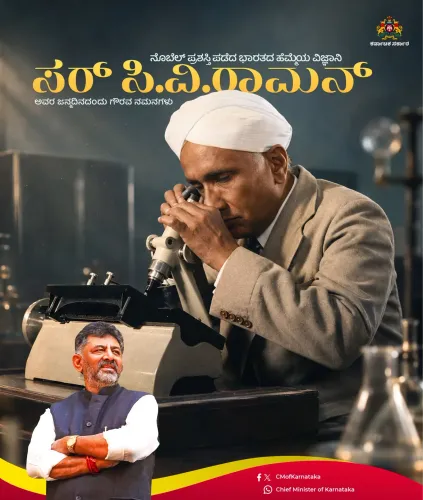
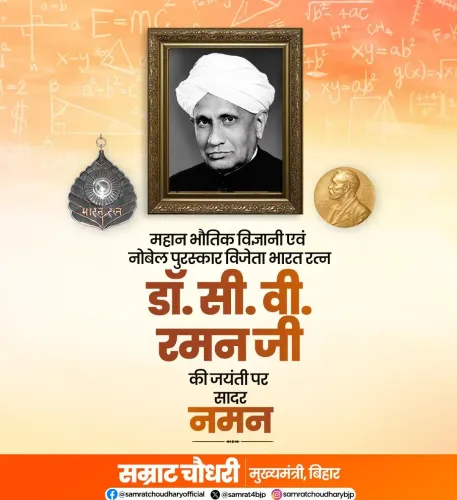
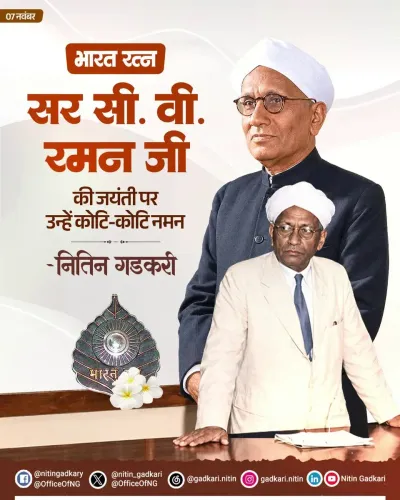
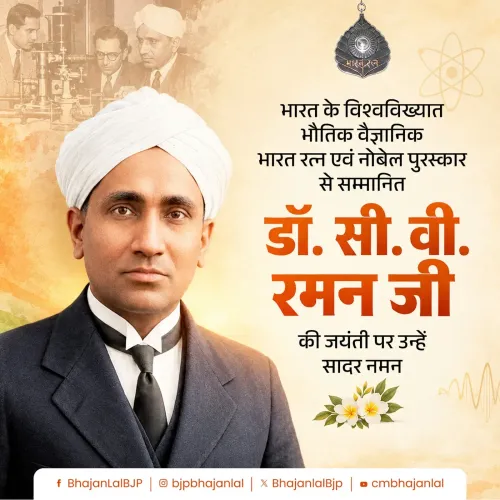
Chhattisgarh CMO pays tribute to C.V. Raman on birth anniversary
Synopsis
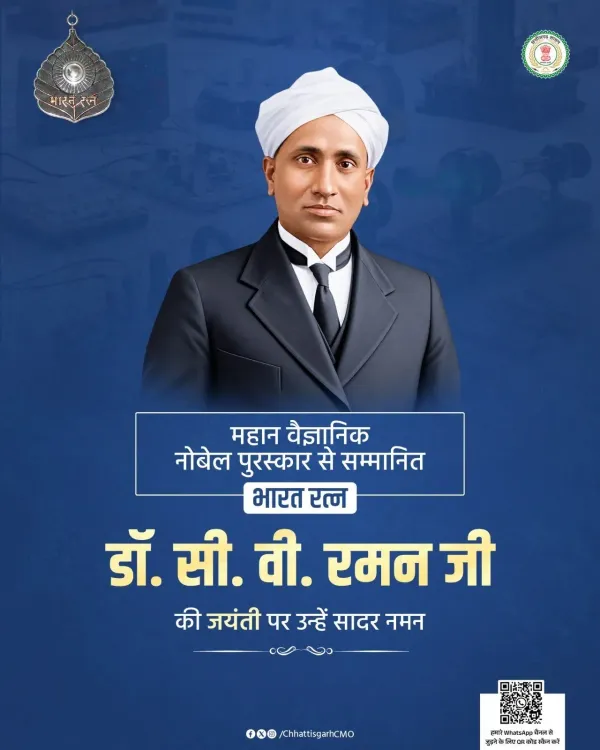
The Chief Minister's Office of Chhattisgarh honoured Nobel laureate and Bharat Ratna Sir C.V. Raman on his 137th birth anniversary on 7 November 2026, remembering the physicist whose discovery of the Raman Effect transformed modern science.
Key Takeaways
Raman was born on 7 November 1888 — the Chhattisgarh CMO's post marks his 137th birth anniversary .
Raman discovered the Raman Effect in 1928 , demonstrating inelastic scattering of light through transparent materials.
He was awarded the Nobel Prize in Physics in 1930 , the first Asian scientist to receive the honour in the sciences.
India conferred the Bharat Ratna on Raman in 1954 , its highest civilian decoration.
28 February is observed as National Science Day in India to commemorate the announcement of his discovery.
Indian state governments, including Chhattisgarh, routinely issue formal tributes on the anniversaries of national scientific icons as part of broader science-heritage outreach.
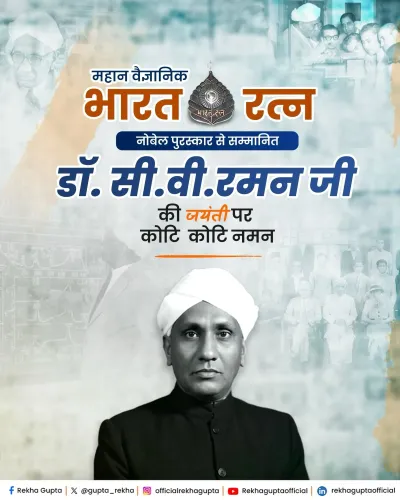
On the 137th birth anniversary of Sir C.V. Raman — Nobel laureate, Bharat Ratna, and the physicist who changed how humanity understands light — the Chief Minister's Office of Chhattisgarh paused on Saturday, 7 November 2026 to offer a formal tribute to one of India's greatest scientific minds.
The post, shared in Hindi, reads: 'Nobel puraskar se sammanit mahan vaigyanik, Bharat Ratna Dr. C.V. Raman ji ki jayanti par unhe sadar naman' — ('Respectful salutations to the great scientist and Nobel laureate, Bharat Ratna Dr. C.V. Raman, on his birth anniversary.')
The discovery that made the world look at light differently
Chandrasekhara Venkata Raman, born on 7 November 1888, demonstrated in 1928 that when light passes through a transparent material, a portion of it scatters at a different wavelength — a phenomenon now universally known as the Raman Effect. The discovery earned him the Nobel Prize in Physics in 1930, making him the first Asian and first non-white scientist to receive a Nobel in the sciences. India honoured him with its highest civilian decoration, the Bharat Ratna, in 1954.
His work laid the groundwork for Raman spectroscopy, a technique now indispensable in fields from pharmaceutical quality control to forensic science and materials research. The name lives on in classrooms across India — his findings remain a cornerstone of physics curricula at every level.
A tradition of remembrance — and what it signals
Indian state governments routinely mark the birth anniversaries of national scientific icons, and Chhattisgarh's CMO joins that established tradition today. The timing also carries national resonance: 28 February — the date Raman first announced his discovery in 1928 — is observed as National Science Day across India each year. Today's anniversary is the man behind that day.
The gesture, modest in length but pointed in its choice of honorifics, keeps Raman's legacy in public discourse — a reminder that scientific heritage is as much a part of India's official identity as its political milestones.
One hundred and thirty-seven years after his birth, the light C.V. Raman scattered still illuminates every physics lab on Earth.
Point of View
And they keep the political establishment publicly aligned with science promotion — a soft but deliberate signal. For Chhattisgarh, a state investing in education and industrial diversification, invoking Raman's legacy connects regional governance to a pan-Indian narrative of scientific pride. The consistency of such posts across party lines suggests they have hardened into an institutional norm rather than a partisan gesture. The deeper question is whether ceremonial remembrance translates into tangible investment in research infrastructure and science education at the state level.
NationPress
7 Nov 2026
Frequently Asked Questions
When is C.V. Raman's birth anniversary?
C.V. Raman was born on 7 November 1888 , so his birth anniversary falls on 7 November each year. In 2026 it marks his 137th anniversary .
What did C.V. Raman discover?
C.V. Raman discovered the Raman Effect in 1928 — the phenomenon by which light scatters at a shifted wavelength when passing through a transparent medium. The discovery earned him the Nobel Prize in Physics in 1930 .
What is National Science Day and why is it celebrated on 28 February?
National Science Day is observed on 28 February every year to commemorate the date in 1928 when C.V. Raman publicly announced the discovery of the Raman Effect. It aims to promote scientific awareness across India.
Did C.V. Raman receive the Bharat Ratna?
Yes. C.V. Raman was awarded the Bharat Ratna — India's highest civilian honour — in 1954 , two decades after his Nobel Prize.
Why is C.V. Raman historically significant for India?
C.V. Raman was the first Asian and first non-white scientist to win a Nobel Prize in the sciences, taking the Nobel Prize in Physics in 1930 . His work on the Raman Effect remains foundational in physics and is embedded in India's school and university curricula.