Gadkari pays tribute to C.V. Raman on birth anniversary
Synopsis
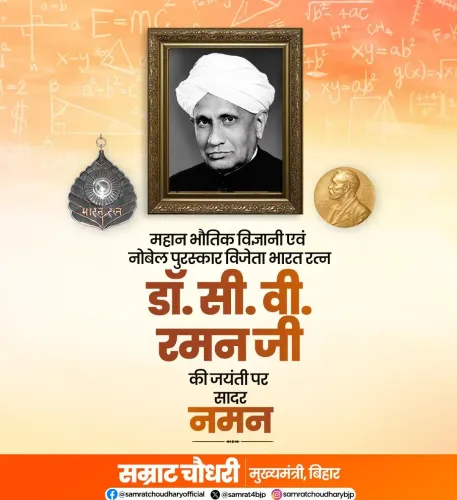
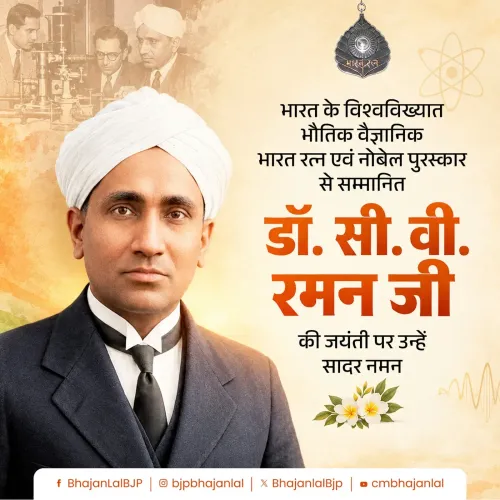
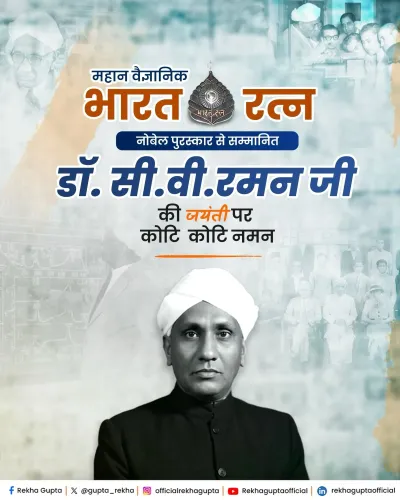
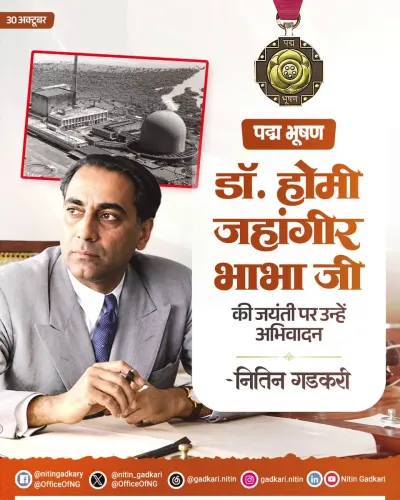
Union Minister Nitin Gadkari paid homage to Nobel Prize-winning physicist Sir C.V. Raman on his birth anniversary. Raman, born 7 November 1888, discovered the Raman Effect in 1928, won the 1930 Nobel Prize in Physics, and received the Bharat Ratna in 1954, becoming a permanent symbol of India's scientific heritage.
Key Takeaways
Union Minister Nitin Gadkari posted a tribute to Sir C.V.
Raman on his birth anniversary, 7 November 2026 .
Raman was born on 7 November 1888 in Tiruchirapalli , British India.
He discovered the Raman Effect in 1928 , demonstrating wavelength-shifting light scattering in transparent media.
Raman won the Nobel Prize in Physics in 1930 , becoming the first Asian scientist to receive the honour.
He was awarded the Bharat Ratna in 1954 , India's highest civilian honour.
India observes National Science Day on 28 February each year to commemorate the discovery of the Raman Effect.
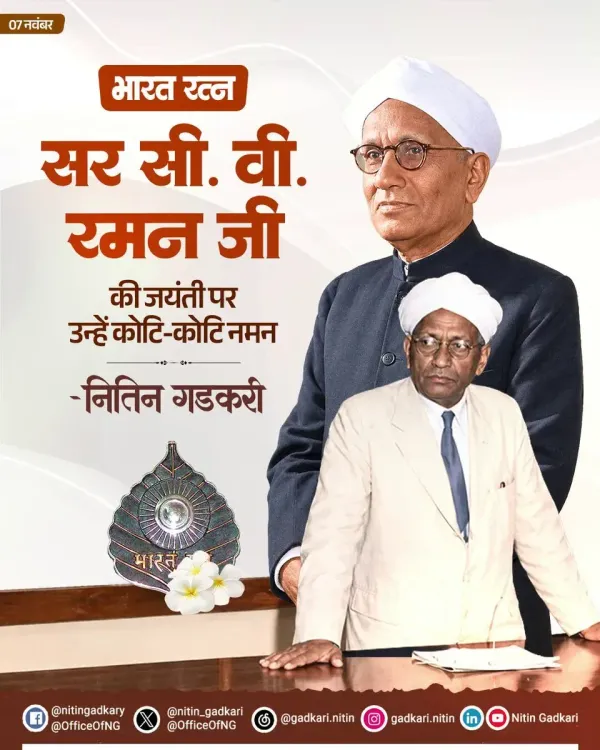
A Nobel laureate, a Bharat Ratna, and the man who changed how science understood light — Union Road Transport and Highways Minister Nitin Gadkari marked the birth anniversary of legendary Indian physicist Sir C.V. Raman on Saturday, 7 November 2026, with a heartfelt tribute on X.
Posting in Hindi, Gadkari wrote: 'प्रतिष्ठित नोबेल पुरस्कार से सन्मानित महान भारतीय भौतिक-शास्त्री भारत रत्न सर सी. वी. रमन जी की जयंती पर उन्हें कोटि-कोटि नमन।' — 'On the birth anniversary of the great Indian physicist Sir C.V. Raman, honoured with the prestigious Nobel Prize and Bharat Ratna, I bow to him a million times.'
The physicist who made history with a beam of light
Sir Chandrasekhara Venkata Raman was born on 7 November 1888 in Tiruchirapalli, then part of British India. His discovery of the Raman Effect in 1928 — which demonstrated that light scattering changes wavelength when it passes through a transparent medium — rewrote the fundamentals of molecular physics. Two years later, in 1930, he became the first Asian scientist to win the Nobel Prize in Physics. India conferred its highest civilian honour, the Bharat Ratna, upon him in 1954.A discovery that still anchors Indian science policy
The legacy of the Raman Effect is not merely archival. Since 1986, India has observed National Science Day every 28 February — the anniversary of the discovery — with lectures, school outreach, and awards designed to connect the next generation of researchers to that foundational moment. Raman's story is frequently invoked by policymakers as evidence that world-class science has deep Indian roots, not borrowed ones. Tributes like Gadkari's, shared by ministers and officials across the political spectrum each November, reflect a broader governmental impulse: to keep India's scientific heritage visible in public discourse, alongside its infrastructure and economic ambitions. The physicist who worked in a Kolkata laboratory nearly a century ago continues to serve as an aspirational anchor for a nation investing heavily in research and innovation today. National Science Day on 28 February 2027 will mark the 99th anniversary of that landmark discovery — a milestone that will almost certainly draw renewed attention to Raman's towering legacy.Point of View
Invoking figures like Raman aligns with its consistent messaging around India's ancient and colonial-era intellectual heritage. That a minister best known for roads and infrastructure takes a moment to salute a physicist underscores how central scientific nationalism has become to mainstream political communication. With National Science Day's 99th-anniversary edition approaching in February 2027, this tribute lands at the opening of a symbolically significant year for Indian science policy.
NationPress
7 Nov 2026
Frequently Asked Questions
When is C.V. Raman's birth anniversary?
Sir C.V. Raman was born on 7 November 1888 , and his birth anniversary is commemorated on 7 November each year.
What is the Raman Effect?
The Raman Effect, discovered in 1928 , is the phenomenon by which light changes its wavelength when scattered through a transparent medium, providing a powerful tool for molecular analysis.
Why did C.V. Raman win the Nobel Prize?
C.V. Raman won the Nobel Prize in Physics in 1930 for his discovery of the Raman Effect, making him the first Asian scientist to receive a Nobel Prize in science.
What is National Science Day and why is it celebrated on 28 February?
National Science Day is observed in India on 28 February every year since 1986 to mark the anniversary of C.V. Raman's discovery of the Raman Effect in 1928.
What is the Bharat Ratna and when did C.V. Raman receive it?
The Bharat Ratna is India's highest civilian honour. C.V. Raman was awarded it in 1954 , recognising his extraordinary contribution to science.