CM Rekha Gupta Pays Tribute to Bipin Chandra Pal on Jayanti
Synopsis
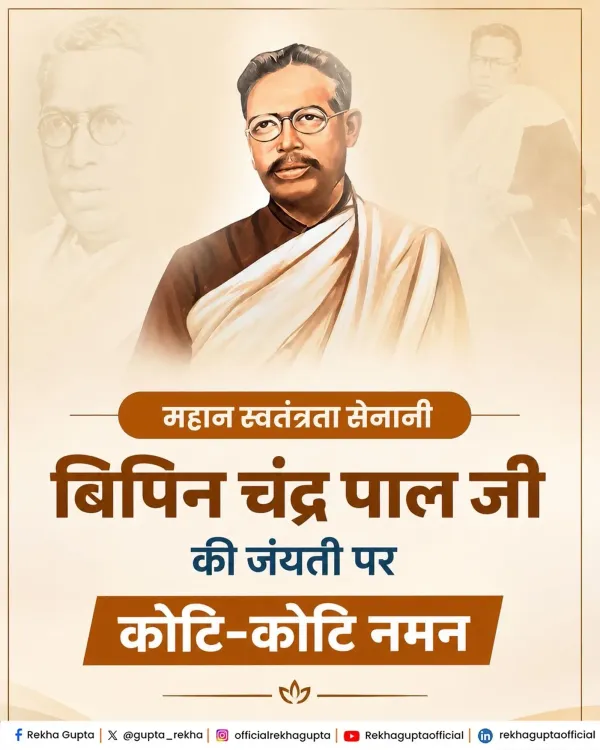
Delhi Chief Minister Rekha Gupta honoured freedom fighter Bipin Chandra Pal on his birth anniversary, drawing a direct line between his Swadeshi and Swaraj ideals and India's contemporary goals of self-reliance and development.
Key Takeaways
Delhi CM Rekha Gupta posted a tribute to Bipin Chandra Pal on his birth anniversary on 7 November 2026 .
Pal was part of the Lal-Bal-Pal triumvirate and a leading voice of the 1905 Swadeshi movement triggered by the Partition of Bengal.
CM Gupta credited Pal with uniting people against the Partition of Bengal and for the cause of India's freedom and self-respect.
The post explicitly links Pal's vision of indigenous self-reliance to present-day goals of Atmanirbhar Bharat and Viksit Bharat .
BJP leaders regularly use birth anniversaries of nationalist icons to reinforce connections between historical themes and contemporary policy slogans.
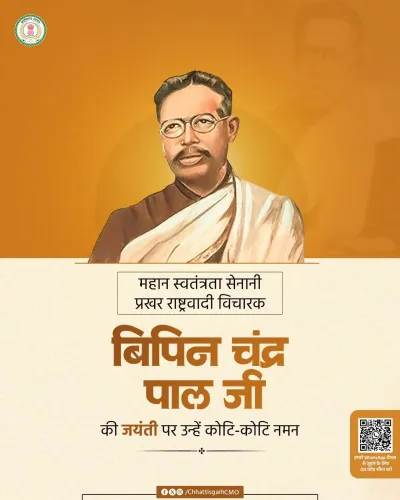
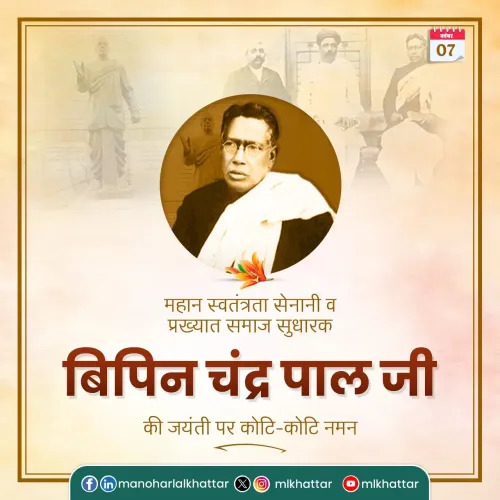
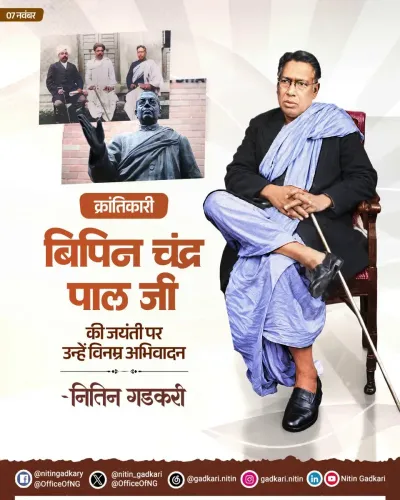
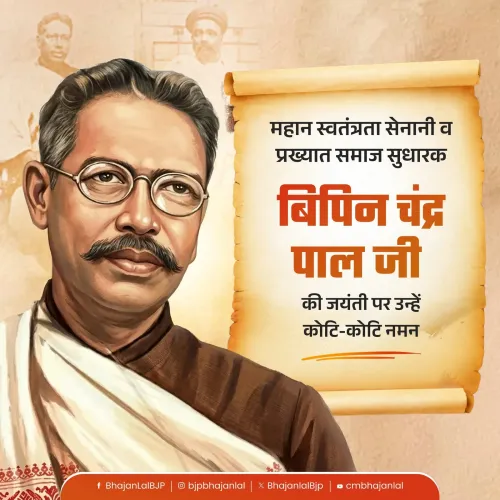
A freedom fighter who gave India the vocabulary of self-rule is being remembered on his birth anniversary — and Delhi Chief Minister Rekha Gupta marked the occasion on Saturday, 7 November 2026, with a tribute to Bipin Chandra Pal, the Bengal-born firebrand who made 'Swadeshi' and 'Swaraj' household words in colonial India.
Posting in Hindi, CM Gupta wrote: 'Bipin Chandra Pal ji ki jayanti par shat-shat naman' — 'a hundredfold salute on the birth anniversary of the great freedom fighter Bipin Chandra Pal' — crediting him with awakening millions against the Partition of Bengal and uniting the people in the cause of India's freedom and self-respect. She added that his courage, patriotism, and vision of a self-reliant India remain alive today in the aspirations of the younger generation and in the resolve for a 'Viksit Bharat' — a developed India.
The Man Who Made Bengal the Cradle of Swadeshi
Bipin Chandra Pal was one-third of the legendary Lal-Bal-Pal triumvirate — alongside Lala Lajpat Rai and Bal Gangadhar Tilak — who represented the radical, uncompromising wing of the Indian nationalist movement in the early twentieth century. Where moderates petitioned, these three agitated. Pal in particular used the spoken and written word as weapons: his oratory and journalism from Bengal carried the demand for complete self-rule to audiences across the subcontinent.
The trigger for his most consequential campaign was the 1905 Partition of Bengal, a British administrative decision to split the province that was widely seen as a deliberate attempt to fracture Hindu-Muslim solidarity. The backlash was immediate and nationwide. Pal stood at its centre, channelling public fury into the Swadeshi movement — a disciplined boycott of British manufactured goods and a push to build indigenous industry. It was arguably independent India's first mass economic-nationalist campaign, more than four decades before the republic was born.
From 1905 to Atmanirbhar Bharat: The Rhetorical Thread
BJP leaders have made a consistent practice of marking the birth and death anniversaries of pre-independence figures whose ideals map neatly onto current policy language. Pal's championing of indigenous production finds a direct echo in the Atmanirbhar Bharat (Self-Reliant India) initiative, and his insistence on Swaraj resonates with the Viksit Bharat 2047 framework — the government's long-term vision of a fully developed India by the centenary of independence. CM Gupta's post draws that line explicitly, framing Pal's nineteenth-century ideas as the seed of twenty-first-century ambition.
It is a communication pattern with clear strategic logic: anchor a living policy goal to a historical hero, and the goal inherits the hero's moral weight. For a party that governs from Delhi and seeks deep roots in Bengal's political landscape, invoking the soil of Bengal — 'Bangal ki dharti', as Gupta writes — carries added resonance.
Bipin Chandra Pal's legacy belongs to no single party, but his anniversary is now also a moment for the ruling establishment to remind a younger electorate that the hunger for self-reliance runs all the way back to colonial Bengal. That is a powerful inheritance — and one worth examining closely every time it is invoked.
Point of View
The post also signals a strategic cultural outreach to Bengal, a state where the party has worked hard to expand its footprint. Bipin Chandra Pal's legacy — anti-colonial, economically assertive, rooted in mass mobilisation — is ideologically malleable enough to be claimed across the political spectrum, which makes such commemorations both resonant and contested. The regularity of this communication pattern suggests it is less about individual remembrance and more about building a continuous nationalist narrative from 1905 to 2047.
NationPress
7 Nov 2026
Frequently Asked Questions
Who was Bipin Chandra Pal?
Bipin Chandra Pal was a prominent Indian freedom fighter and orator from Bengal, best known as one of the 'Lal-Bal-Pal' trio alongside Lala Lajpat Rai and Bal Gangadhar Tilak. He was a leading advocate of Swadeshi, Swaraj, and the boycott of British goods during the anti-partition agitation of 1905.
What was the Swadeshi movement?
The Swadeshi movement was a mass nationalist campaign launched in 1905 in response to the British Partition of Bengal. It called for the boycott of British manufactured goods and the promotion of indigenous Indian industry, and was one of the first large-scale economic-nationalist movements in India's freedom struggle.
Why did the British partition Bengal in 1905?
The British administration officially justified the 1905 Partition of Bengal on administrative grounds, citing the province's large size. However, Indian nationalists widely believed it was a deliberate strategy to divide the Bengali population along religious lines and weaken the growing nationalist movement.
What is Viksit Bharat and how does it connect to Bipin Chandra Pal?
'Viksit Bharat' refers to the Indian government's vision of a fully developed India by 2047 , the centenary of independence. CM Rekha Gupta's tribute draws a direct line between Pal's advocacy for indigenous self-reliance and this contemporary goal, framing modern policy ambitions as a continuation of the freedom struggle's ideals.
What did Delhi CM Rekha Gupta say about Bipin Chandra Pal?
CM Gupta paid tribute to Bipin Chandra Pal on his birth anniversary, crediting him with awakening the nation against the Partition of Bengal and uniting the people for India's freedom and self-respect. She stated that his vision of a self-reliant India remains alive in the aspirations of today's youth and the resolve for a developed India.