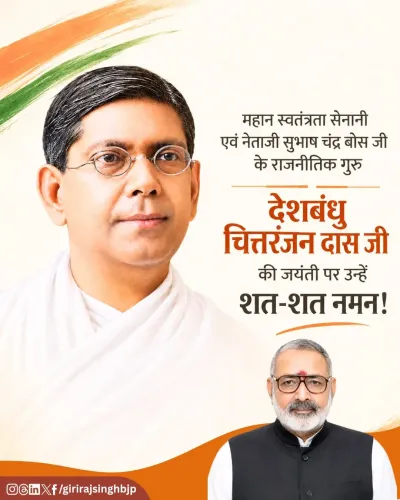
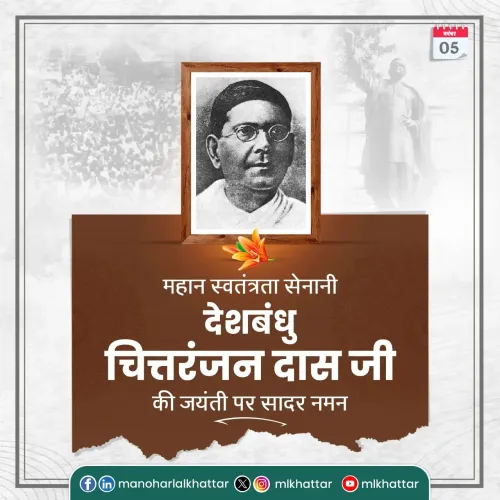
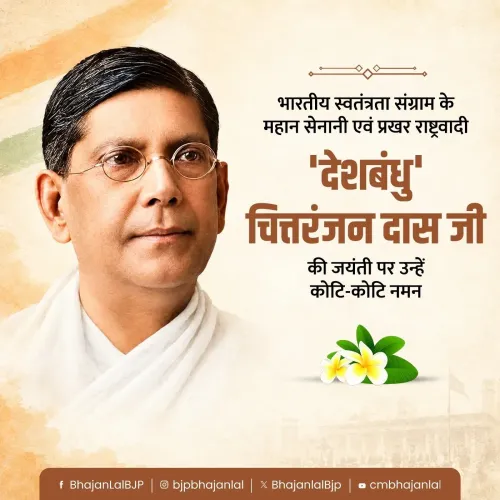
CM Rekha Gupta pays tribute to Deshbandhu Chittaranjan Das on jayanti
Synopsis
Delhi Chief Minister Rekha Gupta paid tribute to Deshbandhu Chittaranjan Das on his birth anniversary, honouring the Swaraj Party founder's sacrifice and his role in shaping nationalist leaders like Subhas Chandra Bose.
Key Takeaways
Chittaranjan Das , known as Deshbandhu , was born on 5 November 1870 and co-founded the Swaraj Party in 1923 alongside Motilal Nehru.
Delhi CM Rekha Gupta paid tribute on his jayanti on 5 November 2026 , praising his sacrifice and national service.
Das is credited as a key political mentor to Subhas Chandra Bose , giving him his first organisational responsibilities.
The Swaraj Party was formed to contest British legislative councils from within as a form of organised resistance after the Non-Cooperation Movement was suspended.
Das died in 1925 , aged 54, while serving as Mayor of Calcutta , having given up personal wealth for the independence cause.
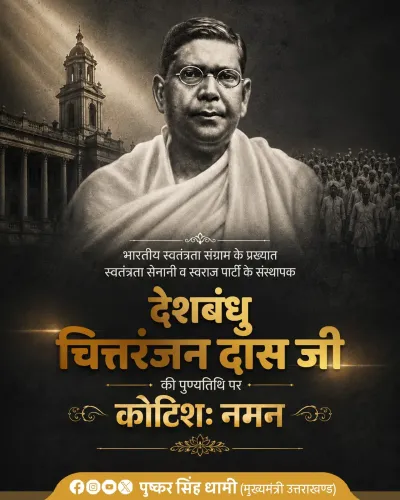
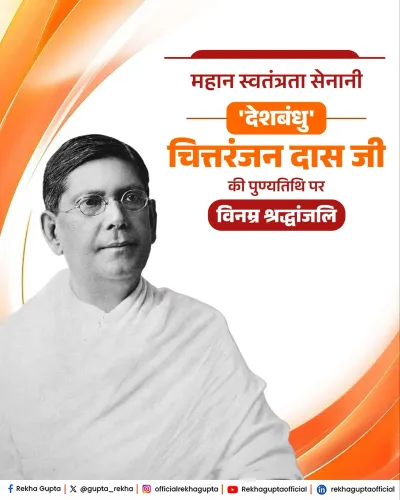
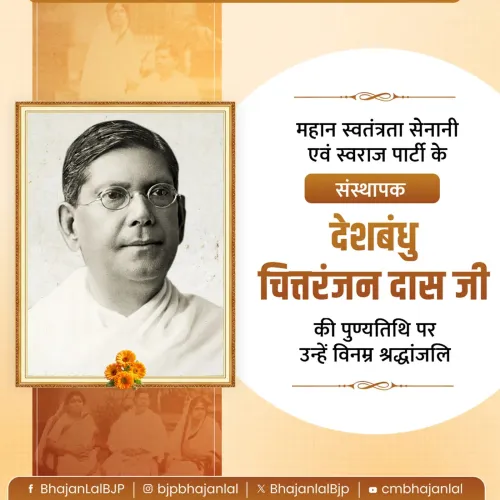
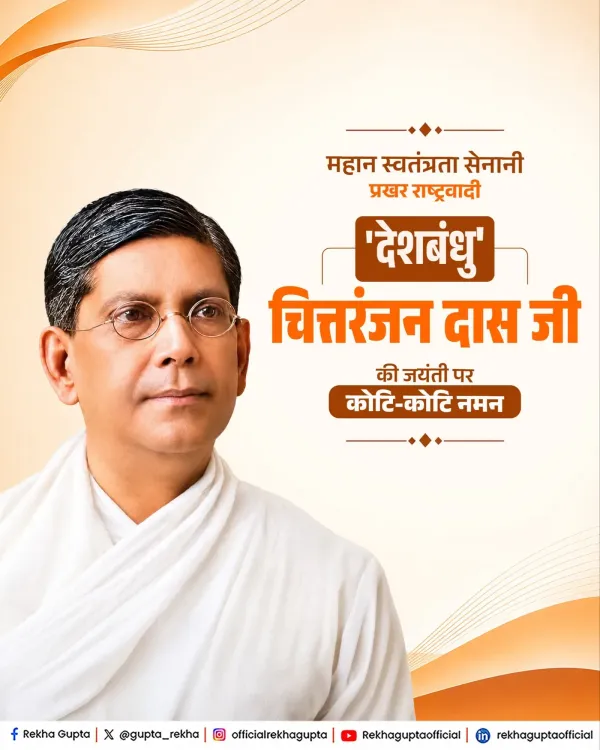
On the birth anniversary of one of India's most selfless freedom fighters, Delhi Chief Minister Rekha Gupta on Thursday, 5 November 2026 paid tribute to Chittaranjan Das, the towering nationalist known as 'Deshbandhu' (Friend of the Nation), honouring a life devoted entirely to the cause of swaraj.
CM Gupta wrote: 'Heartfelt salutations on the birth anniversary of the great freedom fighter, ardent nationalist thinker and founder of the Swaraj Party, Deshbandhu Chittaranjan Das. By dedicating his glorious life to the freedom of the motherland, he established an unparalleled ideal of sacrifice and national service. His contribution to spreading the consciousness of Swaraj to every person and to guiding national heroes like Netaji Subhas Chandra Bose is unforgettable.'
Who was Deshbandhu Chittaranjan Das?
Chittaranjan Das was born on 5 November 1870 — a Bengali barrister who gave up a flourishing legal career to plunge into the independence movement alongside Mahatma Gandhi. His title 'Deshbandhu' was not an honorific handed down by a committee; it was bestowed by the people who felt his extraordinary bond with ordinary Indians. He stood for the accused in the Alipore Bomb Case and defended Bal Gangadhar Tilak in court, before channelling that same fierce conviction into mass politics.
When Gandhi suspended the Non-Cooperation Movement after the Chauri Chaura incident in 1922, Das felt the energy of the struggle needed a new outlet. Together with Motilal Nehru, he founded the Swaraj Party in 1923 — a bold attempt to enter the British-era legislative councils not to collaborate but to obstruct imperial machinery from within. It was politics as organised resistance.
Mentor to Netaji: a bond that shaped history
Among the many legacies CM Gupta highlighted is Das's role as mentor to Subhas Chandra Bose. The young Bose, freshly returned from Cambridge, fell under Das's magnetic influence in Calcutta and chose him as his political guru over all others. Das gave Bose his first real organisational responsibilities in Calcutta's civic politics — shaping the man who would later raise the Indian National Army and challenge British rule from Southeast Asia. That lineage of radical nationalism runs directly from Das to Bose, and BJP leaders citing it draws a deliberate arc from pre-independence sacrifice to contemporary nationalist pride.
BJP's pattern of honouring independence-era icons
CM Gupta's post fits a consistent pattern of BJP leaders publicly commemorating pre-independence nationalist figures on their birth and death anniversaries. The party has long argued that the full breadth of India's freedom struggle — beyond any single political family — deserves equal public memory. Chittaranjan Das, who died in office as Mayor of Calcutta in 1925 at the age of 54, leaving behind wealth and comfort for a life of sacrifice, is a figure few Indians would contest as a genuine hero.
Das's legacy belongs to no party. But the act of invoking him — his tyaag (sacrifice), his rashtraseeva (national service), his gift of direction to Netaji — signals that the idea of Swaraj as a living value, not a museum exhibit, still commands political and moral currency in Delhi in 2026.
Deshbandhu gave everything. The least history owes him is remembrance.
Point of View
A constitutionalist-turned-resistor, and a mentor to Netaji — the party reinforces its claim to a broader nationalist legacy. The Bose connection is particularly potent: Netaji remains a figure of pan-partisan reverence, and anchoring that lineage to Das strengthens the symbolic chain. In an election season, such commemorations are rarely accidental — they are soft cultural messaging with deep historical roots.
NationPress
5 Nov 2026
Frequently Asked Questions
Who was Chittaranjan Das and why is he called Deshbandhu?
Chittaranjan Das was a Bengali lawyer and freedom fighter who gave up his career to join India's independence movement. He was called 'Deshbandhu' meaning 'Friend of the Nation' by ordinary Indians who felt a deep bond with him for his selfless service and sacrifice.
What was the Swaraj Party founded by Chittaranjan Das?
The Swaraj Party was founded in 1923 by Chittaranjan Das and Motilal Nehru. It aimed to enter British-era legislative councils not to cooperate with imperial rule but to obstruct it from within, after the Non-Cooperation Movement was suspended following the Chauri Chaura incident.
What was Chittaranjan Das's connection to Subhas Chandra Bose?
Chittaranjan Das served as the political mentor of Subhas Chandra Bose. When the young Bose returned from Cambridge, he chose Das as his guru and Das gave him his first organisational responsibilities in Calcutta's civic politics, shaping the future leader of the Indian National Army.
When did Chittaranjan Das die and what was his role at the time?
Chittaranjan Das died in 1925 at the age of 54 while serving as Mayor of Calcutta, having devoted his life to the independence cause after giving up considerable personal wealth and a successful legal career.
Why did Delhi CM Rekha Gupta pay tribute to Chittaranjan Das?
Delhi Chief Minister Rekha Gupta posted a tribute on 5 November 2026 to mark the birth anniversary of Chittaranjan Das, honouring his founding of the Swaraj Party, his ideal of sacrifice and national service, and his role in guiding nationalist leaders like Netaji Subhas Chandra Bose.