CM Rekha Gupta Pays Tribute to Durgabai Deshmukh on Jayanti
Synopsis
Delhi Chief Minister Rekha Gupta on 15 July 2026 paid tribute to Durgabai Deshmukh — freedom fighter, Constituent Assembly member and founder of the Andhra Mahila Sabha — on her birth anniversary, saluting her enduring legacy in education, women's empowerment and social justice.
Key Takeaways
Delhi CM Rekha Gupta posted a tribute to Durgabai Deshmukh on her birth anniversary on 15 July 2026 .
Durgabai Deshmukh founded the Andhra Mahila Sabha in 1937 , focused on women's education, health and vocational training.
She was a member of the Constituent Assembly and contributed to drafting the Indian Constitution.
In 1953 , she became the first chairperson of the Central Social Welfare Board , shaping India's welfare architecture.
The Family and Child Welfare Projects she launched in 1958 became the template for later centrally sponsored women's empowerment schemes.
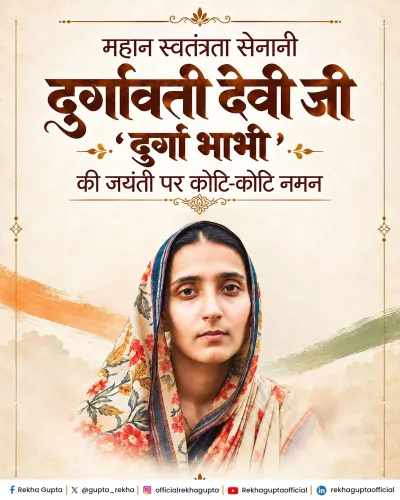
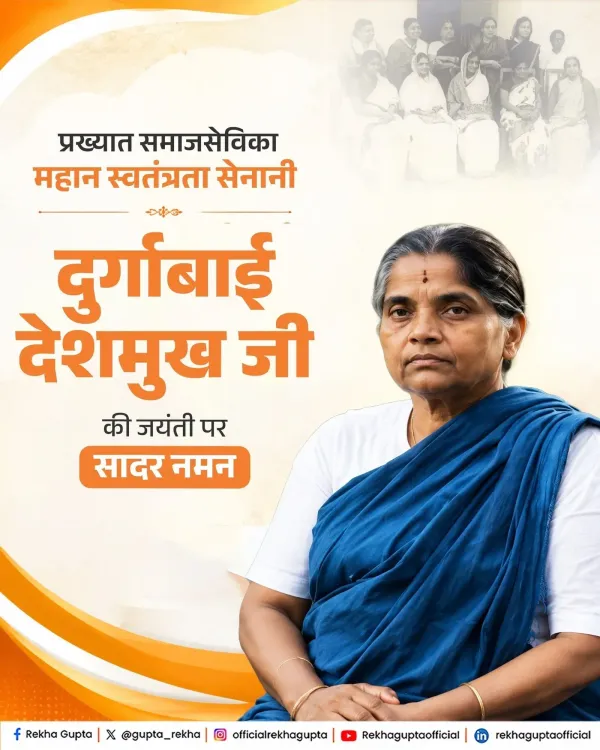
Delhi Chief Minister Rekha Gupta on Wednesday, 15 July 2026 paid tribute to freedom fighter and social reformer Durgabai Deshmukh on her birth anniversary, honouring her legacy of dedication to education, women's empowerment and social justice.
In her post, CM Gupta wrote: 'स्वतंत्रता संग्राम की वीरांगना एवं प्रख्यात समाजसेविका दुर्गाबाई देशमुख जी की जयंती पर उन्हें शत्-शत् नमन' — 'Heartfelt salutations to Durgabai Deshmukh, a brave woman of the freedom struggle and eminent social worker, on her birth anniversary.' She added that Deshmukh's commitment to education, women's empowerment and social justice 'will always remain an inspiration.'
Context
Durgabai Deshmukh was a towering figure in India's independence movement and post-independence social architecture. Born in Rajahmundry in present-day Andhra Pradesh, she participated in the non-cooperation movement as a teenager and later trained as a lawyer. She was elected to the Constituent Assembly and contributed to the drafting of the Indian Constitution.
In 1937, she founded the Andhra Mahila Sabha in Madras, an institution dedicated to women's education, health and vocational training that later expanded its footprint nationally. Her work bridged the nationalist movement and the cause of gender equity at a time when both were contested terrains.
Policy Backdrop
Deshmukh's most consequential institutional contribution came in 1953, when she was appointed the first chairperson of the Central Social Welfare Board — a statutory body established under the Ministry of Education to promote welfare programmes for women, children and the disadvantaged. The Board became the backbone of state-supported voluntary welfare work in independent India.
In 1958, under her stewardship, the Board launched the Family and Child Welfare Projects, which served as the template for later centrally sponsored schemes on women's empowerment. That policy lineage runs through to contemporary programmes on girls' education and self-help groups.
Stakeholders and Impact
Deshmukh's legacy is particularly resonant for women's welfare organisations, educational institutions and social-justice advocates across India. The Andhra Mahila Sabha she founded continues to operate, running schools, colleges and health centres in Andhra Pradesh and beyond.
Indian political leaders across parties routinely issue public tributes on the birth anniversaries of pre-independence reformers to signal continuity with nationalist and gender-equity narratives. BJP-led governments at the central and state levels have linked such commemorations to programmes promoting girls' education and self-help groups since 2014.
What's Next
State-level events marking Durgabai Deshmukh's birth anniversary in July each year draw renewed attention to the functioning and funding of bodies like the Central Social Welfare Board. Observers of Delhi's governance will watch whether the tribute is followed by any new allocations for women's education or social-welfare initiatives in the capital's policy calendar.
Deshmukh's example — combining grassroots institution-building with legislative participation — remains a reference point in debates about how the state and civil society can jointly advance gender equity in India.
Point of View
Lending the tribute broad legitimacy. By highlighting education, women's empowerment and social justice, Gupta implicitly frames Delhi's own policy agenda within that continuum. Whether the commemoration translates into concrete programmatic announcements will determine whether it registers as political signalling or substantive policy intent.
NationPress
13 Oct 2026
Frequently Asked Questions
Who was Durgabai Deshmukh?
Durgabai Deshmukh was an Indian freedom fighter, lawyer and social reformer who participated in the independence movement, served as a member of the Constituent Assembly, founded the Andhra Mahila Sabha in 1937, and became the first chairperson of the Central Social Welfare Board in 1953.
What is the Andhra Mahila Sabha?
The Andhra Mahila Sabha is an institution founded by Durgabai Deshmukh in 1937 in Madras, dedicated to women's education, health and vocational training. It later expanded nationally and continues to operate schools, colleges and health centres.
What was the Central Social Welfare Board?
The Central Social Welfare Board is a statutory body established in 1953 under India's Ministry of Education to promote welfare programmes for women, children and the disadvantaged. Durgabai Deshmukh was its first chairperson.
Why did Delhi CM Rekha Gupta pay tribute to Durgabai Deshmukh?
CM Rekha Gupta posted the tribute on Durgabai Deshmukh's birth anniversary on 15 July 2026, honouring her contributions to education, women's empowerment and social justice.
What is Durgabai Deshmukh's contribution to women's empowerment in India?
Durgabai Deshmukh advanced women's empowerment through the Andhra Mahila Sabha, her role in the Constituent Assembly, and her leadership of the Central Social Welfare Board, where she launched the Family and Child Welfare Projects in 1958 that became the model for later national women's welfare schemes.