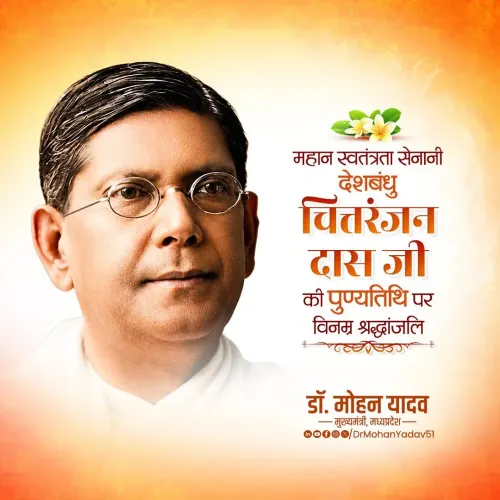
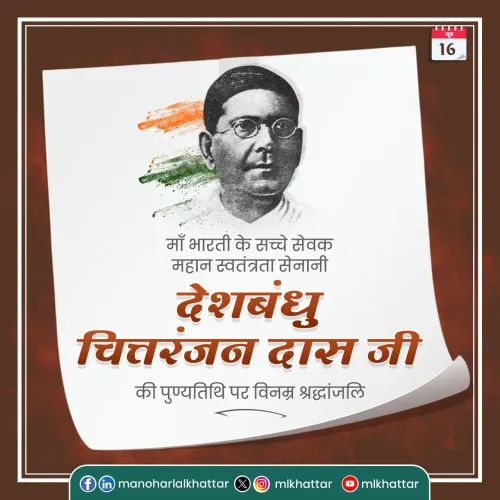
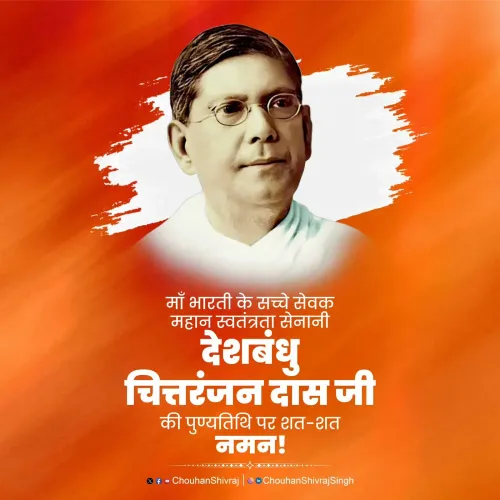
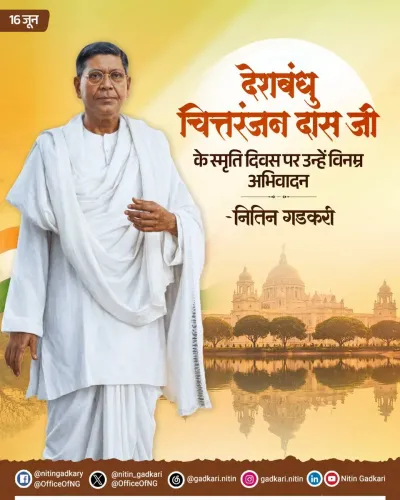
Delhi CM Rekha Gupta pays tribute to Deshbandhu Chittaranjan Das
Synopsis
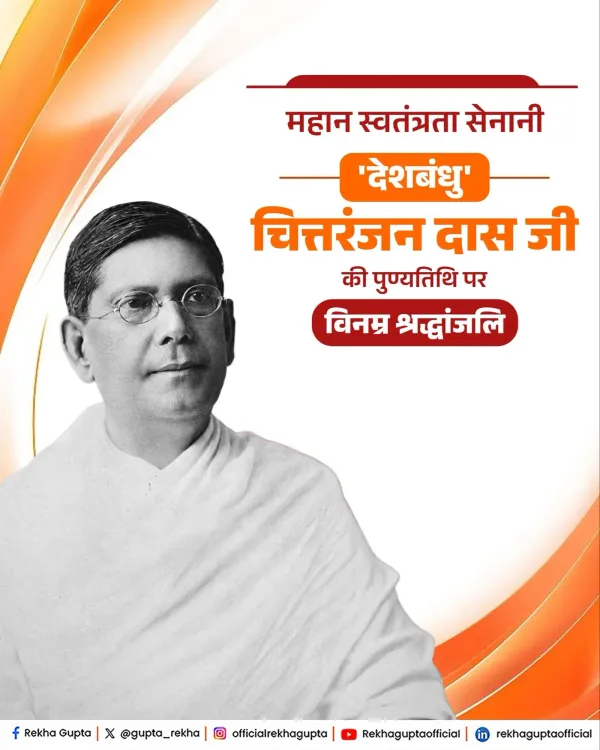
Delhi Chief Minister Rekha Gupta on 16 June 2026 paid tribute to Deshbandhu Chittaranjan Das on his 101st death anniversary, honouring the co-founder of the Swaraj Party as an immortal freedom fighter whose dedication to self-rule and national reconstruction remains an inspiration for all Indians.
Key Takeaways
Delhi CM Rekha Gupta posted a tribute to Chittaranjan Das on 16 June 2026 , his death anniversary.
Chittaranjan Das , titled Deshbandhu , died on 16 June 1925 , making this his 101st death anniversary .
Das co-founded the Swaraj Party in 1923 with Motilal Nehru to contest colonial councils from within.
He served as Mayor of Calcutta in 1924 and was known for advocating Hindu-Muslim unity and civic reforms.
Gupta's tribute highlights themes of Swaraj and sacrifice consistent with annual commemorative practice across India's political parties.
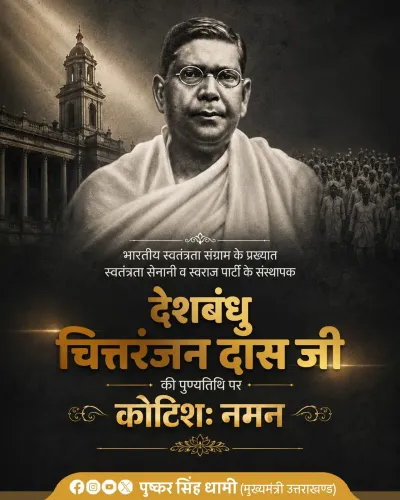
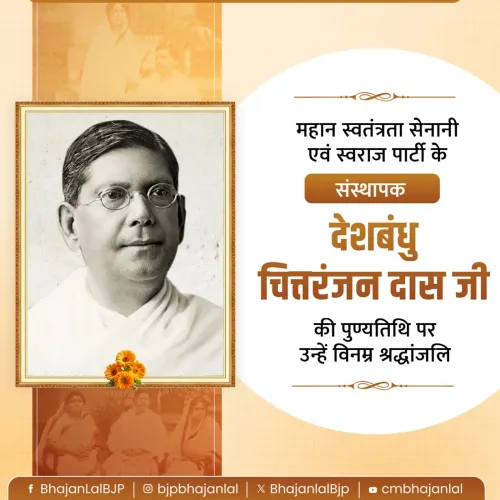
Delhi Chief Minister Rekha Gupta on Tuesday, 16 June 2026 paid homage to freedom fighter Chittaranjan Das on his death anniversary, describing him as an immortal soldier of India's independence movement whose commitment to Swaraj remains an enduring source of inspiration.
In her post, Gupta wrote: 'स्वाधीनता आंदोलन के अमर सेनानी देशबंधु चित्तरंजन दास जी की पुण्यतिथि पर उन्हें विनम्र श्रद्धांजलि' — 'Humble tribute to Deshbandhu Chittaranjan Das Ji, an immortal fighter of the freedom movement, on his death anniversary.' She added that he dedicated his entire life to the country's independence and reconstruction, and that his unwavering commitment to Swaraj and national service is an inspiration for all.
Context
Chittaranjan Das, widely revered by his honorary title Deshbandhu (Friend of the Nation), died on 16 June 1925, making this year the 101st death anniversary of one of Bengal's most prominent independence leaders. A celebrated lawyer, he gave up a lucrative legal career to join the nationalist movement under Mahatma Gandhi, famously defending Bal Gangadhar Tilak and later those accused in the Alipore Bomb Case.
Das presided over the Indian National Congress session at Gaya in 1922 and subsequently co-founded the Swaraj Party in 1923 alongside Motilal Nehru. The party sought to enter colonial legislative councils and obstruct British governance from within — a tactical departure from Gandhi's non-cooperation approach.
Policy Backdrop
The Swaraj Party, established in 1923, marked a significant strategic evolution in India's anti-colonial politics. By contesting elections and winning seats in provincial councils, Das and Nehru aimed to paralyse colonial administration from the inside, a method that influenced later constitutional strategies adopted by the nationalist movement.
Das was also known for his progressive social outlook, advocating Hindu-Muslim unity at a time of communal tension, and for his work as Mayor of Calcutta in 1924, where he championed civic reforms and reserved a share of municipal jobs for minorities — measures considered radical for their era.
Stakeholders and Impact
Annual tributes to Chittaranjan Das on 16 June are observed across India's political spectrum, with physical commemorations including wreath-laying ceremonies at memorials in Kolkata and New Delhi. His legacy holds particular resonance in West Bengal, where he is regarded as a founding figure of modern Bengali political identity.
For the BJP-led Delhi government, invoking figures like Das — who embodied themes of Swaraj, sacrifice, and national reconstruction — aligns with a broader effort to claim a wide nationalist heritage that transcends party or regional lines. Such commemorative statements by elected leaders form a consistent pattern in Indian public life around freedom fighter anniversaries.
What's Next
Commemorative cycles in Indian political discourse typically intensify around 15 August (Independence Day) and 2 October (Gandhi Jayanti), when tributes to a broader range of freedom fighters are expected from central and state government leaders alike. The 101st death anniversary of Das may also prompt academic events or cultural programmes in Kolkata and other cities with strong ties to his legacy, keeping his contributions in public conversation through the year.
Point of View
Invoking Das — a Congress-era leader associated with Swaraj and Hindu-Muslim unity — reflects a deliberate broadening of nationalist heritage claims beyond the party's own historical lineage. Such commemorative messaging carries low immediate policy weight but reinforces a governing party's image as custodian of the entire freedom struggle. The pattern is likely to intensify as Independence Day approaches in August.
NationPress
18 Sept 2026
Frequently Asked Questions
Who was Deshbandhu Chittaranjan Das?
Deshbandhu Chittaranjan Das was a prominent Indian freedom fighter and lawyer who co-founded the Swaraj Party in 1923 alongside Motilal Nehru. He presided over the Indian National Congress session at Gaya in 1922 and served as Mayor of Calcutta in 1924.
When did Chittaranjan Das die?
Chittaranjan Das died on 16 June 1925. His death anniversary is observed annually with tributes from political leaders across India.
Why did Rekha Gupta pay tribute to Chittaranjan Das?
Delhi Chief Minister Rekha Gupta paid tribute to mark the 101st death anniversary of Chittaranjan Das on 16 June 2026, honouring his contributions to India's independence movement and his commitment to Swaraj.
What was the Swaraj Party?
The Swaraj Party was a political party founded in 1923 by Chittaranjan Das and Motilal Nehru. It aimed to contest elections to colonial legislative councils and obstruct British governance from within, marking a tactical shift from Gandhi's non-cooperation strategy.
What does Deshbandhu mean?
Deshbandhu is an honorary title in Hindi and Bengali meaning 'Friend of the Nation.' It was conferred on Chittaranjan Das in recognition of his selfless service to the Indian independence movement.