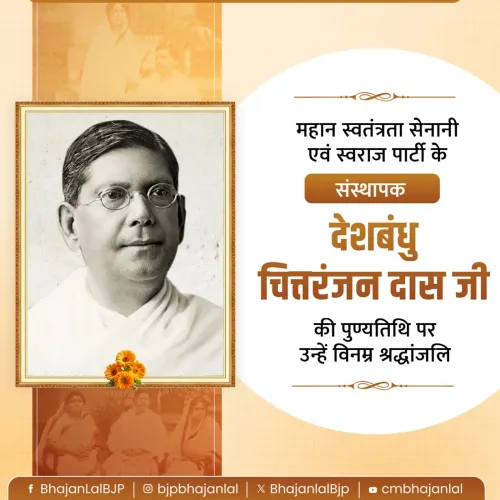
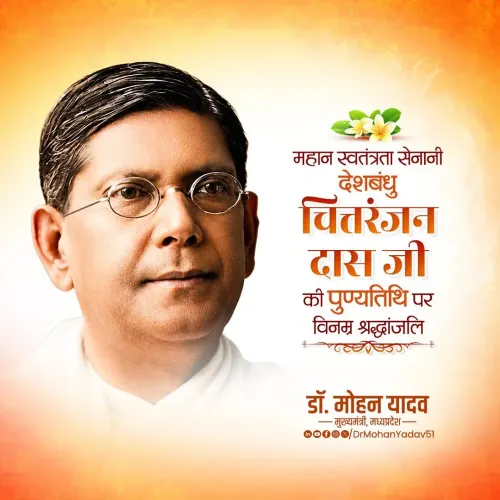
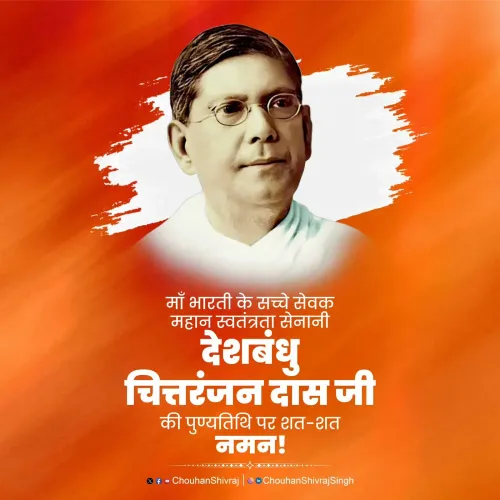
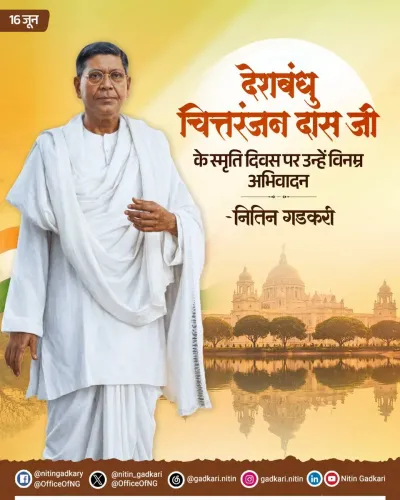
Khattar pays tribute to freedom fighter Chittaranjan Das
Synopsis
Union Power Minister Manohar Lal Khattar on 16 June 2026 paid homage to freedom fighter Chittaranjan Das, known as Deshbandhu, on his death anniversary. Khattar said Das's spirited ideas will continue to inspire future generations to serve the nation and uplift society.
Key Takeaways
Manohar Lal Khattar , Union Minister of Power and Housing & Urban Affairs, posted a tribute to Chittaranjan Das on 16 June 2026 , the freedom fighter's death anniversary.
Chittaranjan Das , known as Deshbandhu (Friend of the Nation), was a celebrated lawyer and Congress leader who died on 16 June 1925 .
Das co-founded the Swaraj Party in 1923 alongside Motilal Nehru and presided over the 1922 INC session at Gaya.
Khattar invoked themes of 'national service' and 'social upliftment,' consistent with the Azadi Ka Amrit Mahotsav commemorative framework active since 2021 .
Das served as the first elected Mayor of Calcutta in 1924 and championed Hindu-Muslim unity.
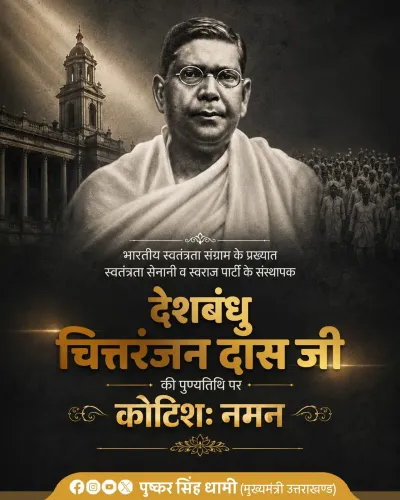
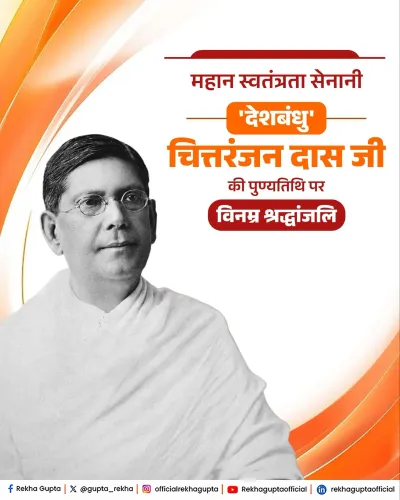
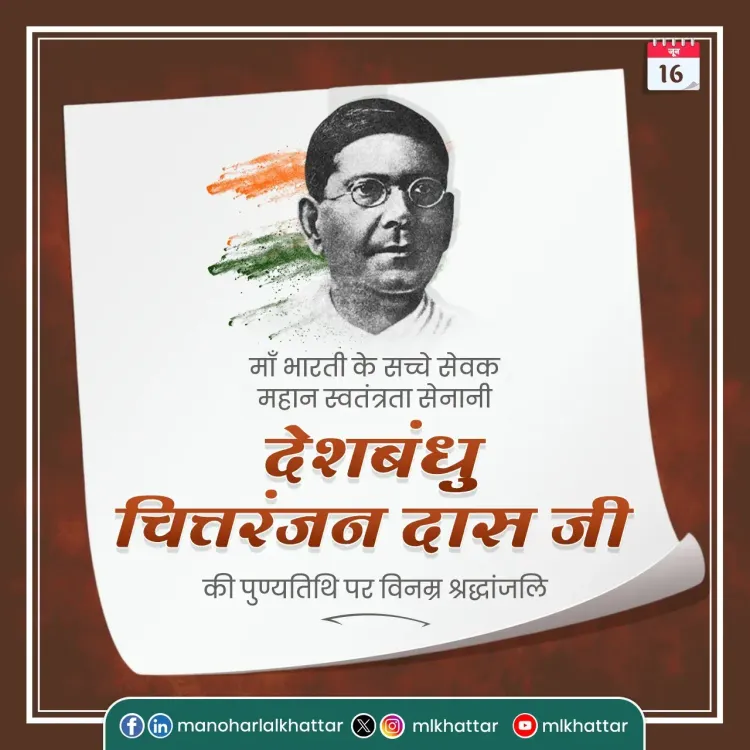
Union Power Minister Manohar Lal Khattar on Tuesday, 16 June 2026 paid homage to legendary freedom fighter and lawyer Chittaranjan Das, popularly known as 'Deshbandhu' (Friend of the Nation), on his death anniversary. Khattar posted a tribute on X, calling Das a 'true servant of Mother India' and a 'great freedom fighter' whose ideas continue to inspire future generations.
In his post, the minister wrote: 'Maa Bharati ke sachche sevak, mahan swatantrata senani, Deshbandhu Chittaranjan Das ji ki punyatithi par vinamra shraddhanjali arpit karta hoon.' Translated: 'I humbly pay tribute on the death anniversary of a true servant of Mother India, the great freedom fighter, Deshbandhu Chittaranjan Das.' He added that Das's 'brilliant and spirited ideas will always inspire future generations to serve the nation and uplift society.'
Context
Chittaranjan Das was born on 5 November 1870 in Calcutta and became one of the most towering figures of India's independence movement. A celebrated lawyer, he famously defended Bal Gangadhar Tilak and later Aurobindo Ghosh in colonial courts, earning widespread admiration. He died on 16 June 1925 in Darjeeling, and the nation has marked his death anniversary ever since.
Das presided over the 1922 Indian National Congress session at Gaya. Disillusioned with the Congress's decision to abstain from legislative councils, he co-founded the Swaraj Party in 1923 alongside Motilal Nehru, advocating participation in colonial legislatures to disrupt British governance from within. His honorific 'Deshbandhu' — Friend of the Nation — was conferred by a grateful public.
Policy Backdrop
The tribute aligns with the Government of India's broader Azadi Ka Amrit Mahotsav programme, launched in 2021, which systematically commemorates pre-independence leaders to connect their legacy with contemporary nation-building efforts. The initiative has seen central ministers and BJP office-bearers regularly posting tributes on the birth and death anniversaries of nationalist icons.
Khattar's framing — emphasising 'national service' and 'social upliftment' — mirrors the thematic vocabulary the ruling party has consistently deployed when invoking early 20th-century freedom fighters. Such commemorations serve to keep these figures visible in digital political discourse and reinforce a continuity narrative between the independence era and present governance.
Stakeholders and Impact
Annual tributes to Chittaranjan Das on 16 June have become a bipartisan practice among Indian political leaders, given his stature as a figure who transcended regional and ideological boundaries. His legacy is particularly significant in West Bengal, where he served as the first elected Mayor of Calcutta in 1924 and championed Hindu-Muslim unity during a period of communal tension.
For Indian youth — a primary audience cited in the research — such commemorations are framed as civic education moments, reminding the public of the diverse ideological traditions that fed into the independence movement. Khattar's post, shared early on a weekday morning, is consistent with the pattern of senior leaders using social media to mark such anniversaries for a national audience.
What's Next
Similar commemorative activity is expected around 15 August (Independence Day) and 2 October (Gandhi Jayanti), when central ministers routinely post tributes to a wider set of freedom fighters, including other Swaraj Party figures. The Azadi Ka Amrit Mahotsav framework continues to provide institutional scaffolding for such remembrances, suggesting the practice will persist through the current government's tenure.
As India's political discourse increasingly plays out on social media, the regularity and reach of these tributes signal that commemorating independence-era icons remains a durable feature of mainstream political communication — one that both ruling and opposition leaders are unlikely to abandon.
Point of View
The minister subtly links a Congress-era icon to themes the ruling party has made its own. The choice of Das — a figure revered in West Bengal — also carries implicit political salience given the BJP's sustained focus on expanding its footprint in that state. Such tributes, while ceremonial, are calibrated acts of political communication as much as expressions of historical respect.
NationPress
15 Sept 2026
Frequently Asked Questions
Who was Chittaranjan Das and why is he called Deshbandhu?
Chittaranjan Das was a prominent Indian freedom fighter, lawyer and Congress leader born in 1870. He earned the honorific 'Deshbandhu,' meaning Friend of the Nation, for his selfless service to the independence movement and his defence of nationalist leaders in colonial courts.
When did Chittaranjan Das die?
Chittaranjan Das died on 16 June 1925 in Darjeeling. Indian political leaders across parties mark this date annually with tributes to his memory.
What was the Swaraj Party founded by Chittaranjan Das?
The Swaraj Party was co-founded by Chittaranjan Das and Motilal Nehru in 1923 after they broke with the Congress over the question of contesting elections to colonial legislative councils. The party sought to disrupt British governance from within the legislatures.
Why did Manohar Lal Khattar post a tribute to Chittaranjan Das?
Khattar posted the tribute on 16 June 2026 to mark the death anniversary of Chittaranjan Das. The post is consistent with a wider government and BJP practice of commemorating freedom fighters under the Azadi Ka Amrit Mahotsav framework.
What is Azadi Ka Amrit Mahotsav?
Azadi Ka Amrit Mahotsav is a Government of India programme launched in 2021 to celebrate and commemorate the contributions of pre-independence leaders and freedom fighters as part of the 75th anniversary of Indian independence.