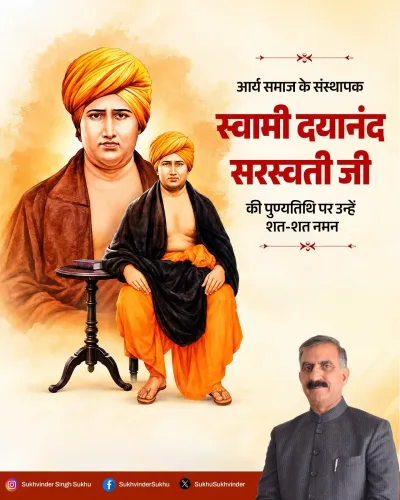
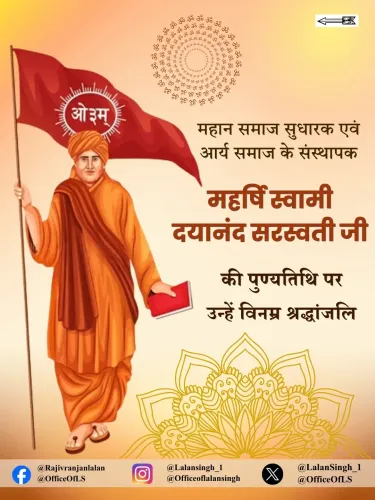
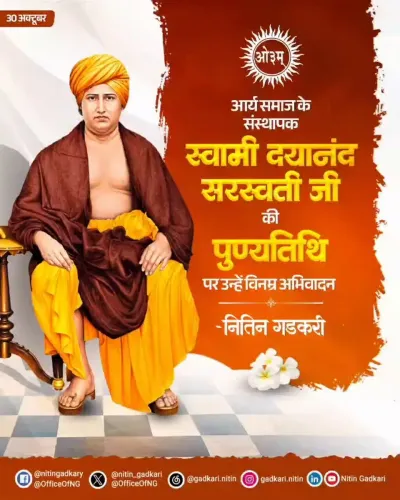
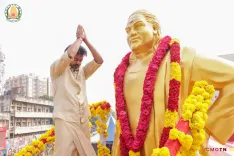
Khattar pays tribute to Swami Dayanand Saraswati on death anniversary
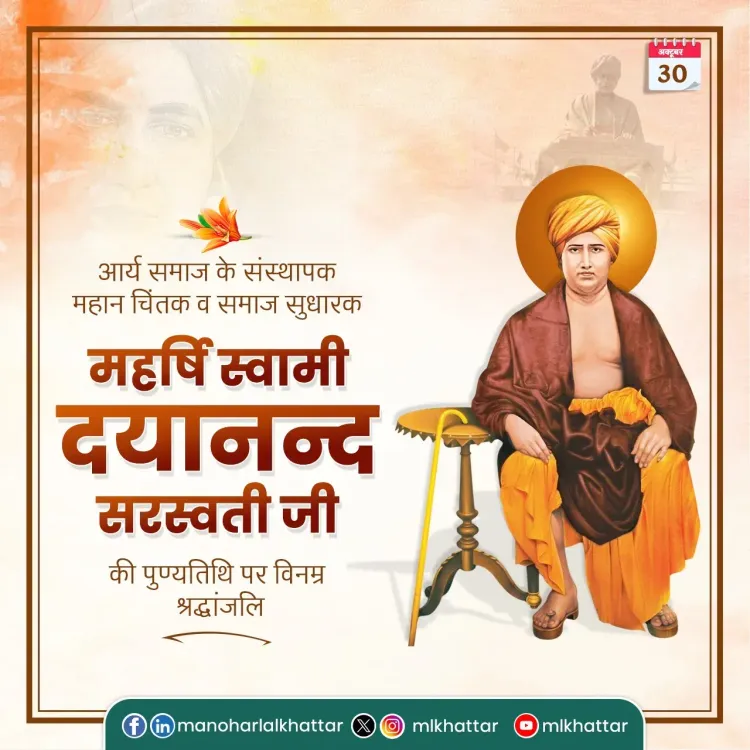
Synopsis
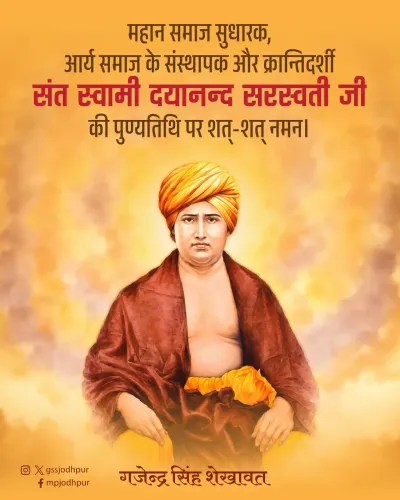
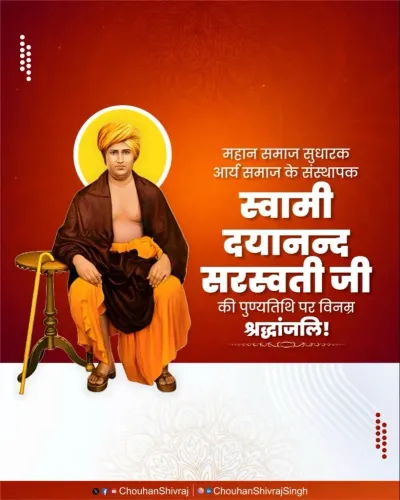
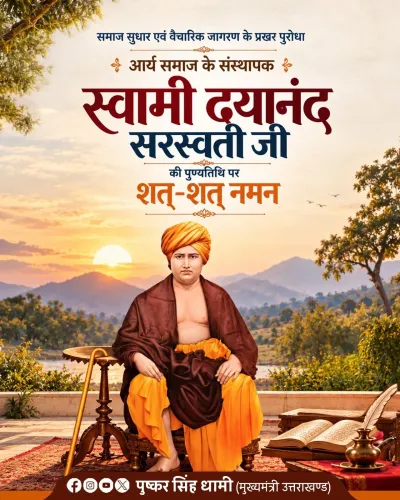
Union Power Minister Manohar Lal Khattar on Friday paid tribute to Maharshi Swami Dayanand Saraswati on his death anniversary, honouring the Arya Samaj founder as a pioneer of India's renaissance and champion against superstition and social inequality.
Key Takeaways
Union Power Minister Manohar Lal Khattar posted a tribute to Swami Dayanand Saraswati on his death anniversary, October 30, 2026 .
Khattar described Swami Dayanand as a 'forerunner of modern India's renaissance' and a proponent of truth, self-righteousness, and self-rule.
Arya Samaj , founded by Swami Dayanand in 1875 , advocated monotheism, Vedic education, and equality, opposing caste discrimination and superstition.
Khattar highlighted Swami Dayanand's lifelong struggle against superstition, conservatism, and social inequality as having given India 'a new consciousness.' The tribute reflects BJP 's consistent pattern of publicly engaging with the legacies of 19th-century Hindu reformist movements.
Haryana, Khattar's political home, has a deep historical connection with the Arya Samaj movement.
On the death anniversary of Maharshi Swami Dayanand Saraswati, Union Power Minister Manohar Lal Khattar offered his reverence to the 19th-century reformer, calling him a forerunner of modern India's renaissance and a great proponent of truth, self-righteousness, and self-rule.
Khattar opened his tribute with a quote: 'वह लोग जो दूसरों के लिए अच्छा करते हैं, वह कभी भी आत्म सम्मान और दुरूपयोग के बारे में नहीं सोचते हैं' — 'Those who do good for others never think about self-respect or exploitation.' The line anchors the rest of his message: that Swami Dayanand's life was defined by selfless service, not personal glory.
A reformer who rewired India's social conscience
Swami Dayanand Saraswati, born in 1824, founded the Arya Samaj in 1875 — a movement that took direct aim at superstition, caste discrimination, and social inequality by returning to the monotheistic authority of the Vedas. At a time when colonial rule was tightening its grip and orthodox religious structures reinforced social hierarchy, Dayanand offered a radical counter-argument: that the original Vedic texts permitted no untouchability, no idol worship, and no barrier to education for women.
Khattar's tribute specifically acknowledged this combative legacy. 'The struggle Swamiji waged against superstition, conservatism, and social inequalities gave India a new consciousness,' the minister wrote, adding that his dedication to national uplift and social reconstruction 'will always remain a source of inspiration.'
BJP's reformist lineage and the Arya Samaj connection
The tribute fits a deliberate pattern: senior BJP leaders have consistently invoked the legacies of 19th-century Hindu reform movements as part of a broader cultural discourse on national awakening. Arya Samaj's emphasis on Vedic education, rationalism over ritualism, and a unified Hindu identity has long resonated with constituencies the party cultivates.
For Khattar — a former Chief Minister of Haryana, a state where the Arya Samaj has deep historical roots and a significant institutional presence — the anniversary carries particular weight beyond political symbolism.
Swami Dayanand's death anniversary on October 30 falls on the Hindu calendar day of Diwali in many years, a detail that deepens the emotional register of commemorations held annually by Arya Samaj institutions across the country.
A reformer who died in 1883 continues to shape the terms of India's conversation about faith, reason, and social equality — and the fact that a sitting Union minister frames those terms in a morning post speaks to how alive that legacy still is.
Point of View
Presenting it as the natural heir to a rationalist, anti-superstition, socially progressive strand of Hinduism. For a leader whose political base is Haryana — where Arya Samaj commands significant institutional and social presence — the message carries both cultural and electoral resonance. The emphasis on themes of social equality and national awakening also allows the party to contest the narrative that Hindu nationalism is exclusively orthodox or conservative. As similar commemorations are expected from other senior BJP figures, the day functions less as a private act of remembrance and more as a coordinated assertion of reformist Hindu heritage.
NationPress
30 Oct 2026
Frequently Asked Questions
Who was Swami Dayanand Saraswati?
Swami Dayanand Saraswati was a 19th-century Hindu reformer born in 1824 who founded the Arya Samaj in 1875. He advocated a return to Vedic principles, opposed idol worship, caste discrimination, and social evils, and is regarded as a pioneer of modern India's social and religious renaissance.
When is Swami Dayanand Saraswati's death anniversary?
Swami Dayanand Saraswati passed away on October 30, 1883. His death anniversary, known as 'Punya Tithi,' is observed annually on this date by Arya Samaj institutions and followers across India.
What is the Arya Samaj?
The Arya Samaj is a Hindu reform movement founded by Swami Dayanand Saraswati in 1875. It promotes monotheism, Vedic education, and social equality, and actively opposed superstition, untouchability, and caste-based discrimination.
Why did Manohar Lal Khattar pay tribute to Swami Dayanand Saraswati?
Union Power Minister Manohar Lal Khattar paid tribute on Swami Dayanand Saraswati's death anniversary, October 30, 2026, honouring his legacy as a reformer who fought superstition and social inequality. Khattar also has a strong political connection to Haryana, a state with deep Arya Samaj roots.
What did Swami Dayanand Saraswati do for social reform in India?
Swami Dayanand Saraswati campaigned vigorously against caste discrimination, untouchability, idol worship, and the denial of education to women. He grounded his reform arguments in Vedic scripture, arguing that original Vedic texts supported equality and rationalism, laying the foundation for several later independence-era reform movements.