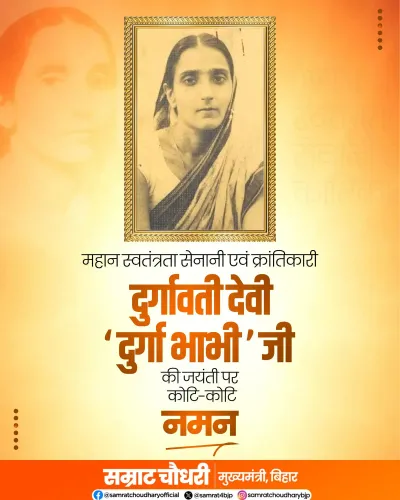
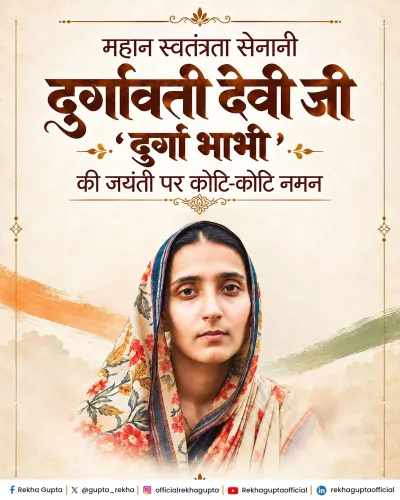
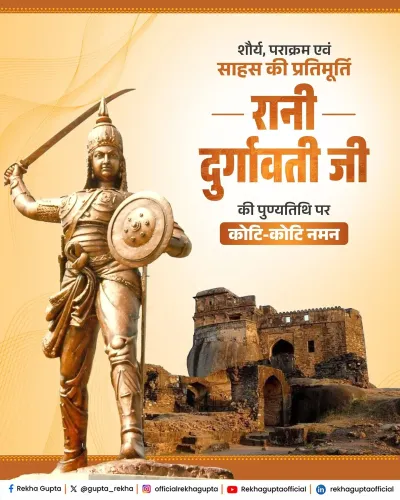
CM Rekha Gupta pays tribute to Durga Bhabhi on her death anniversary
Synopsis
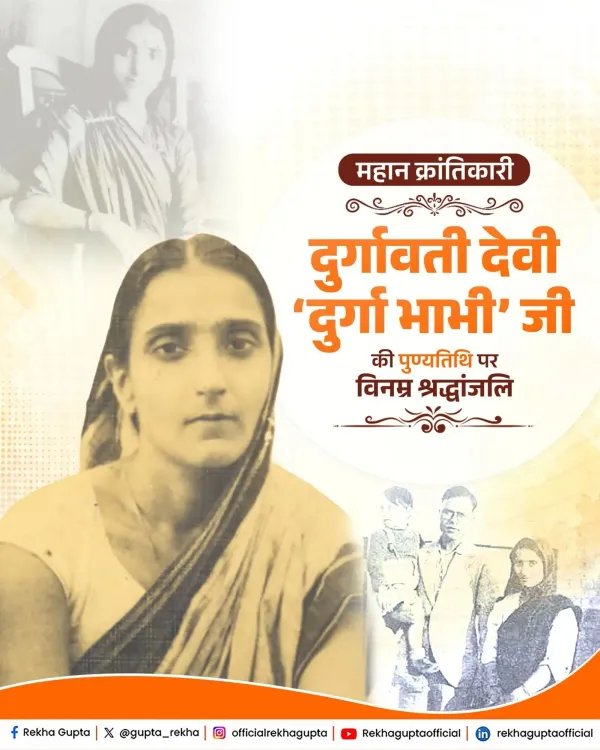
Delhi Chief Minister Rekha Gupta honoured revolutionary freedom fighter Durgavati Devi 'Durga Bhabhi' on her death anniversary, saluting her indomitable courage and her pivotal role in the armed independence movement of the 1920s.
Key Takeaways
Delhi CM Rekha Gupta posted a tribute on 15 October 2026 marking the death anniversary of Durgavati Devi 'Durga Bhabhi' .
Durga Bhabhi was a member of the Hindustan Socialist Republican Association (HSRA) , the armed revolutionary network of the 1920s.
She famously helped Bhagat Singh escape from Lahore after the 1928 Saunders assassination by posing as his wife.
CM Gupta described her as a symbol of 'indomitable courage' whose sacrifice will remain immortal in national memory.
Paying tribute to freedom fighters on their punyatithi is a long-standing practice among Indian political leaders across party lines.
On the death anniversary of one of India's most fearless revolutionary figures, Delhi Chief Minister Rekha Gupta paused to honour a woman whose courage shaped the arc of the independence struggle — Durgavati Devi, remembered across generations as 'Durga Bhabhi'.
In a Hindi tribute posted on Thursday, 15 October 2026, CM Gupta wrote: 'Mahan swatantrata senani evam adamya sahas ki pratik veerangana Durgavati Devi Durga Bhabhi ji ki punyatithi par vinamra shraddhanjali' — 'Humble homage on the death anniversary of the great freedom fighter and symbol of indomitable courage, Durgavati Devi Durga Bhabhi.' She added that Durga Bhabhi's bravery, sacrifice, and invaluable contribution to the revolutionary struggle for the motherland's freedom 'will remain immortal forever in the nation's memory.'
Who was Durga Bhabhi — and why she still matters
Durgavati Devi was a key figure in the Hindustan Socialist Republican Association (HSRA), the clandestine network of armed revolutionaries operating in the 1920s that counted Bhagat Singh, Chandrashekhar Azad, and Sukhdev among its members. Her role was not peripheral — she was a trusted operative who provided crucial logistical support, safe passage, and cover during some of the most daring anti-colonial actions of the era.
Most famously, she disguised herself as Bhagat Singh's wife to help him escape from Lahore after the Saunders assassination in 1928, a mission that required nerves of steel in a city swarming with British police. That act alone secured her place in the revolutionary canon. She was one of very few women directly embedded in the armed wing of the independence movement, and her story offers a counterpoint to narratives that confine women's roles in the freedom struggle to non-violent civil disobedience.
A tradition of remembrance — and what it signals
Paying tribute to freedom fighters on their punyatithi (death anniversary) is a deeply embedded political and civic practice across India's party spectrum. For a sitting Chief Minister of Delhi, such tributes carry added weight — they signal which historical figures a government chooses to elevate in public memory, particularly figures whose legacy is sometimes overlooked in mainstream commemorations. Durga Bhabhi's story, rooted in Punjab and the revolutionary underground, resonates especially in a capital city shaped by the partition and the independence movement's many threads.
Point of View
Azad, and their circle — as distinct from the Nehruvian-Congress narrative of the freedom movement. Elevating a woman revolutionary in particular broadens that framing. Tributes like these are low-cost but high-signal political acts: they shape which histories are kept alive in public discourse and which figures get institutional commemoration in a BJP-governed Delhi.
NationPress
15 Oct 2026
Frequently Asked Questions
Who was Durga Bhabhi?
Durgavati Devi, popularly known as Durga Bhabhi, was an Indian revolutionary and member of the Hindustan Socialist Republican Association (HSRA) in the 1920s. She is best known for helping Bhagat Singh escape from Lahore in 1928 by posing as his wife after the Saunders assassination.
When is Durga Bhabhi's death anniversary?
Delhi CM Rekha Gupta's tribute was posted on 15 October 2026, marking Durga Bhabhi's death anniversary, though the precise verified date of her passing is not independently confirmed in widely available records.
What was the Hindustan Socialist Republican Association?
The Hindustan Socialist Republican Association (HSRA) was a clandestine armed revolutionary organisation active in colonial India during the 1920s. Its prominent members included Bhagat Singh, Chandrashekhar Azad, and Sukhdev, and it carried out several high-profile anti-colonial actions.
Why did Rekha Gupta pay tribute to Durga Bhabhi?
Delhi Chief Minister Rekha Gupta paid tribute on the occasion of Durga Bhabhi's death anniversary, describing her as a symbol of indomitable courage whose sacrifice for the nation's freedom will remain immortal. Tributes on freedom fighters' death anniversaries are a standard practice among Indian political leaders.
What is the significance of Durga Bhabhi in India's independence movement?
Durga Bhabhi is significant as one of very few women directly embedded in the armed wing of India's independence movement. Her operational role in the HSRA — particularly sheltering and evacuating revolutionaries at great personal risk — sets her apart from many other women commemorated primarily for non-violent roles.