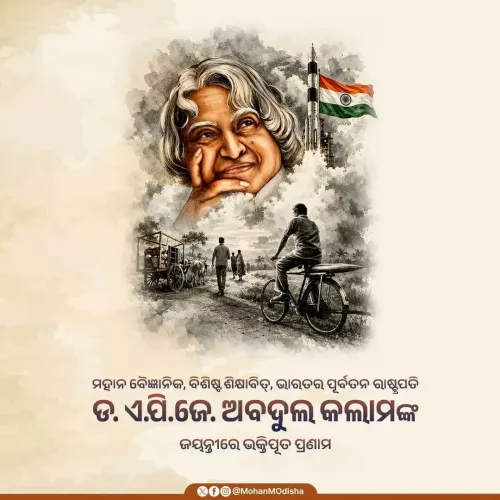
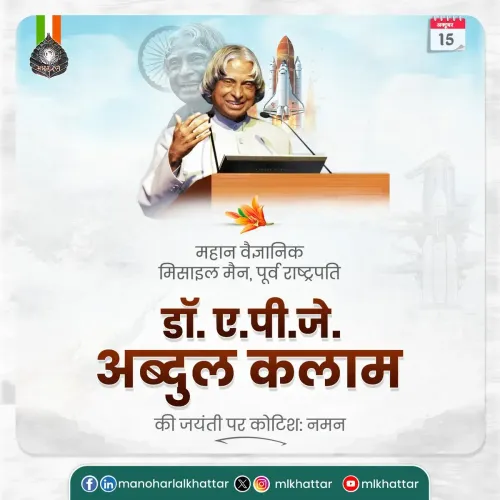
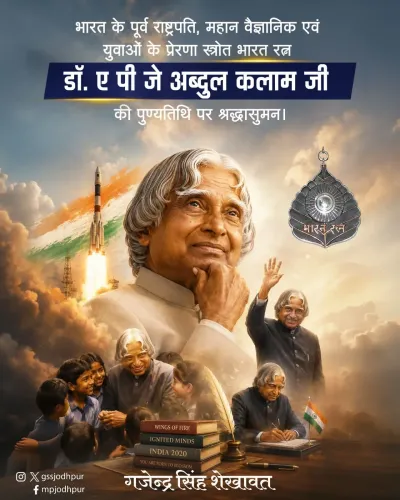
Gadkari pays tribute to APJ Abdul Kalam on birth anniversary
Synopsis
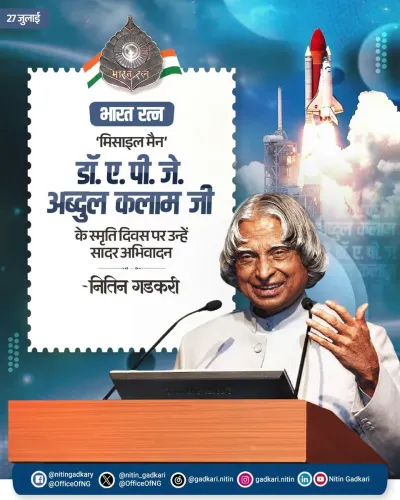
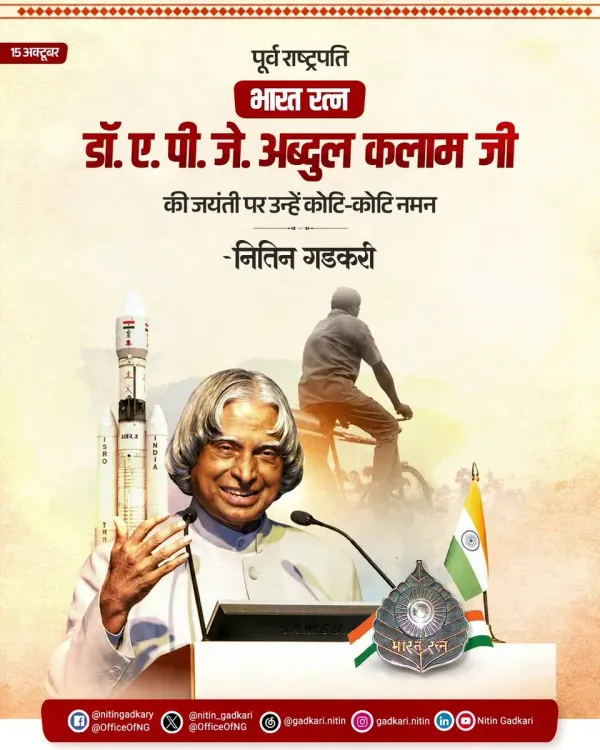
Union Minister Nitin Gadkari honoured Bharat Ratna Dr. APJ Abdul Kalam on his October 15 birth anniversary, remembering the former President as a symbol of simplicity, knowledge, and lifelong service to a stronger India whose ideas will inspire generations.
Key Takeaways
Union Minister Nitin Gadkari paid tribute to Dr.
APJ Abdul Kalam on his birth anniversary, October 15, 2026 .
Kalam served as India's 11th President from 2002 to 2007 and received the Bharat Ratna in 1997 .
He was appointed Principal Scientific Adviser to the Government of India in 1999 .
Gadkari described Dr.
Kalam as a symbol of knowledge and dedication who devoted his life to making India powerful.
Annual October 15 tributes to Dr.
Kalam draw leaders across party lines, reflecting his status as a non-partisan national icon.
Kalam's legacy remains especially resonant among Indian youth and in science and education policy discourse.
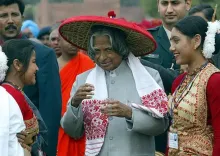
A life of simplicity, science, and selfless service — Union Road Transport and Highways Minister Nitin Gadkari honoured former President and Bharat Ratna Dr. A.P.J. Abdul Kalam on his birth anniversary, October 15, calling him a symbol of knowledge and dedication who gave every moment of his life to make India powerful.
Paying tribute in Hindi, Gadkari wrote: 'कोटि-कोटि नमन' — a salute from the depths of the nation's heart. He described Dr. Kalam's life as one 'filled with simplicity and ideals,' and affirmed that 'his thoughts will continue to inspire generations.'
The scientist who became the people's President
Dr. Avul Pakir Jainulabdeen Abdul Kalam served as India's 11th President from 2002 to 2007, a tenure that brought an unusual warmth and accessibility to Rashtrapati Bhavan. Long before the presidency, he had already reshaped India's strategic landscape — leading the development of missile systems under the Integrated Guided Missile Development Programme and playing a pivotal role in India's Pokhran-II nuclear tests of 1998. In 1997, the nation recognised his contributions with the Bharat Ratna, India's highest civilian honour.
He was appointed Principal Scientific Adviser to the Government of India in 1999, channelling his expertise directly into national technology policy. But it was his ability to speak to ordinary Indians — especially students and the young — that made him a figure transcending politics, party, and era.
A tribute that crosses party lines every October 15
Annual commemorations on October 15 have become a fixture of Indian public life, with leaders across the political spectrum honouring Dr. Kalam's memory. Gadkari's tribute fits within this broader national conversation — one that consistently frames Dr. Kalam not merely as a scientist or a statesman, but as a moral compass for a modernising India.
His insistence on a vision of 'Developed India' — articulated through books, speeches, and his decade-long post-presidential journey through university campuses — left a blueprint that continues to be cited in education and science policy discussions. For Indian youth in particular, the Kalam legacy remains a living reference point, not a museum exhibit.
A son of Rameswaram, Tamil Nadu, who rose to occupy the highest constitutional office — Dr. Kalam's story remains the most democratic arc in modern Indian history. Gadkari's tribute is a reminder that some legacies do not fade; they compound.
Point of View
Making October 15 tributes a near-obligatory act of public positioning. For a senior BJP leader like Gadkari, invoking Kalam's ideals of simplicity and national service also reinforces a broader governance narrative around technology-led development and aspirational nationalism. The consistency of such tributes across decades signals that Dr. Kalam's image has been institutionalised as a shared national symbol, insulating it from political contestation. What remains to be tested is whether that symbolism translates into substantive policy choices in science, education, and defence research.
NationPress
15 Oct 2026
Frequently Asked Questions
When is APJ Abdul Kalam's birth anniversary?
Dr. APJ Abdul Kalam was born on October 15, 1931 , in Rameswaram, Tamil Nadu. His birth anniversary is observed nationally every year on October 15.
What award did APJ Abdul Kalam receive from the Indian government?
Dr. Kalam was awarded the Bharat Ratna , India's highest civilian honour, in 1997 , in recognition of his contributions to science, defence research, and national development.
When did APJ Abdul Kalam serve as President of India?
Dr. A.P.J. Abdul Kalam served as India's 11th President from 2002 to 2007 . He was widely known as the 'People's President' for his accessibility and connection with youth.
Why is Nitin Gadkari paying tribute to APJ Abdul Kalam?
Union Minister Nitin Gadkari posted a tribute on October 15, 2026 , marking Dr. Kalam's birth anniversary. Senior leaders across parties routinely honour Dr. Kalam on this date.
What was APJ Abdul Kalam's role before becoming President?
Before his presidency, Dr. Kalam was a leading aerospace and defence scientist, playing a key role in India's missile development programme. He was appointed Principal Scientific Adviser to the Government of India in 1999 .