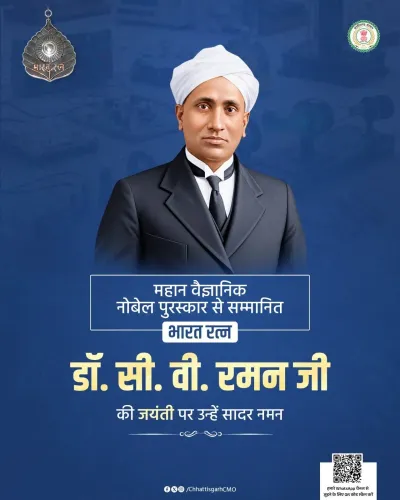
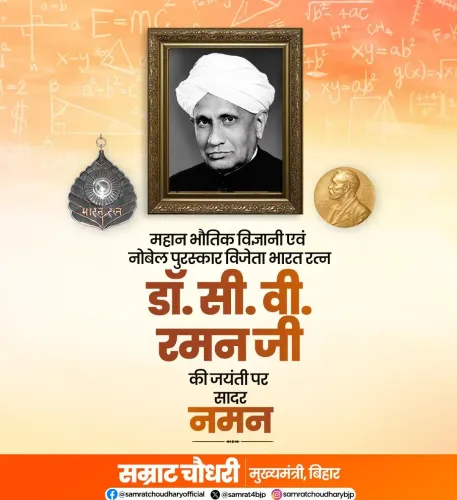
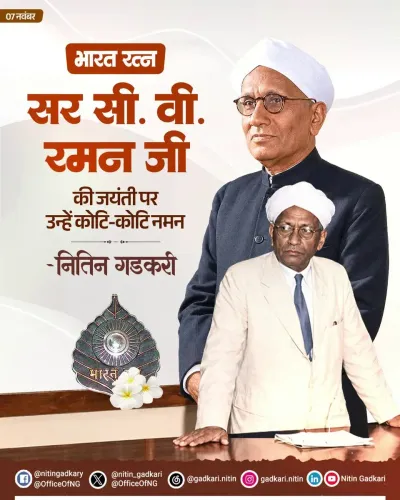
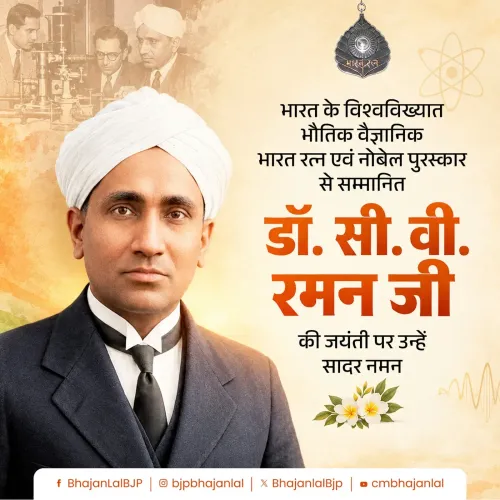
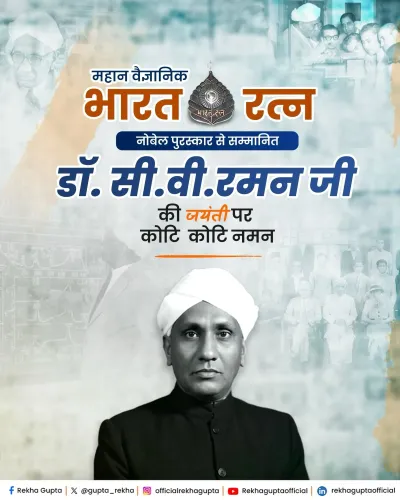
Karnataka CM's Office honours C.V. Raman on his birth anniversary
Synopsis
The Chief Minister's Office of Karnataka honoured Sir C.V. Raman on his birth anniversary, paying tribute to the Nobel Prize-winning physicist whose discovery of the Raman Effect in 1928 and Bharat Ratna in 1954 cemented his place as one of India's greatest scientific figures.
Key Takeaways
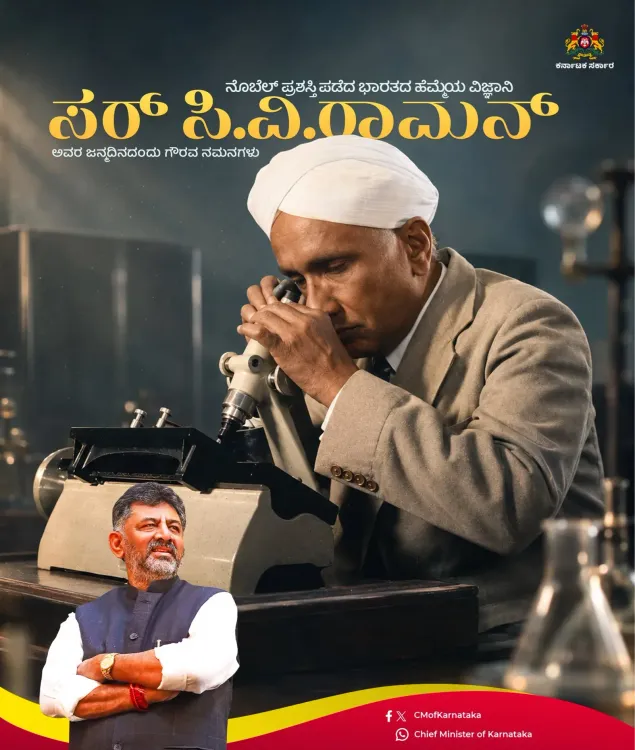
The Chief Minister's Office of Karnataka posted a tribute to Sir C.V.
Raman on his birth anniversary, November 7, 2026 .
Raman won the Nobel Prize in Physics in 1930 for the discovery of the Raman Effect , which demonstrated the scattering of light by molecules.
He was awarded the Bharat Ratna in 1954 , making him one of the earliest recipients of India's highest civilian honour.
National Science Day is observed on February 28 each year to mark the 1928 announcement of the Raman Effect, a tradition established by the Government of India in 1986 .
The CMO's message specifically called on India's youth to pursue knowledge, curiosity, and research, reflecting a broader state emphasis on STEM culture.
The man who revealed light's hidden secret to the world — and in doing so, wrote one of science's most luminous chapters — is being remembered today. The Chief Minister's Office of Karnataka paid tribute to Sir C.V. Raman on his birth anniversary on Saturday, November 7, 2026, honouring the Nobel laureate whose discovery reshaped humanity's understanding of light and matter.
The post, written in Kannada, reads: 'ಬೆಳಕಿನ ರಹಸ್ಯವನ್ನು ಜಗತ್ತಿಗೆ ಪರಿಚಯಿಸಿ...' — 'Respectful salutations to the great scientist Sir C.V. Raman, who introduced the secret of light to the world and illuminated the glory of Indian science on a global stage. May his scientific achievements and spirit of inquiry forever inspire the next generation of young scientists. May his life — which wrote an entirely new chapter in the field of science — always motivate the youth to advance on the path of knowledge, curiosity, and research.'
The discovery that made India's name in physics
Born on November 7, 1888, Sir Chandrasekhara Venkata Raman grew up to make a discovery that the scientific world had not anticipated. In 1928, working at the Indian Association for the Cultivation of Science in Calcutta, he demonstrated that when light passes through a transparent material, a small fraction of it scatters at a different wavelength — a phenomenon that would bear his name forever: the Raman Effect. The Nobel Committee in Stockholm awarded him the 1930 Nobel Prize in Physics, making him the first Asian and the first non-white scientist to win a Nobel Prize in a science category.
The scale of that achievement is worth pausing on. At a time when India was still under colonial rule, Raman did not travel to a European laboratory to make his mark. He made it here — with modest resources, formidable curiosity, and a conviction that Indian science could stand with the best in the world.
Bharat Ratna and the institutionalisation of his legacy
The Indian state has long sought to anchor national scientific identity to Raman's legacy. He received the Bharat Ratna — India's highest civilian honour — in 1954, among the earliest recipients of that newly instituted award. Decades later, in 1986, the Government of India established National Science Day on February 28 — the date of the Raman Effect's announcement — to institutionalise the celebration of scientific temper across the country. Every year, schools, colleges, and research institutions use the occasion to kindle curiosity among students.
Karnataka, as his home state, holds this legacy with particular pride. Tributes from state authorities on his birth anniversary reinforce a broader governmental pattern: invoking foundational scientists to signal commitment to STEM education and a research-driven culture among the young.
A message aimed squarely at the next generation
The CMO's tribute is pointed in its audience. It does not dwell only on commemoration — it explicitly calls on 'yuvapīḷige' (youth) to walk the path of knowledge, curiosity, and research. That framing reflects a wider national anxiety and ambition: India produces millions of science graduates annually, but translating that volume into globally competitive original research remains an ongoing challenge. Raman's story — of a government official who pursued physics in his spare time before it consumed his life — is precisely the kind of origin myth that policymakers reach for when making the case that transformative science is possible anywhere, by anyone with enough will.
Raman died in Bangalore in 1970, leaving behind not just a Nobel and a Bharat Ratna, but the Raman Research Institute he founded — still active, still producing work. His city remembers him today, as it does every year, with the quiet certainty that his light has not scattered.
Point of View
Suggesting the message is designed as much for STEM aspiration as for historical commemoration. With India's research output still lagging its graduate numbers on global indices, anchoring ambition to a homegrown Nobel laureate carries real motivational utility. The question is whether such symbolic salutes will be backed by concrete allocations — fellowship programmes, research infrastructure funding — in the state's forthcoming budget cycle.
NationPress
7 Nov 2026
Frequently Asked Questions
Why is C.V. Raman famous?
Sir C.V. Raman is famous for discovering the Raman Effect in 1928 — the phenomenon of light scattering by molecules — for which he was awarded the Nobel Prize in Physics in 1930, becoming the first Asian to win a Nobel Prize in science.
When is C.V. Raman's birth anniversary?
Sir C.V. Raman was born on November 7, 1888. His birth anniversary is observed on November 7 each year.
What is the Raman Effect?
The Raman Effect is the phenomenon where light passing through a transparent material scatters at a different wavelength due to its interaction with molecules. This discovery fundamentally advanced spectroscopy and molecular physics.
Did C.V. Raman receive the Bharat Ratna?
Yes. Sir C.V. Raman received the Bharat Ratna — India's highest civilian honour — in 1954, making him one of the very first recipients of the newly instituted award.
What is National Science Day and why is it celebrated on February 28?
National Science Day is observed in India on February 28 each year to commemorate the 1928 announcement of the Raman Effect. It was instituted by the Government of India in 1986 to promote scientific temper and honour Raman's legacy.