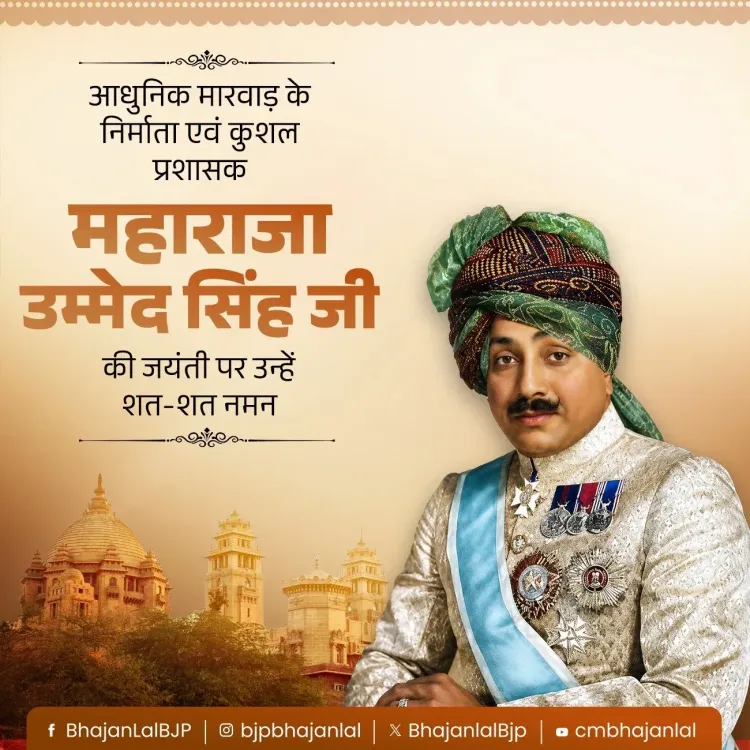
CM Bhajan Lal Sharma Pays Tribute to Maharaja Umaid Singh
Synopsis
Rajasthan Chief Minister Bhajan Lal Sharma on 8 July 2026 honoured Maharaja Umaid Singh on his birth anniversary, praising the Jodhpur ruler's legacy of public welfare, good governance, and infrastructure development in the Marwar region.
Key Takeaways
Rajasthan CM Bhajan Lal Sharma posted a tribute to Maharaja Umaid Singh on his birth anniversary on 8 July 2026 .
Maharaja Umaid Singh ruled Marwar (Jodhpur) from 1918 to 1947 and is credited with commissioning Umaid Bhawan Palace as a famine-relief public works project.
Sharma described Umaid Singh as the 'builder of modern Marwar' and praised his dedication to public welfare and good governance.
The tribute fits a broader BJP pattern in Rajasthan of invoking pre-independence princely legacies to reinforce contemporary development narratives.
Jodhpur 's accession to the Indian Union in 1947 and integration into Rajasthan by 1949 built upon the administrative and infrastructure foundations laid during Umaid Singh's reign.
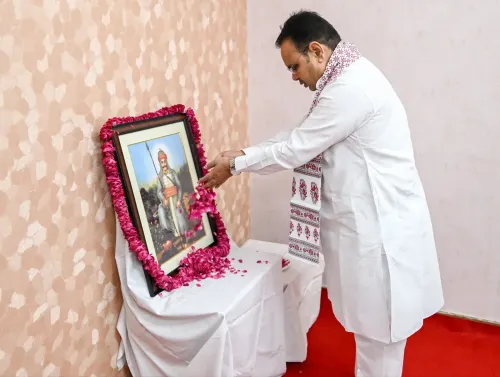
Rajasthan Chief Minister Bhajan Lal Sharma on Wednesday, 8 July 2026 paid tribute to Maharaja Umaid Singh of Jodhpur on his birth anniversary, hailing the former ruler as the 'builder of modern Marwar' and a skilled administrator. The Chief Minister's post on X praised Umaid Singh's dedication to public welfare, good governance, and the holistic development of the region.
In his post, Sharma wrote: 'Aadhunik Marwar ke nirmata evam kushal prashask Maharaja Umaid Singh ji ki jayanti par unhe shat-shat naman!' — loosely translated as 'A hundredfold salute to Maharaja Umaid Singh, builder of modern Marwar and a skilled administrator, on his birth anniversary!' He added that Umaid Singh's commitment to public welfare, good governance, and the overall development of the region 'is exemplary and worth emulating.'
Context
Maharaja Umaid Singh ruled the princely state of Marwar (Jodhpur) from 1918 to 1947. He is widely credited with commissioning the iconic Umaid Bhawan Palace — not merely as a royal residence but as a large-scale public works project designed to provide employment to thousands of famine-stricken labourers during a prolonged drought in the 1920s and 1930s. The palace remains one of the largest private residences in the world and a landmark of Jodhpur.
Beyond the palace, Umaid Singh oversaw significant expansion of Marwar's railways, roads, and irrigation networks, laying infrastructure that continued to serve the region well into the post-independence era. Jodhpur acceded to the Indian Union in 1947, and the region was formally integrated into the state of Rajasthan by 1949, with further reorganisation in 1956.
Policy Backdrop
Rajasthan's BJP leadership has consistently invoked the legacy of pre-independence princely rulers to anchor contemporary narratives of development and governance. Tributes to rulers such as Maharaja Umaid Singh are part of a broader pattern in which state governments highlight royal-era infrastructure — particularly in western Rajasthan — as a foundation for present-day public administration.
Post-independence Rajasthan governments have, since the 1970s, periodically restored and promoted royal-era monuments including Umaid Bhawan Palace for heritage tourism and public engagement. Jodhpur, as the largest city in western Rajasthan and the historic capital of the Marwar princely state, continues to benefit from this legacy through sustained tourism revenue and heritage conservation efforts.
Stakeholders and Impact
Residents of Jodhpur and the wider Marwar region maintain a strong cultural connection to the Rathore dynasty's administrative history. Heritage conservation groups active in western Rajasthan view official tributes as an opportunity to renew public and governmental attention toward the preservation of royal-era sites and infrastructure.
For the BJP government in Rajasthan, associating contemporary governance priorities — welfare, development, and administrative efficiency — with respected historical figures like Maharaja Umaid Singh reinforces a continuity narrative that resonates with local sentiment in the region.
What's Next
Observers will watch for any state government events, heritage project announcements, or tourism initiatives linked to Jodhpur's royal legacy in the coming weeks, particularly as the BJP government continues to position Rajasthan's princely history as an asset for development and cultural identity. Such anniversaries have in the past served as occasions for policy announcements related to heritage conservation or infrastructure upgrades in the Marwar region.
Point of View
' Sharma draws a symbolic line between royal-era welfare initiatives and the current government's own development agenda. This approach serves a dual purpose: reinforcing cultural pride in western Rajasthan, where the Rathore dynasty commands deep historical reverence, while simultaneously positioning the BJP as the natural custodian of that legacy. Such ceremonial tributes, while routine in form, carry political weight in regions where historical identity and electoral mobilisation are closely intertwined.
NationPress
8 Jul 2026
Frequently Asked Questions
Who was Maharaja Umaid Singh of Jodhpur?
Maharaja Umaid Singh ruled the princely state of Marwar (Jodhpur) from 1918 to 1947. He is best known for commissioning Umaid Bhawan Palace as a public works project to provide employment during a severe famine, and for expanding railways, roads, and irrigation across the Marwar region.
Why did Bhajan Lal Sharma pay tribute to Maharaja Umaid Singh?
Rajasthan Chief Minister Bhajan Lal Sharma paid tribute on Maharaja Umaid Singh's birth anniversary on 8 July 2026, praising his legacy of public welfare, good governance, and regional development as exemplary and worth emulating.
What is Umaid Bhawan Palace and why is it significant?
Umaid Bhawan Palace in Jodhpur is one of the largest private residences in the world, commissioned by Maharaja Umaid Singh in the 1920s and 1930s. It was designed as a public works project to provide employment to thousands of labourers during a prolonged famine, making it a symbol of welfare-oriented governance.
What is the Marwar region?
Marwar is a historical region in western Rajasthan, centred on Jodhpur, that was ruled by the Rathore dynasty for centuries. It functioned as a semi-autonomous princely state until Jodhpur's accession to the Indian Union in 1947 and was formally integrated into Rajasthan by 1949.
Does the Rajasthan BJP regularly pay tribute to former princely rulers?
Yes, Rajasthan BJP leaders routinely issue public tributes to pre-1947 rulers on birth and death anniversaries, linking their infrastructure and administrative records to the party's contemporary narrative of development and good governance in the state.