KTR Hails World Bank Report Placing Telangana Among Upper-Middle-Income States
Synopsis
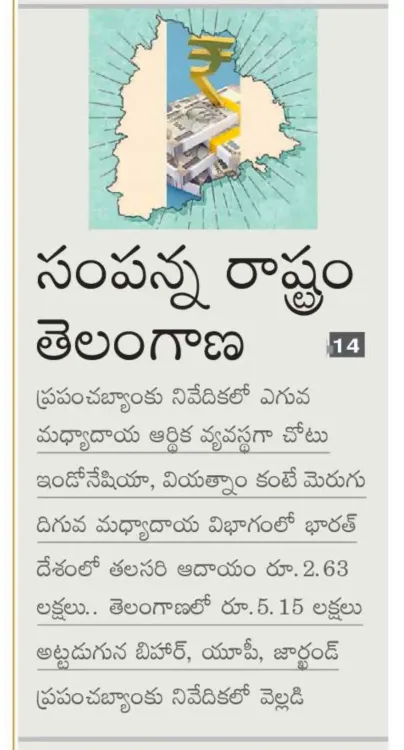
BRS working president K. T. Rama Rao cited a World Bank report on 8 July 2026 claiming Telangana has crossed the upper-middle-income benchmark, placing it among India's top five states — crediting a decade of BRS rule under K. Chandrashekar Rao for the transformation.
Key Takeaways
Rama Rao posted on 8 July 2026 citing a World Bank report that places Telangana among the upper-middle-income states.
He claimed Telangana is one of only five states in India to have crossed this income benchmark.
He attributed the achievement to ten years of BRS governance under founder K.
The post dismisses narratives of Telangana being a 'bankrupt state', calling the World Bank report a direct rebuttal.
Telangana was formed on 2 June 2014 ; BRS governed until December 2023 when it lost power to Congress.
The specific World Bank report title and exact threshold-crossing date remain unverified from independent sources.
BRS working president K. T. Rama Rao on Wednesday, 8 July 2026, cited a World Bank report to declare that Telangana has crossed the upper-middle-income benchmark, placing it among the top five states in India to achieve that status. Posting in Telugu on X, he credited a decade of BRS governance under founder K. Chandrashekar Rao for transforming what he described as a historically impoverished region into a prosperous state.
Context
In his post, Rama Rao wrote: 'తెలంగాణ రాష్ట్రం అప్పర్ మిడిల్ ఇన్ కం బెంచ్ మార్క్ ను దాటి ఎదిగింది' — ('Telangana state has grown past the upper-middle-income benchmark'). He called it a moment of pride for the people of Telangana and congratulated every citizen who, in his words, 'blended their sweat, skill, and intellect to take Telangana from ruins to peaks.' He also dismissed what he called 'baseless campaigns' labelling the state bankrupt, saying the World Bank report itself was the answer to such claims.
The post references a World Bank income classification report, though the specific report title and the exact date of crossing the threshold have not been independently confirmed. The World Bank periodically publishes country and sub-national income classifications that are widely cited in Indian political and policy discourse.
Policy Backdrop
Telangana was carved out of Andhra Pradesh on 2 June 2014 under the Andhra Pradesh Reorganisation Act, fulfilling a long-standing demand by the region's people. The Bharat Rashtra Samithi assumed office immediately upon statehood and governed for approximately a decade, introducing a range of welfare, industrial, and infrastructure policies.
During that period, the BRS government pointed to rapid growth in per capita income, expansion of the information technology sector centred on Hyderabad, and large-scale irrigation projects as markers of economic transformation. The party lost power in the December 2023 assembly elections but has continued to assert credit for the state's developmental trajectory.
Stakeholders and Impact
The upper-middle-income classification, if confirmed by the cited report, would have tangible implications for Telangana's residents: higher per capita income benchmarks typically translate into greater access to credit, improved human development indices, and stronger investor confidence. It also affects how central government grants and scheme eligibility are calculated for the state.
For the BRS as an opposition party, the data point carries political weight ahead of future electoral cycles. The current state government, led by the Indian National Congress, has offered its own narrative on fiscal management, making the framing of economic data a contested political space in Telangana.
What's Next
Analysts will watch for the full text of the World Bank report to verify the precise classification methodology and whether the upper-middle-income designation applies at the state level or is extrapolated from national data. Upcoming state economic surveys and NITI Aayog assessments for southern states will provide additional data points to either corroborate or contextualise the claim.
If the classification holds up to scrutiny, it is likely to intensify the debate between the BRS and the ruling Congress over which government's policies deserve primary credit — a question that will shape political messaging in Telangana well into the next election cycle.
Point of View
BRS attempts to reclaim the economic story of Telangana's first decade on terms that are harder for the ruling Congress to dispute. The upper-middle-income framing also subtly resets the baseline — shifting public memory from pre-statehood deprivation to a benchmark of global standing. However, the lack of a verifiable report citation leaves the claim open to challenge, and the current government is likely to contest both the data and the attribution. This pattern of sub-national parties leveraging World Bank or IMF classifications for electoral positioning is increasingly common across Indian states, signalling a broader professionalisation of economic messaging in regional politics.
NationPress
8 Jul 2026
Frequently Asked Questions
Has Telangana really crossed the World Bank upper-middle-income benchmark?
BRS working president K. T. Rama Rao cited a World Bank report on 8 July 2026 making this claim, but the specific report and the exact threshold-crossing date have not been independently verified. The World Bank periodically publishes income classifications that are widely referenced in Indian political discourse.
Which five states in India have reached upper-middle-income status according to KTR?
KTR's post states that Telangana is among the top five Indian states to have crossed the upper-middle-income benchmark, but does not name the other four states. The specific list has not been independently confirmed from the cited report.
When was Telangana formed and who governed it?
Telangana was formally created on 2 June 2014 following the bifurcation of Andhra Pradesh. The Bharat Rashtra Samithi, led by founder K. Chandrashekar Rao, governed the state from its formation until December 2023, when the Indian National Congress won the assembly elections.
What is KTR's role in BRS?
K. T. Rama Rao is the working president of the Bharat Rashtra Samithi and the son of party founder K. Chandrashekar Rao. He previously served as Telangana's minister for IT, industries, and municipal administration during the BRS government.
Why is BRS highlighting Telangana's economic data now?
As the principal opposition party in Telangana, BRS uses favourable economic indicators to assert that the state's growth was built on its decade of governance, countering the ruling Congress government's narrative on fiscal management ahead of future elections.