CM Mohan Yadav Urges MP Citizens to Join Swachhata Jan Andolan
Synopsis
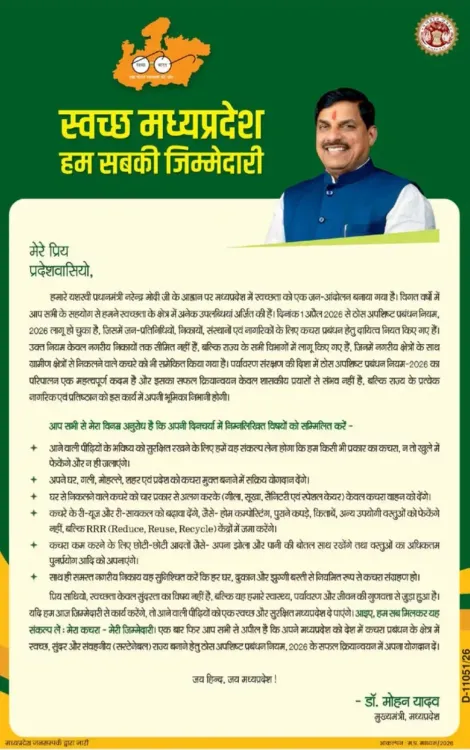
Chief Minister Dr. Mohan Yadav has urged the people of Madhya Pradesh to embrace cleanliness as a collective responsibility and transform it into a jan andolan, reinforcing the state's commitment to the Swachh Bharat Mission framework.
Key Takeaways
Mohan Yadav issued a public appeal on 8 July 2026 urging all residents of Madhya Pradesh to participate in building a clean, beautiful, and healthy state.
The appeal uses the theme 'Swachh Madhya Pradesh, hum sabki zimmedari' — framing sanitation as a shared civic duty, not just a government function.
The call is anchored in the Swachh Bharat Mission , India's national sanitation programme active since 2014 , under which states are ranked annually via Swachh Survekshan .
Urban local bodies and rural communities are the key implementation stakeholders who must translate the appeal into on-ground action.
Upcoming Swachh Survekshan results and state budget allocations for waste infrastructure in 2026-27 will be the next indicators of progress.
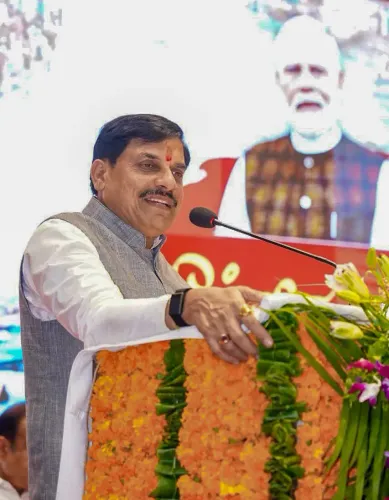
The Chief Minister's Office of Madhya Pradesh, on behalf of Chief Minister Dr. Mohan Yadav, on Wednesday, 8 July 2026, issued a public appeal urging the people of the state to make cleanliness a mass movement and contribute to building a clean, beautiful, and healthy Madhya Pradesh.
Context
Posting under the theme 'Swachh Madhya Pradesh, hum sabki zimmedari' ('Clean Madhya Pradesh, the responsibility of all of us'), CM Dr. Mohan Yadav called on residents across the state to treat sanitation not as a government obligation but as a shared civic duty. The appeal frames cleanliness as a jan andolan — a people's movement — echoing the participatory language that has defined national sanitation outreach since 2014.Policy Backdrop
The appeal is firmly rooted in the Swachh Bharat Mission, the Government of India's flagship national sanitation programme launched in October 2014 to eliminate open defecation and institutionalise waste management practices at the grassroots level. Under this framework, states including Madhya Pradesh are evaluated annually through the Swachh Survekshan survey, which ranks cities and towns on indicators such as garbage-free status, open-defecation-free sustainability, and citizen feedback. Madhya Pradesh has pursued incremental improvements in these rankings and in sanitation coverage across both urban and rural areas since the mission's inception. Dr. Mohan Yadav assumed office as Chief Minister in December 2023, succeeding Shivraj Singh Chouhan, and has continued the state's engagement with centrally sponsored sanitation and development programmes. State-level appeals of this nature typically precede or accompany ground-level cleanliness drives, local body campaigns, and community outreach events coordinated by urban local bodies and gram panchayats.Stakeholders and Impact
The primary audiences for this appeal are the residents of Madhya Pradesh's urban localities and rural communities — the twin pillars of the state's sanitation ecosystem. Urban local bodies are responsible for door-to-door waste collection, segregation infrastructure, and public space upkeep, while rural residents and gram panchayats anchor open-defecation-free sustainability and solid-liquid waste management in villages. When a Chief Minister publicly frames cleanliness as collective responsibility, it typically signals renewed administrative focus and can mobilise local officials to intensify on-ground activity. Citizens, resident welfare associations, and self-help groups are also implicitly called upon to participate in drives and maintain standards in their immediate surroundings.What's Next
Attention will now turn to whether this public appeal translates into specific state-level targets, budget allocations for waste-processing infrastructure, or a formal campaign calendar for 2026-27. The results of the next Swachh Survekshan assessment for Madhya Pradesh cities will serve as a key benchmark for measuring the on-ground impact of such outreach. Sustained citizen participation, backed by administrative follow-through from urban local bodies and rural development machinery, will determine how effectively the state converts this appeal into measurable cleanliness outcomes.Point of View
' the messaging deflects scrutiny from administrative shortfalls and places the burden of outcomes on citizen behaviour. This is a well-worn playbook in Indian sanitation governance: high-visibility appeals generate social pressure and media coverage without requiring immediate fiscal commitments. The real test will be whether this translates into measurable rank improvements for Madhya Pradesh's cities in the next national survey.
NationPress
8 Jul 2026
Frequently Asked Questions
What did CM Mohan Yadav say about cleanliness in Madhya Pradesh?
CM Dr. Mohan Yadav appealed to all residents of Madhya Pradesh to make cleanliness a mass movement, calling it a shared responsibility under the theme 'Swachh Madhya Pradesh, hum sabki zimmedari.'
What is the Swachh Bharat Mission and how does it affect Madhya Pradesh?
The Swachh Bharat Mission is a national sanitation programme launched in 2014 to eliminate open defecation and improve waste management. Madhya Pradesh participates in its annual Swachh Survekshan rankings, which assess cities on cleanliness and citizen feedback.
What is Swachh Survekshan and when are the next results?
Swachh Survekshan is an annual national survey that ranks Indian cities on sanitation, waste processing, and open-defecation-free status. The next results for Madhya Pradesh cities will be a key measure of the state's cleanliness progress.
Who is CM Mohan Yadav and when did he become Chief Minister of Madhya Pradesh?
Dr. Mohan Yadav became Chief Minister of Madhya Pradesh in December 2023, succeeding Shivraj Singh Chouhan, and has continued the state's focus on governance and development programmes including sanitation.
How can citizens of Madhya Pradesh participate in the cleanliness drive?
Citizens can participate by maintaining cleanliness in their surroundings, supporting local waste segregation initiatives, and engaging with drives organised by urban local bodies and gram panchayats under the Swachh Bharat Mission framework.