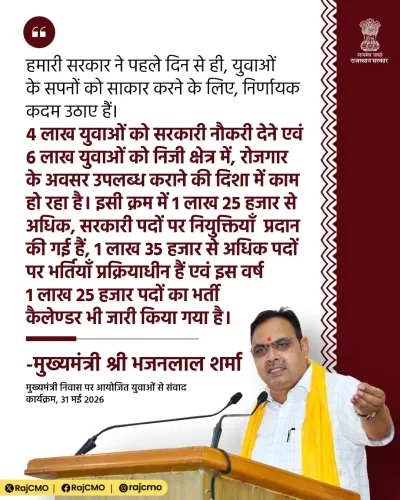
CM Bhajan Lal Sharma tears into opposition over 'anarchy politics'
Synopsis
Rajasthan CM Bhajan Lal Sharma accused the opposition on October 16 of hiding a power-hungry agenda behind public-interest protests, exploiting youth and farmers, dividing society on caste and language lines, and undermining democratic institutions.
Key Takeaways
CM Bhajan Lal Sharma posted a sharp Hindi-language attack on the opposition on 16 October 2026 .
He accused rivals of using youth and farmers as political pawns under the cover of public welfare.
Sharma charged the opposition with dividing society along caste and language lines for electoral advantage.
He alleged an organised effort to undermine democratic institutions and spread anarchy in the name of protest.
BJP has governed Rajasthan since its December 2023 assembly election victory; the statement fits a mid-term sharpening of political lines.
The specific incident or group referenced in the post has not been independently confirmed.
A charge that had been building for weeks finally arrived in plain language on Friday — Rajasthan Chief Minister Bhajan Lal Sharma levelled a pointed, unsparing attack on the political opposition, accusing it of using youth and farmers as pawns, stoking caste and linguistic divisions, and weaponising protest to spread what he called outright anarchy.
Posting in Hindi on 16 October 2026, Sharma declared: 'आखिर अराजकता के पीछे छिपा असली मकसद जुबान पर आ ही गया!' — 'The real motive hiding behind the anarchy has finally come out in the open!' He listed what he described as the opposition's true political face: invoking public welfare as a cover for a naked hunger for power, converting young people and farmers into political chess pieces, fracturing society along caste and language lines, attacking the credibility of democratic institutions, and spreading disorder in the name of dissent.
The four-point indictment Sharma put on record
The CM's broadside was structured as an explicit four-count charge sheet. First, exploiting youth and farmers under the banner of public interest while the real driver, he argued, is the pursuit of power. Second, dividing society on caste and language — a perennial fault-line in Rajasthan's politics, where communities spanning Jat, Gujjar, Meena, and Dalit blocs have historically been mobilised ahead of assembly cycles. Third, undermining democratic institutions — a phrase that, in Indian political discourse, typically targets the judiciary, the Election Commission, or the governorship. Fourth, using the vocabulary of protest as a vehicle for what Sharma called 'anarchy', rather than legitimate democratic dissent.
Rajasthan's recurring rhetoric — and why it lands differently now
This kind of sharp public attack from a sitting Chief Minister is not unusual in Indian state politics — ruling parties and opposition benches routinely trade accusations about who is really exploiting India's social fault-lines for votes. What gives Sharma's statement its edge is timing. BJP assumed power in Rajasthan in December 2023 after a decisive assembly election win, and the government is now entering the mid-term stretch where opposition pressure typically intensifies, protests multiply, and the battle over narrative sharpens considerably.
The research trail flags one important caveat: the specific incident or group Sharma is responding to has not been independently confirmed from available records. His post attaches a video — suggesting he may be reacting to footage of a protest or a public statement — but the identity of the group and the triggering event remain unconfirmed at this point.
What the opposition in Jaipur is likely to say next
The Congress and other opposition formations in Rajasthan have historically responded to such broadsides by turning the 'anarchy' charge back on the ruling party, arguing that law-and-order failures under BJP prove the very institutional crisis Sharma claims to oppose. Expect the sharpest response to emerge either in a formal press conference or on the floor of the Rajasthan assembly during the next session. The war of words, in other words, is far from over — it just found its clearest statement yet.
Point of View
Thereby shifting the public debate from the substance of the grievance to the character of the protestors. The explicit invocation of caste and language as divisive tools is a pointed attempt to neutralise identity-based mobilisation — a pressure point Rajasthan's opposition has historically exploited ahead of electoral cycles. That the CM chose a direct social-media broadside rather than a press conference signals confidence in the BJP's digital-first communication strategy. The mid-term timing also matters: mid-cycle is precisely when governments look to reset the narrative before opposition pressure can consolidate into a credible electoral challenge.
NationPress
16 Oct 2026
Frequently Asked Questions
What did Rajasthan CM Bhajan Lal Sharma say about the opposition?
Sharma accused the opposition of exploiting youth and farmers as political pawns, dividing society on caste and language lines, attacking democratic institutions, and using protest as a cover for spreading anarchy — all in pursuit of power.
Who is Bhajan Lal Sharma?
Bhajan Lal Sharma is the Chief Minister of Rajasthan and a BJP leader who took office in December 2023 after the party's victory in the Rajasthan assembly elections.
Why is BJP accusing the opposition of anarchy in Rajasthan?
While the specific incident triggering the charge has not been confirmed, CM Sharma's statement reflects a broader BJP pattern of framing opposition-led protests as politically motivated disorder rather than legitimate democratic dissent.
How does caste politics factor into Rajasthan's political battles?
Rajasthan has significant communities including Jat, Gujjar, Meena, and Dalit blocs that are frequently mobilised ahead of assembly elections; the BJP and opposition routinely accuse each other of exploiting these identities for electoral gain.
What might the opposition say in response to Sharma's statement?
Opposition parties in Rajasthan are expected to rebut the anarchy charge at a press conference or in the assembly, likely turning the institutional-credibility argument back on the ruling government.