CM Bhajanlal Backs Modi's Viksit Bharat Infrastructure Push
Synopsis
The Chief Minister's Office of Rajasthan on 23 July 2026 reaffirmed PM Modi's commitment to the Viksit Bharat vision, emphasising next-generation infrastructure as a shared priority for the state and central governments under CM Bhajanlal Sharma.
Key Takeaways
The Rajasthan CMO posted on 23 July 2026 reaffirming alignment with PM Modi 's Viksit Bharat infrastructure agenda.
Chief Minister Bhajanlal Sharma was tagged, signalling state leadership's endorsement of the message.
The Viksit Bharat initiative targets developed-nation status for India by 2047 , with infrastructure as a core pillar.
The National Infrastructure Pipeline (2019) committed over Rs 111 lakh crore to roads, railways, ports, and urban infrastructure.
Rajasthan , India's largest state by area, has seen accelerated central infrastructure approvals since 2014 .
The hashtag #आपणो_अग्रणी_राजस्थान ('Our Leading Rajasthan') reflects a state-level branding effort tied to national development goals.
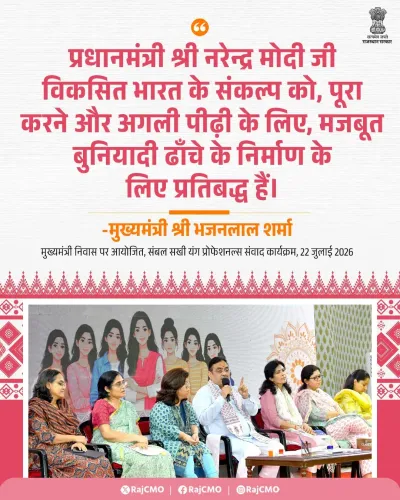
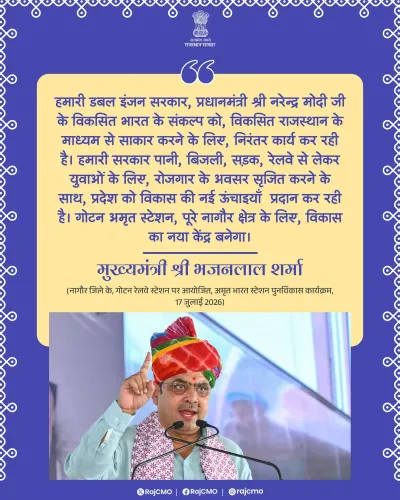
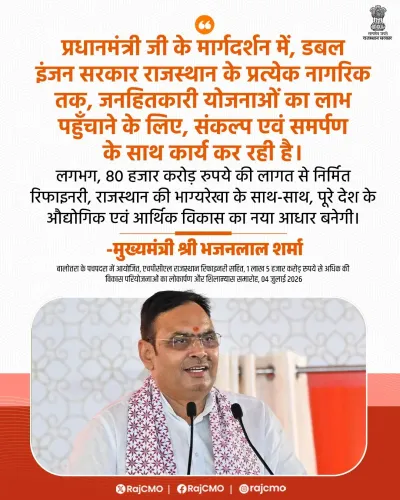
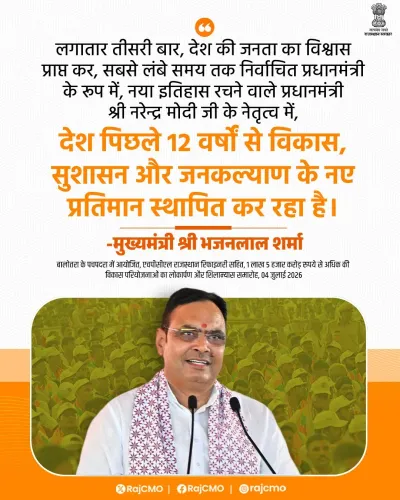
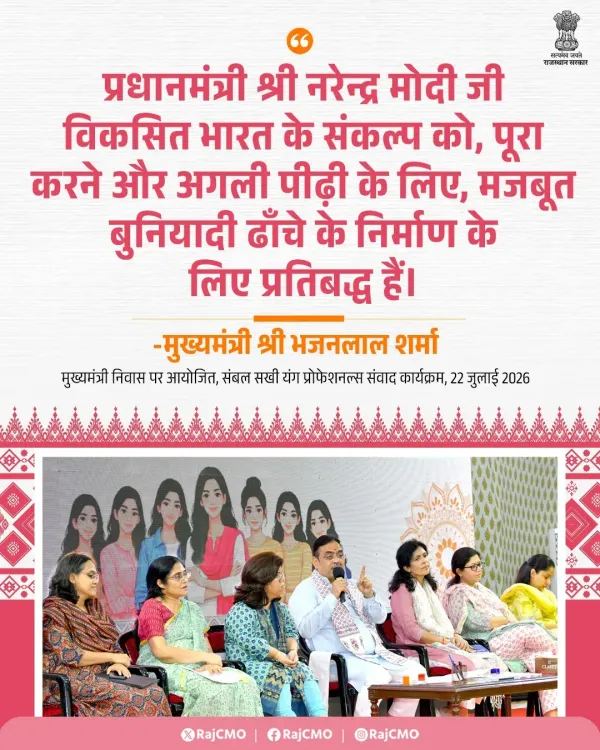
The Chief Minister's Office of Rajasthan on Thursday, 23 July 2026 reaffirmed the state government's alignment with Prime Minister Narendra Modi's infrastructure-first agenda, invoking the Viksit Bharat vision as the guiding framework for next-generation development in Rajasthan.
Context
The post, attributed to the Rajasthan CMO and tagging Chief Minister Bhajanlal Sharma (@BhajanlalBjp), states that Prime Minister Modi is 'committed to fulfilling the resolve of Viksit Bharat and building strong infrastructure for the next generation.' The hashtag #आपणो_अग्रणी_राजस्थान — translating broadly to 'Our Leading Rajasthan' — signals a state-level branding effort tied to national development priorities.
The message reflects a pattern of routine alignment communications by state BJP governments with the central government's long-term policy narrative, particularly ahead of budget cycles and investment summits.
Policy Backdrop
The Viksit Bharat initiative is the Government of India's overarching roadmap to achieve developed-nation status by 2047, the centenary of independence. Infrastructure — spanning roads, railways, ports, and urban systems — is a core pillar of this vision.
The foundation was laid with the National Infrastructure Pipeline, announced in 2019, which envisaged investments of over Rs 111 lakh crore across sectors by 2025. This was followed by the PM Gati Shakti National Master Plan, launched in 2021, which integrates planning across ministries to enable multimodal connectivity and improve logistics efficiency.
Rajasthan, India's largest state by area, has seen accelerated central approvals in highways, railways, and renewable energy infrastructure under these frameworks since 2014. The state's geographic scale makes it a significant node in national connectivity corridors.
Stakeholders and Impact
Rajasthan's residents — particularly its youth — stand as the primary intended beneficiaries of the infrastructure commitments invoked in the post. Stronger road, rail, and energy networks directly affect employment generation, logistics costs, and industrial investment in the state.
Private investors and industrial groups tracking Rajasthan's business environment will read such messaging as a signal of policy continuity between the state and central governments. The explicit mention of 'the next generation' frames infrastructure spending as a long-horizon commitment rather than a near-term electoral promise.
What's Next
Attention will now turn to Rajasthan's share in upcoming Union Budget infrastructure allocations and the pace of project execution under schemes such as PM Gati Shakti and the Bharatmala highway programme. Progress on state-specific corridors and renewable energy targets will be the practical test of the commitments signalled here.
As the Viksit Bharat 2047 deadline draws closer on the policy calendar, communications such as this one are likely to intensify, with state governments competing to demonstrate delivery on central priorities.
Point of View
Shifting the conversation from immediate deliverables to a long-arc vision that is harder to hold accountable in the short term. Analysts will watch whether this messaging is followed by concrete project announcements or investment commitments in Rajasthan.
NationPress
23 Jul 2026
Frequently Asked Questions
What is Viksit Bharat and how does it relate to Rajasthan?
Viksit Bharat is the Government of India's initiative to achieve developed-nation status by 2047. Rajasthan, as India's largest state, is a key participant in the infrastructure corridors and schemes that form the backbone of this vision.
What did the Rajasthan CMO post about PM Modi on 23 July 2026?
The Rajasthan CMO posted that PM Narendra Modi is committed to fulfilling the Viksit Bharat resolve and building strong infrastructure for the next generation, tagging Chief Minister Bhajanlal Sharma.
What is the National Infrastructure Pipeline announced in 2019?
The National Infrastructure Pipeline is a Government of India programme announced in 2019 to invest over Rs 111 lakh crore in roads, railways, ports, and urban infrastructure by 2025.
What is PM Gati Shakti and does it cover Rajasthan?
PM Gati Shakti is a National Master Plan launched in 2021 to integrate infrastructure planning across central ministries for multimodal connectivity. Rajasthan is included in its logistics and connectivity framework.
Who is Bhajanlal Sharma and what is his role in Rajasthan's infrastructure push?
Bhajanlal Sharma is the Chief Minister of Rajasthan since late 2023, representing the BJP. He oversees state-level implementation of central infrastructure and development schemes under the Viksit Bharat framework.