CM Bhajanlal Govt Strengthens Jaipur Infrastructure
Synopsis
The Chief Minister's Office of Rajasthan declared on June 25, 2026, that the Bhajanlal Sharma government is strengthening foundational infrastructure in Jaipur to better the lives of ordinary citizens, continuing the BJP administration's urban renewal push since December 2023.
Key Takeaways
The Rajasthan CMO posted on June 25, 2026 , that the state government is strengthening foundational infrastructure in Jaipur .
Chief Minister Bhajanlal Sharma was tagged in the post, underlining his personal ownership of the infrastructure agenda.
The hashtag #आपणो_अग्रणी_राजस्थान ('Our Leading Rajasthan') frames the initiative as part of a broader state branding effort.
The BJP government identified urban infrastructure renewal in Jaipur as a priority from its first budget after winning the December 2023 assembly elections.
Key stakeholders include Jaipur's residents and urban local bodies overseeing civic amenities across the city.
The next state budget and assembly sessions are expected to bring concrete project milestones and scrutiny of implementation timelines.
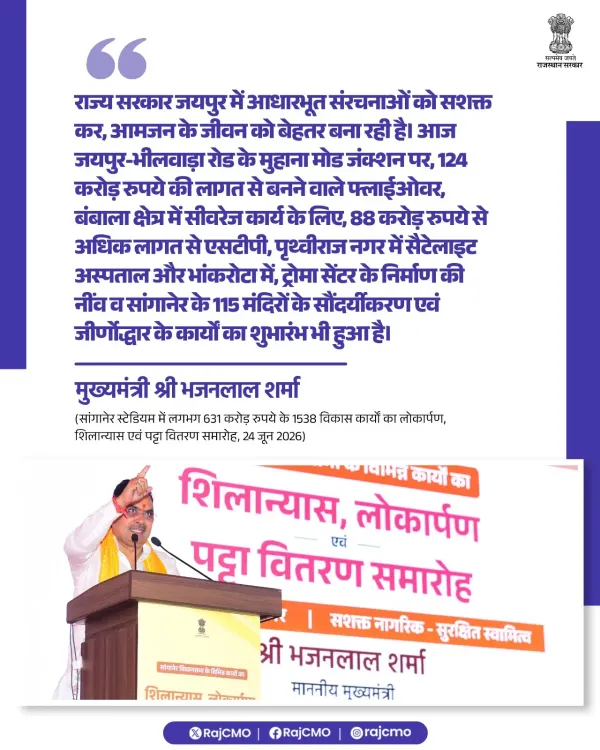
The Chief Minister's Office of Rajasthan on Thursday, June 25, 2026, stated that the state government is strengthening foundational infrastructure in Jaipur to improve the everyday lives of ordinary citizens, tagging Chief Minister Bhajanlal Sharma in the post under the hashtag #आपणो_अग्रणी_राजस्थान ('Our Leading Rajasthan').
Context
The post, shared on the official CMO handle, states: 'राज्य सरकार जयपुर में आधारभूत संरचनाओं को सशक्त कर, आमजन के जीवन को बेहतर बना रही है' — translated as 'The state government is empowering foundational infrastructure in Jaipur and improving the lives of the common people.' The message positions urban infrastructure as a direct lever for public welfare, a framing the Bhajanlal Sharma administration has consistently used since taking office.
Jaipur, the capital and largest city of Rajasthan, has been a focal point of the current government's urban renewal push, encompassing roads, drainage systems, and public amenities across the city.
Policy Backdrop
The BJP-led Rajasthan government, which came to power in December 2023 after winning the state assembly elections, identified urban infrastructure renewal in Jaipur as an immediate priority in its first budget and early policy statements. Chief Minister Bhajanlal Sharma has repeatedly linked capital expenditure on physical works to the administration's broader promise of improving quality of life for residents.
This approach mirrors a wider pattern seen across Indian states since the mid-2010s, where higher capital allocations for city infrastructure — supported by both central and state schemes — have become a standard plank of governance messaging. The hashtag #आपणो_अग्रणी_राजस्थान ('Our Leading Rajasthan') signals the government's intent to brand the state as a front-runner in development.
Stakeholders and Impact
The primary beneficiaries of Jaipur's infrastructure upgrades are the city's residents and urban local bodies responsible for maintaining civic amenities. Improved roads, drainage, and public infrastructure directly affect daily commutes, flood resilience, and access to services for Jaipur's population of over 30 lakh people.
Urban local bodies stand to gain administrative capacity as infrastructure projects modernise the city's underlying systems, reducing maintenance burdens and enabling more efficient service delivery over time.
What's Next
Observers will watch for the release of the next state budget and any Jaipur-specific project milestones that put concrete numbers and timelines to the government's infrastructure commitments. Assembly sessions are also expected to surface questions on implementation progress and fund utilisation.
As the Sharma government approaches the midpoint of its term, the pace and visibility of urban infrastructure delivery in Jaipur will be a key measure by which voters and opposition alike assess the administration's governance record.
Point of View
The Bhajanlal Sharma administration reinforces its core electoral promise ahead of the midterm stretch. Tagging the Chief Minister directly ensures the political credit flows upward, a deliberate move in a state where BJP must demonstrate tangible delivery to sustain its 2023 mandate. The 'Our Leading Rajasthan' hashtag signals an attempt to build a durable development brand, much as other BJP-governed states have done with similar slogans. The real test will come when project completion data and budget utilisation figures are placed before the assembly.
NationPress
25 Jun 2026
Frequently Asked Questions
What infrastructure work is the Rajasthan government doing in Jaipur?
The Rajasthan government, led by Chief Minister Bhajanlal Sharma, has stated it is strengthening foundational infrastructure in Jaipur — including roads, drainage, and public amenities — to improve the daily lives of residents, as communicated by the CMO on June 25, 2026.
Who is the Chief Minister of Rajasthan in 2026?
Bhajanlal Sharma of the BJP is the Chief Minister of Rajasthan, having taken office in December 2023 after the party's victory in the state assembly elections.
What does 'Aapno Agrani Rajasthan' mean?
'Aapno Agrani Rajasthan' (आपणो अग्रणी राजस्थान) is a Rajasthani-Hindi phrase meaning 'Our Leading Rajasthan,' used by the Bhajanlal Sharma government as a branding hashtag for its development and governance initiatives.
When did the Bhajanlal Sharma government start its Jaipur infrastructure push?
The Bhajanlal Sharma government identified urban infrastructure renewal in Jaipur as a priority from its first budget and policy statements after assuming office in December 2023.
What is the Rajasthan CMO Twitter or X account?
The official Chief Minister's Office of Rajasthan posts on X (formerly Twitter) at the handle @RajCMO, where government announcements including infrastructure updates are shared regularly.