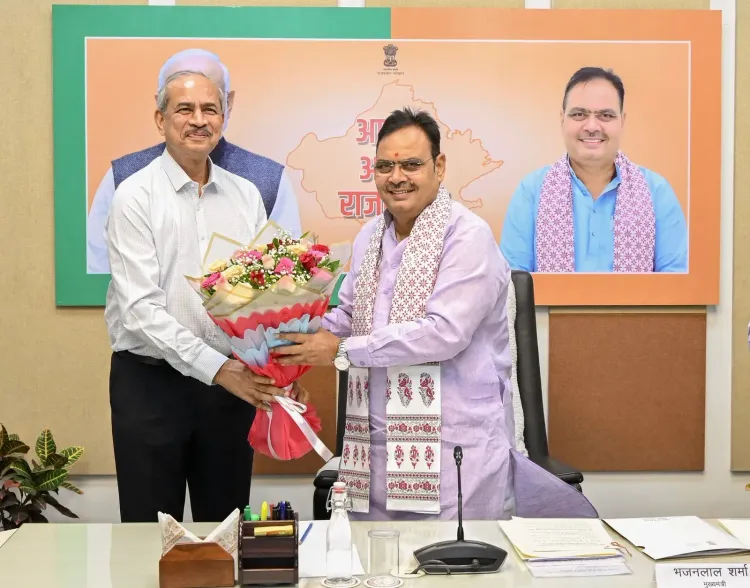
CM Bhajanlal chairs district GDP meet with NITI Aayog member
Synopsis
Chief Minister Bhajanlal Sharma chaired a meeting on district domestic product estimation with NITI Aayog member Prof. K. V. Raju at the Chief Minister's Residence in Jaipur on 22 June 2026, reaffirming Rajasthan's commitment to a district-based development model under the Viksit Bharat 2047 vision.
Key Takeaways
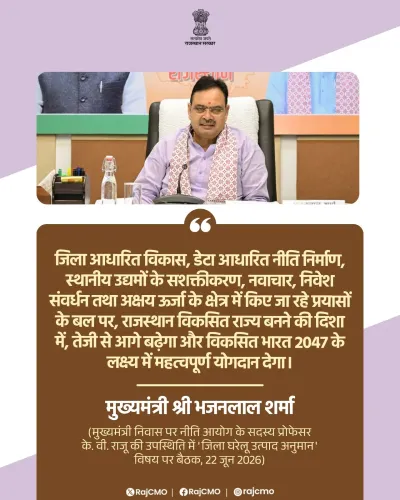
CM Bhajanlal Sharma chaired a meeting on 'District Domestic Product Estimation' at the Chief Minister's Residence in Jaipur on 22 June 2026 .
NITI Aayog member Professor K.
Raju was present at the meeting, signalling central government engagement with Rajasthan's planning exercise.
The Chief Minister stated that Rajasthan is playing a 'leading role' in realising the Viksit Bharat 2047 national development vision.
The state government is prioritising a district-based development model that centres each district's unique identity, local resources, and economic potential.
The exercise builds on NITI Aayog's Aspirational Districts Programme (launched 2018 ) and the broader push for data-driven, bottom-up policy making across Indian states.
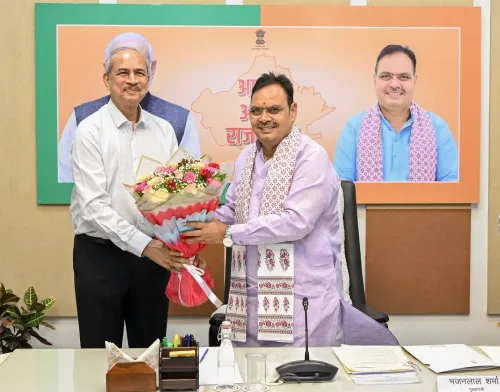
The Chief Minister's Office of Rajasthan announced on Monday, 22 June 2026 that Chief Minister Bhajanlal Sharma chaired a meeting on 'District Domestic Product Estimation' at the Chief Minister's Residence in Jaipur, held in the presence of NITI Aayog member Professor K. V. Raju.
Context
Addressing the gathering, CM Sharma stated that Rajasthan is playing a 'leading role' (अग्रणी भूमिका) in realising the resolve of Viksit Bharat 2047 — the national vision for India to become a developed nation by the centenary of its independence. He said the state government is working in a 'planned manner' (योजनाबद्ध तरीके से) by prioritising a district-based development model.
The Chief Minister added that a new conception of development is being built by placing each district's 'unique identity, local resources, and economic potential' (विशिष्ट पहचान, स्थानीय संसाधनों और आर्थिक संभावनाओं) at the centre, with the aim of taking the state's economy to 'new heights' (नई ऊँचाइयों).
Policy Backdrop
NITI Aayog, established in 2015 to replace the Planning Commission, has championed data-driven, bottom-up policy making since its inception. Its Aspirational Districts Programme, launched in 2018, introduced real-time monitoring of targeted development in backward districts — laying the intellectual groundwork for district-level GDP estimation exercises now being taken up by states.
Prime Minister Narendra Modi formally articulated the Viksit Bharat @2047 vision in 2023, calling on states to align their planning frameworks with national development goals. Rajasthan's focus on district-level economic data is part of a broader pattern of Indian states adopting granular, resource-based planning to reduce intra-state regional disparities.
Stakeholders and Impact
District administrations across Rajasthan's 50 districts stand to be directly affected, as the district GDP estimation framework is expected to inform resource allocation, infrastructure prioritisation, and scheme targeting at the local level. Regional industries — particularly those anchored in Rajasthan's diverse economic base spanning mining, tourism, textiles, and agriculture — could benefit from planning that accounts for each district's specific economic profile.
The participation of Professor K. V. Raju of NITI Aayog signals central government engagement with the state's methodology, which could facilitate smoother integration of Rajasthan's district data into national planning documents and fund-flow mechanisms.
What's Next
Observers will watch for the formal release of Rajasthan's district domestic product estimates and their incorporation into the state's planning and budgetary documents. Follow-up coordination meetings between the state government and NITI Aayog on implementation milestones are expected. The outcome of this exercise could serve as a reference model for other large states seeking to build district-level economic accounts aligned with the Viksit Bharat 2047 framework.
Point of View
A pattern increasingly visible across BJP-governed states seeking to demonstrate policy coherence with New Delhi. The presence of a NITI Aayog member at a state-level meeting is notable — it suggests the exercise is being treated as more than routine bookkeeping, potentially positioning Rajasthan as a pilot for district-level national accounts methodology. For CM Bhajanlal Sharma, who took office in December 2023, the initiative also serves a political function: projecting technocratic governance credentials ahead of a full budget cycle. The real test will be whether the district GDP data, once released, translates into measurable shifts in resource allocation rather than remaining a planning document.
NationPress
21 Sept 2026
Frequently Asked Questions
What is the district domestic product estimation meeting in Rajasthan about?
It is a meeting chaired by Chief Minister Bhajanlal Sharma to develop district-level GDP estimates for Rajasthan, aimed at identifying each district's economic potential and guiding resource allocation under a district-based development model.
Who is Professor K. V. Raju and why was he at the Rajasthan CM's meeting?
Professor K. V. Raju is a member of NITI Aayog, the Government of India's policy think tank. He attended the meeting to support Rajasthan's district domestic product estimation exercise, reflecting central government engagement with the state's planning initiative.
What is Viksit Bharat 2047 and how does Rajasthan fit in?
Viksit Bharat 2047 is Prime Minister Narendra Modi's national vision for India to become a developed country by the centenary of its independence in 2047. Rajasthan is aligning its district-based development model with this framework, as stated by CM Bhajanlal Sharma at the 22 June 2026 meeting.
What is NITI Aayog's Aspirational Districts Programme?
Launched in 2018, the Aspirational Districts Programme is a NITI Aayog initiative that uses real-time data monitoring to drive targeted development in backward districts across India. It laid the groundwork for district-level economic planning exercises like the one Rajasthan is now undertaking.
What will happen after Rajasthan's district GDP estimates are prepared?
The estimates are expected to be integrated into the state's planning and budgetary documents, informing infrastructure prioritisation and scheme targeting at the district level. Follow-up coordination with NITI Aayog on implementation milestones is also anticipated.