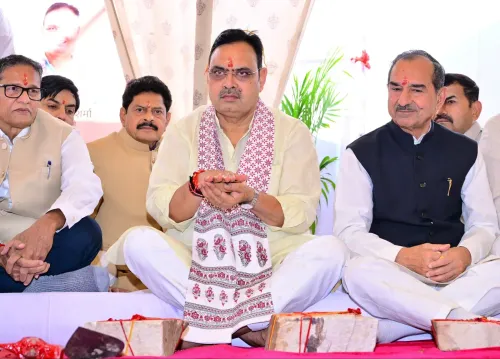
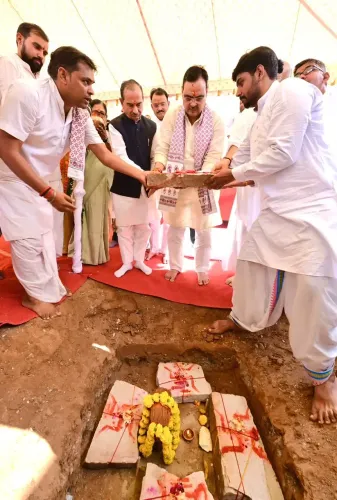
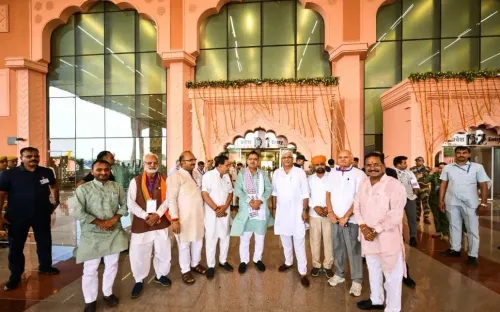
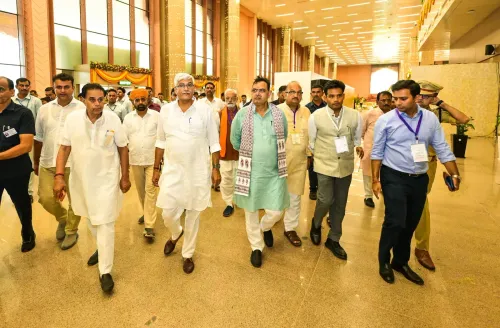
CM Bhajanlal Sharma at Jaipur Airport New State Terminal Bhoomi Pujan
Synopsis
Chief Minister Bhajanlal Sharma attended the ground-breaking ceremony for Jaipur Airport's new State Terminal Building on 12 November 2026, using the occasion to highlight rail connectivity expansion and modernisation across Rajasthan under Prime Minister Narendra Modi's leadership.
Key Takeaways
CM Bhajanlal Sharma addressed the bhoomi pujan of Jaipur Airport's new State Terminal Building on 12 November 2026 .
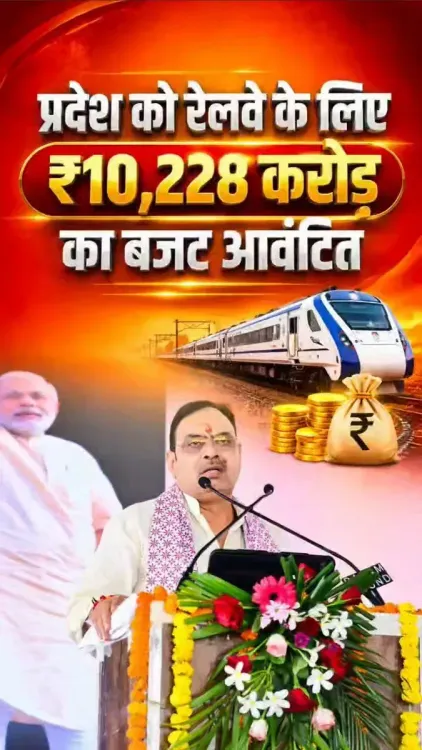
The CM stated that 'many important works are being carried out in Rajasthan for the expansion of rail connectivity and modernisation of railway facilities' under PM Modi .
The new terminal is intended to significantly expand passenger handling capacity at Jaipur Airport , Rajasthan's principal air hub.
The UDAN regional connectivity scheme (launched 2016 ) has supported airport development across Rajasthan alongside successive central railway investments.
The ceremony reflects the broader pattern of coordinated centre-state infrastructure delivery since CM Sharma took office in December 2023 .
A ceremonial spade in the ground at Jaipur Airport on Thursday, 12 November 2026 marked the beginning of a new chapter for Rajasthan's gateway to the skies — and Chief Minister Bhajanlal Sharma used the occasion to frame it squarely within a larger national infrastructure ambition. Speaking at the bhoomi pujan (ground-breaking ceremony) for the airport's new State Terminal Building, the Chief Minister tied the event to an ongoing expansion of railway connectivity across the state under Prime Minister Narendra Modi.
What CM Sharma said at the terminal ground-breaking
Addressing the gathering, CM Sharma stated that 'under the leadership of Prime Minister Narendra Modi, many important works are being carried out in Rajasthan for the expansion of rail connectivity and modernisation of railway facilities.' The remarks, shared by the Chief Minister's Office of Rajasthan on X, signal a deliberate effort to link a high-visibility aviation milestone with the broader connectivity agenda being executed in coordination with the Centre.
The new State Terminal Building at Jaipur Airport — the capital's principal air hub and a key gateway for both business and tourism traffic — is intended to significantly augment passenger handling capacity. The bhoomi pujan ritual formally inaugurated the construction phase, lending the project both official sanction and political visibility ahead of the work ahead.
Rail and air — Rajasthan's twin connectivity push
The Chief Minister's decision to invoke railways at an airport ceremony is not incidental. It reflects a pattern of coordinated centre-state infrastructure delivery in Rajasthan, where aviation upgrades and rail modernisation are being pursued in parallel as pillars of a multimodal connectivity drive. The UDAN regional connectivity scheme, launched in 2016, has supported airport development across the state, while successive Union Budgets since 2014 have cleared rail projects including track doubling and electrification across Rajasthan's network.
Indian Railways, as the national operator, has been the executing arm for rail expansion in the state. For Rajasthan — a state whose economic engine is substantially driven by tourism, mining, and agricultural trade — improved rail and air links are not peripheral amenities but structural economic inputs. Faster, more reliable connections between Rajasthan's cities and the national rail grid directly reduce logistics costs and open up interior districts to visitor traffic.
The bigger picture: Modi's infrastructure imprint on Rajasthan
Since CM Bhajanlal Sharma took charge in December 2023, the state government has aligned closely with the Centre's infrastructure priorities, presenting joint projects as the dividend of a BJP government in both Jaipur and New Delhi. The airport terminal ceremony fits that political-administrative logic: a visible, bricks-and-mortar deliverable that the ruling dispensation can point to as proof of a working partnership between state and central governments.
The specific timelines, costs, and the rail works referenced in the CM's address are yet to be detailed publicly — but the ceremony itself plants a marker. Rajasthan's infrastructure calendar now has a concrete new entry, and both aviation passengers and rail commuters will be watching how fast the promises convert into passenger gates and electrified tracks.
The ground has been broken. Now comes the harder part — building it on time.
Point of View
Still in his third year in office, associating visible projects with PM Modi's brand equity is a proven electoral and administrative strategy in a state historically swayed by infrastructure delivery. The deliberate mention of railways at an aviation event signals that the state is positioning multimodal connectivity — not just individual projects — as the defining infrastructure story of the current term. How quickly the terminal construction progresses and how clearly the railway announcements are specified will determine whether this bhoomi pujan moment translates into durable political capital.
NationPress
12 Nov 2026
Frequently Asked Questions
What is the new State Terminal Building at Jaipur Airport?
It is a new terminal building being constructed at Jaipur Airport to expand the airport's passenger handling capacity. Its ground-breaking ceremony ( bhoomi pujan ) was held on 12 November 2026 , addressed by Chief Minister Bhajanlal Sharma.
What did CM Bhajanlal Sharma say at the Jaipur Airport bhoomi pujan?
CM Sharma said that under PM Narendra Modi's leadership, many important works are being carried out in Rajasthan for the expansion of rail connectivity and modernisation of railway facilities.
What is the UDAN scheme and how does it relate to Jaipur Airport?
The UDAN (Ude Desh ka Aam Naagrik) regional connectivity scheme, launched in 2016 , has supported airport development across Rajasthan, including infrastructure upgrades at Jaipur Airport.
What rail projects are being developed in Rajasthan under the central government?
The central government has approved rail projects in Rajasthan including track doubling and electrification across the network, funded through successive Union Budgets since 2014 and executed by Indian Railways .
When did Bhajanlal Sharma become Chief Minister of Rajasthan?
Bhajanlal Sharma became Chief Minister of Rajasthan in December 2023 , representing the BJP .