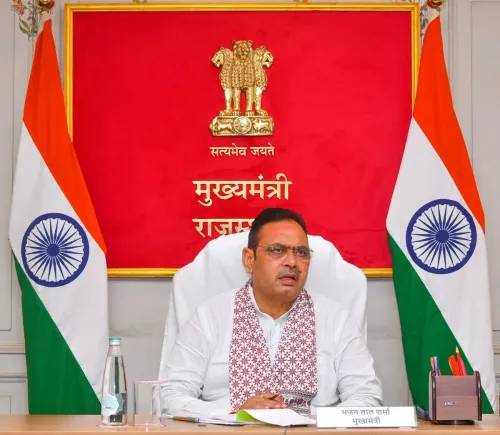
CM Bhajanlal Approves Permanent Lok Adalats in 8 Rajasthan Districts
Synopsis
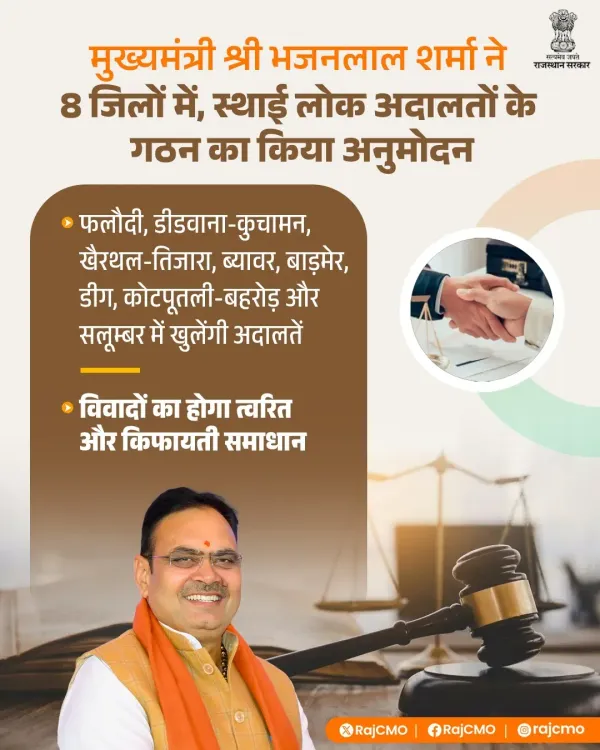
Chief Minister Bhajanlal Sharma has approved Permanent Lok Adalats in eight Rajasthan districts — including several newly created ones — extending statutory, cost-free dispute resolution to litigants in Phalodi, Barmer, Kotputli-Behror, and five others.
Key Takeaways
Eight districts — Phalodi, Didwana-Kuchaman, Khairthal-Tijara, Beawar, Barmer, Deeg, Kotputli-Behror, and Salumber — will get Permanent Lok Adalats.
Several of the listed districts are newly created post-2023 districts receiving judicial infrastructure for the first time.
Permanent Lok Adalats operate under the Legal Services Authorities Act, 1987 and deliver consensual, decree-equivalent settlements that cannot be appealed.
The forums are cost-free and faster than regular courts, directly benefiting rural and semi-urban litigants.
The move is part of Rajasthan's broader effort to staff new districts with full state institutional presence.
Formal gazette notification and first sittings of the new benches remain the next milestones to watch.
Eight districts of Rajasthan — several of them newly carved out of older administrative units — are set to get their own Permanent Lok Adalats, after Chief Minister Bhajanlal Sharma approved the formation of these statutory dispute-resolution bodies. The decision, announced by the Chief Minister's Office of Rajasthan on 30 July 2026, extends a key pillar of India's alternative-justice architecture to corners of the state where litigants have long had to travel to distant courts.
The Eight Districts Getting Permanent Lok Adalats
The districts named in the approval are Phalodi, Didwana-Kuchaman, Khairthal-Tijara, Beawar, Barmer, Deeg, Kotputli-Behror, and Salumber. Several of these — Phalodi, Didwana-Kuchaman, Khairthal-Tijara, Deeg, Kotputli-Behror, and Salumber — are among the new districts created by the Rajasthan government after 2023, meaning they are receiving permanent judicial infrastructure for the first time. Barmer, bordering Pakistan in the state's far west, is among the older, more populous districts now formally brought into the Permanent Lok Adalat network.
What a Permanent Lok Adalat Actually Does
Permanent Lok Adalats are statutory bodies established under the Legal Services Authorities Act, 1987. Unlike regular courts, they operate on the principle of consensual settlement — parties reach a mutually agreed decision, which then carries the force of a court decree and cannot be appealed. The CMO noted that these forums offer 'त्वरित और किफायती समाधान' (swift and affordable resolution), saving litigants both time and money. For rural and semi-urban populations in these districts, that is not an abstraction — it means avoiding years of pendency and the cost of repeated court appearances in far-off district headquarters.
Rajasthan's Wider Push to Staff New Districts With State Institutions
The approval fits a clear administrative pattern: since Rajasthan created a fresh wave of new districts, the state has been systematically extending government institutions — from revenue offices to now judicial bodies — to those new district headquarters. Case pendency is a national crisis, and Permanent Lok Adalats have emerged as a front-line tool in India's alternative dispute resolution strategy. Getting them operational in these eight districts will be the next milestone to watch — specifically, the formal gazette notification and the date of first sittings.
For millions of litigants in western, northern, and southern Rajasthan, the real test of this approval will be how quickly the benches are constituted and how many disputes they clear in their first year. The infrastructure is approved. Now it has to work.
Point of View
Slower work of institutional delivery. Access to justice at the local level is a credibility test for new districts: without courts, revenue offices, and dispute-resolution bodies, a new district is little more than a renamed headquarters. By anchoring these bodies in the Legal Services Authorities Act framework, the state also aligns itself with the Supreme Court's long-running push to reduce case pendency through alternative dispute resolution. The real political dividend — and the real accountability test — will come when the first benches sit and the first settlements are recorded.
NationPress
14 Sept 2026
Frequently Asked Questions
What is a Permanent Lok Adalat?
A Permanent Lok Adalat is a statutory dispute-resolution body under the Legal Services Authorities Act, 1987. It helps parties reach a mutually agreed settlement, which carries the force of a court decree and cannot be challenged in appeal — making it faster and cheaper than regular litigation.
Which 8 districts in Rajasthan are getting Permanent Lok Adalats?
Chief Minister Bhajanlal Sharma approved Permanent Lok Adalats for Phalodi, Didwana-Kuchaman, Khairthal-Tijara, Beawar, Barmer, Deeg, Kotputli-Behror, and Salumber.
Are these newly created districts in Rajasthan?
Several of them — including Phalodi, Didwana-Kuchaman, Khairthal-Tijara, Deeg, Kotputli-Behror, and Salumber — are among the new districts created by the Rajasthan government after 2023. Barmer and Beawar are older, established districts.
Is Lok Adalat free of cost for litigants?
Yes. Lok Adalats do not charge court fees and the process is designed to be cost-free for the parties involved, which is a major advantage for rural and lower-income litigants.
When will the new Permanent Lok Adalats in Rajasthan become operational?
The Chief Minister has approved their formation, but the exact operational date depends on formal gazette notification and constitution of benches, which had not been announced as of the CMO's post on 30 July 2026.