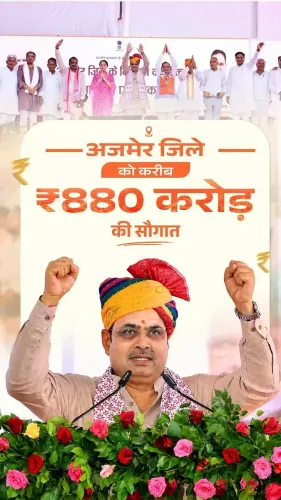
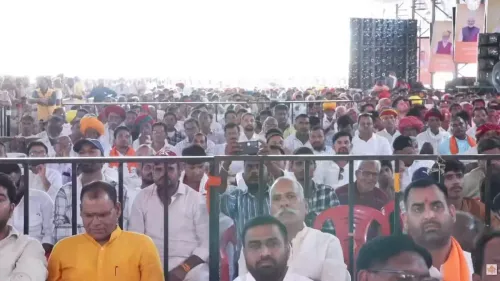
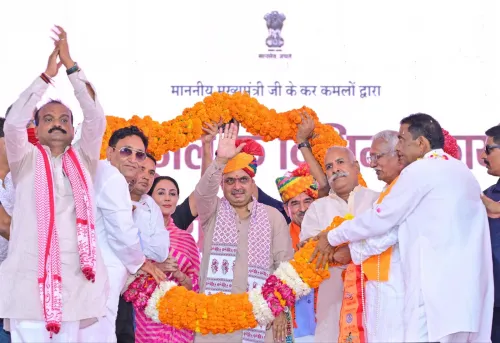
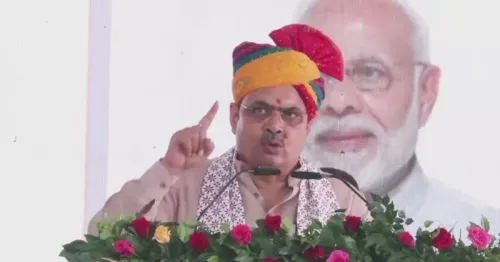
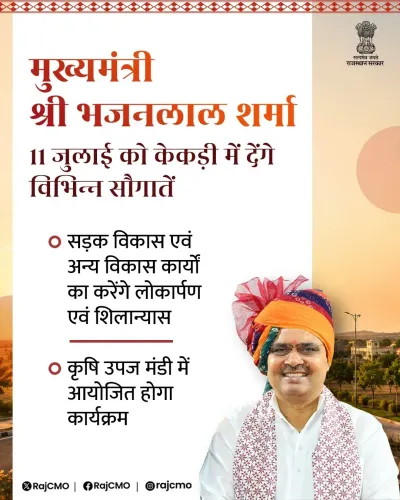
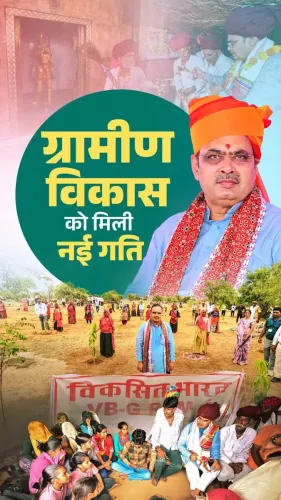
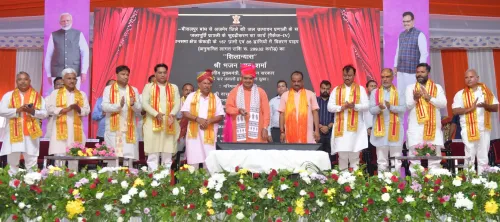
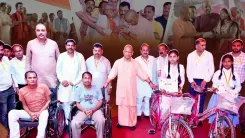
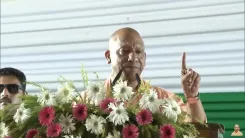
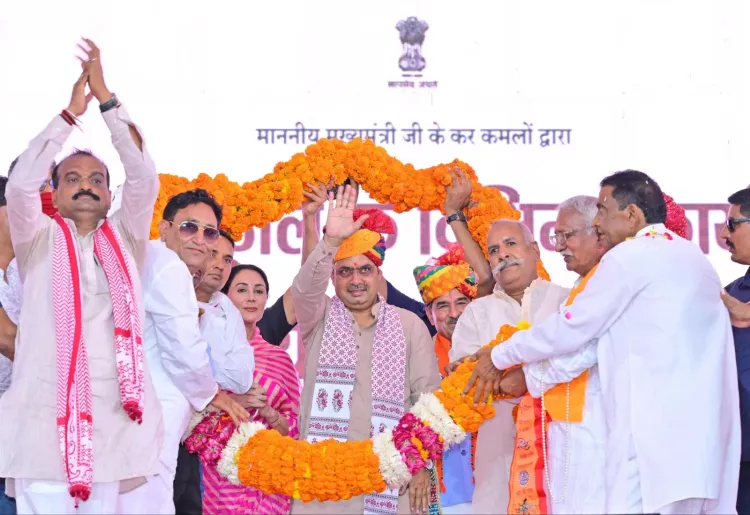
CM Bhajanlal Sharma addresses development event in Kekri, Ajmer
Synopsis
Chief Minister Bhajanlal Sharma addressed a dedication and foundation-stone laying ceremony in Kekri, Ajmer on 11 July 2026, spotlighting Rajasthan's road network expansion, PMGSY works, and major water projects as part of the Viksit Bharat–Viksit Rajasthan vision.
Key Takeaways
CM Bhajanlal Sharma addressed a lokarpaṇ evam shilānyas samāroh (dedication and foundation-stone laying ceremony) at Kekri, Ajmer on 11 July 2026 .
The Chief Minister highlighted development in six sectors: roads, water, electricity, education, health, and employment .
Progress under the Pradhan Mantri Gram Sadak Yojana (PMGSY) — a central rural roads scheme launched in 2000 — was specifically cited.
Updates on major water projects in Rajasthan were shared, relevant to the state's water-scarce geography.
The event was framed under the Viksit Bharat–Viksit Rajasthan vision, targeting a developed state by 2047 .
Primary beneficiaries are rural residents and farmers in Ajmer district and surrounding areas.
The Chief Minister's Office of Rajasthan announced on Saturday, 11 July 2026 that Chief Minister Bhajanlal Sharma addressed a dedication and foundation-stone laying ceremony (lokarpaṇ evam shilānyas samāroh) held at Kekri in Ajmer district, underscoring the state government's push to translate the 'Viksit Bharat–Viksit Rajasthan' vision into ground-level development across roads, water, electricity, education, health, and employment.
Context
At the Kekri event, CM Bhajanlal Sharma highlighted ongoing development works in six key sectors — roads, water, electricity, education, health, and employment — framing them as essential steps toward the national goal of a developed India by 2047. The Chief Minister also shared updates on the expansion of the state's road network, construction of new roads, progress under the Pradhan Mantri Gram Sadak Yojana (PMGSY), and the status of major water projects in Rajasthan.
The ceremony, held under the hashtag #आपणो_अग्रणी_राजस्थान ('Our Leading Rajasthan'), combined the inauguration of completed projects with the laying of foundation stones for new ones — a format commonly used by state governments to signal both delivery and pipeline simultaneously.
Policy Backdrop
The Pradhan Mantri Gram Sadak Yojana, launched in 2000, is a centrally sponsored scheme designed to provide all-weather road connectivity to previously unconnected rural habitations. Rajasthan, with its vast geography and dispersed population, has historically been one of the larger beneficiaries of the programme. Progress on PMGSY works in the state is periodically reviewed at both the state and central levels.
On the water front, the Jal Jeevan Mission, launched nationally in 2019, aims to deliver piped drinking water to every rural household. Major water projects referenced by the Chief Minister are likely to intersect with this mission's targets. The BJP-led administration that took office in December 2023 has consistently positioned infrastructure delivery as a centrepiece of its governance agenda, aligning state schemes with the broader Viksit Bharat framework articulated by the Government of India.
Stakeholders and Impact
The primary beneficiaries of the road and water projects cited at Kekri are rural residents and farmers in Ajmer district and surrounding areas. All-weather road connectivity directly affects agricultural supply chains, access to markets, schools, and health facilities — making PMGSY-linked works especially consequential for remote villages in Rajasthan's semi-arid interior.
Water projects in a state that faces recurring drought conditions carry outsized significance. Improved water supply infrastructure reduces dependence on tankers and seasonal sources, with downstream benefits for household health and women's daily labour burden. The scale of impact depends on the specific projects inaugurated and their coverage, details of which are expected to emerge in subsequent government communications.
What's Next
The physical and financial progress of the road and water projects cited at the Kekri ceremony will be a key indicator of the administration's delivery record ahead of future electoral cycles. State budget documents and periodic review meetings are the primary forums where such progress is formally reported. Similar lokarpaṇ events are expected to continue as the government seeks to demonstrate momentum on the 'Viksit Rajasthan' agenda across districts.
Observers will watch whether the projects inaugurated and announced at Kekri translate into measurable improvements in rural connectivity and water access — metrics that will shape both public perception and policy assessments of the current administration's infrastructure push.
Point of View
The Rajasthan administration is aligning state-level optics with the national BJP narrative ahead of future electoral tests. The focus on PMGSY and water projects signals that rural connectivity and water security remain the administration's most politically salient infrastructure bets in a state where agricultural distress and water scarcity are persistent voter concerns. Progress on these projects, when independently verifiable, will be the real measure of whether the ceremony's promises translate into durable governance gains.
NationPress
11 Jul 2026
Frequently Asked Questions
What happened at Kekri in Ajmer on 11 July 2026?
Chief Minister Bhajanlal Sharma addressed a dedication and foundation-stone laying ceremony at Kekri in Ajmer district, where he highlighted development works in roads, water, electricity, education, health, and employment under the Viksit Bharat–Viksit Rajasthan vision.
What is the Pradhan Mantri Gram Sadak Yojana mentioned by CM Bhajanlal Sharma?
The Pradhan Mantri Gram Sadak Yojana (PMGSY) is a centrally sponsored scheme launched in 2000 to provide all-weather road connectivity to unconnected rural habitations. CM Bhajanlal Sharma cited progress on PMGSY works in Rajasthan at the Kekri event.
What is 'Viksit Bharat–Viksit Rajasthan'?
'Viksit Bharat' is the Government of India's vision for a developed nation by 2047. The Rajasthan government has adopted 'Viksit Bharat–Viksit Rajasthan' as a parallel state-level framework to align its development programmes with this national goal.
Who is Bhajanlal Sharma?
Bhajanlal Sharma is the Chief Minister of Rajasthan, in office since December 2023, representing the BJP. He has prioritised infrastructure delivery — roads, water, electricity — as a core part of his administration's agenda.
What water projects did CM Bhajanlal Sharma discuss at Kekri?
The Chief Minister shared updates on major water projects in Rajasthan at the Kekri ceremony. Specific project names were not detailed in the official post; further details are expected in subsequent government communications and budget review documents.