CM Bhajanlal flags rising role of urban local bodies in Rajasthan
Synopsis
Chief Minister Bhajan Lal Sharma's office has flagged the growing decisiveness of urban local bodies in Rajasthan, calling their role increasingly vital amid rapid urbanisation. The statement connects to a broader national debate on municipal capacity, constitutional devolution and the future of city governance in India.
Key Takeaways
The Chief Minister's Office of Rajasthan posted a statement by CM Bhajan Lal Sharma on 31 May 2026 emphasising the expanding role of urban local bodies.
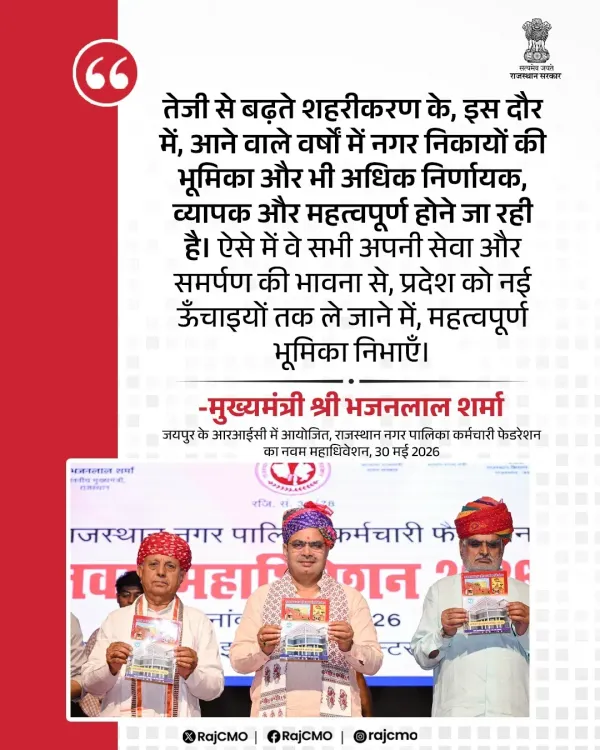
CM Bhajanlal stated that in an era of rapid urbanisation, nagar nikayas will become 'more decisive, wide-ranging and important' in coming years.
Urban local bodies in India derive constitutional status from the 74th Constitutional Amendment Act, 1992 , which mandated elections, devolution of functions and ward committees.
Rajasthan's growing cities face rising demand for water, sanitation, waste management and infrastructure, placing greater pressure on municipal bodies.
The statement was posted under the hashtag #आपणो_अग्रणी_राजस्थान ('Our Pioneering Rajasthan'), aligning it with the state's broader development branding.
Upcoming Rajasthan municipal elections and potential legislative changes to urban governance frameworks are key developments to watch.
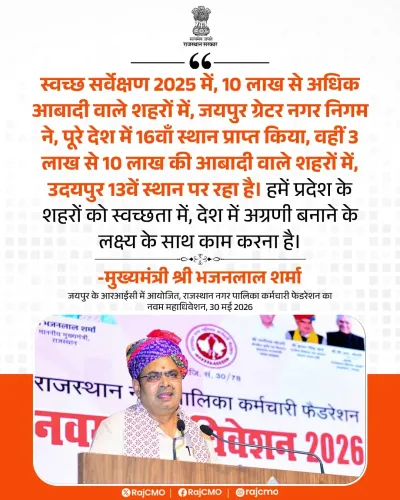
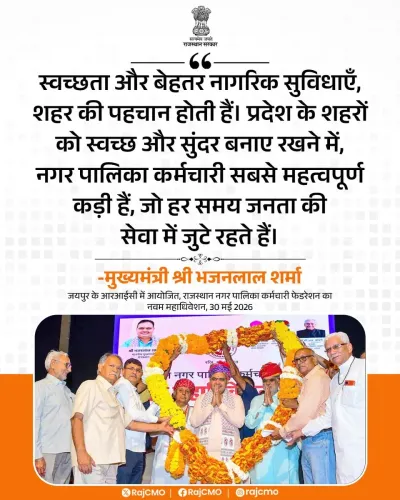
The Chief Minister's Office of Rajasthan on Sunday, 31 May 2026, shared a statement from Chief Minister Bhajan Lal Sharma underlining the growing importance of urban local bodies in the state as India's cities continue to expand rapidly.
Context
The post, shared under the hashtag #आपणो_अग्रणी_राजस्थान ('Our Pioneering Rajasthan'), carries a pointed observation from CM Bhajanlal Sharma: 'तेजी से बढ़ते शहरीकरण के इस दौर में, आने वाले वर्षों में नगर निकायों की भूमिका और भी अधिक निर्णायक, व्यापक और महत्वपूर्ण होने जा रही है' — 'In this era of rapidly growing urbanisation, the role of urban local bodies is going to become even more decisive, wide-ranging and important in the years to come.' The statement signals the state government's intent to position municipal governance at the centre of its administrative agenda.
Policy Backdrop
Urban local bodies — encompassing municipal corporations, municipal councils and nagar palikas — derive their constitutional mandate from the 74th Constitutional Amendment Act, 1992, which granted them formal status, mandated regular elections, and required devolution of civic functions to the ward level. Despite this framework, urban local bodies across India have historically struggled with thin finances, limited technical capacity and overlapping jurisdictions with state agencies.
Rajasthan, home to several fast-growing cities, has periodically sought to strengthen its nagar nikayas through state policy interventions. The broader national push — through centrally-sponsored schemes targeting urban infrastructure, water supply, sanitation and land-use planning — has reinforced the expectation that municipalities must graduate from passive service providers to active urban planners.
Stakeholders and Impact
The statement directly concerns urban residents across Rajasthan, who depend on municipal corporations and councils for drinking water, solid waste management, road maintenance and building permissions. As the state's urban population grows, demand for these services is rising faster than the administrative and financial capacity of most local bodies to deliver them.
For elected and appointed officials within the urban local body system, the Chief Minister's emphasis signals potential policy attention — and possibly legislative or financial measures — aimed at expanding the powers and resources available to municipalities. Civil society groups and urban planners have long argued that genuine devolution of funds, functions and functionaries is essential before local bodies can fulfil the role envisaged by the 74th Amendment.
What's Next
Rajasthan's municipal election cycle and any forthcoming state legislation on urban governance will be closely watched as indicators of whether this stated priority translates into concrete institutional change. Observers will look for budget allocations, amendments to the Rajasthan Municipalities Act, or new capacity-building programmes for urban local bodies as follow-through measures.
The Chief Minister's public articulation of this theme suggests urban governance is being positioned as a pillar of the state's development narrative — one that will likely feature prominently in policy announcements and electoral messaging in the period ahead.
Point of View
The BJP-led Rajasthan government is staking out an urban governance agenda at a time when municipal elections are on the horizon. The statement also implicitly acknowledges a structural gap: constitutional devolution under the 74th Amendment has remained incomplete in most states, and Rajasthan is no exception. Whether this rhetorical priority is backed by fiscal transfers and legislative teeth will determine its real-world impact.
NationPress
24 Sept 2026
Frequently Asked Questions
What did CM Bhajan Lal Sharma say about urban local bodies in Rajasthan?
CM Bhajan Lal Sharma stated that in an era of rapidly growing urbanisation, the role of urban local bodies will become even more decisive, wide-ranging and important in the years ahead.
What are urban local bodies in Rajasthan?
Urban local bodies in Rajasthan include municipal corporations, municipal councils and nagar palikas. They are responsible for civic services such as water supply, sanitation, solid waste management and local planning in cities and towns.
What is the 74th Constitutional Amendment and how does it relate to this?
The 74th Constitutional Amendment Act of 1992 gave constitutional status to urban local bodies across India, mandated regular elections, required devolution of civic functions and made provision for ward committees. It forms the legal foundation for the role CM Bhajanlal is highlighting.
When are the next Rajasthan municipal elections?
Rajasthan's municipal elections are expected in the coming years, though specific dates had not been officially announced at the time of this statement. The elections will be a key test of the government's urban governance agenda.
What does #AapnoAgraniRajasthan mean?
The hashtag #आपणो_अग्रणी_राजस्थान translates from Rajasthani as 'Our Pioneering Rajasthan' and is used by the state government to brand its development and governance initiatives.