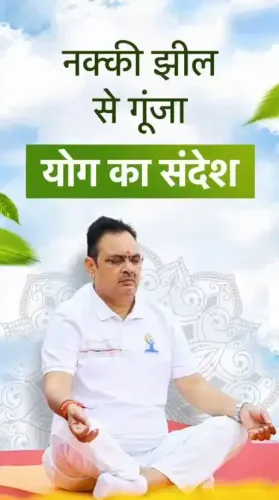
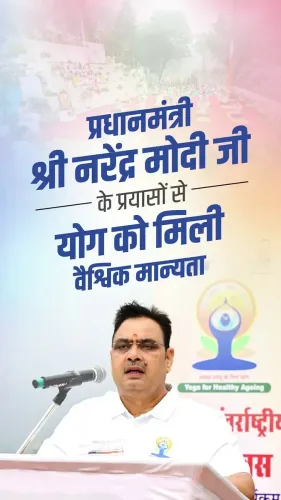
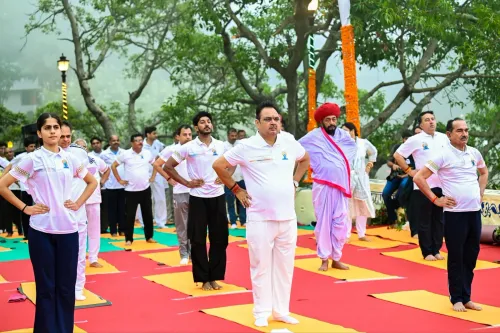
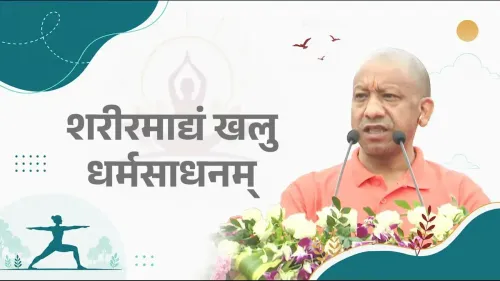
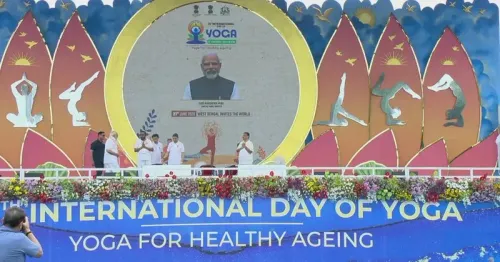
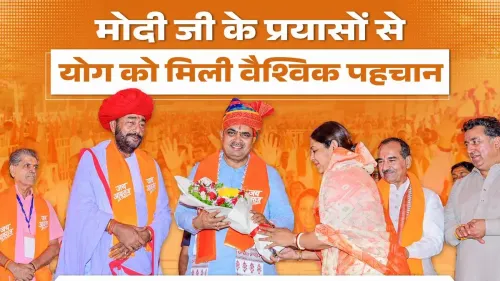
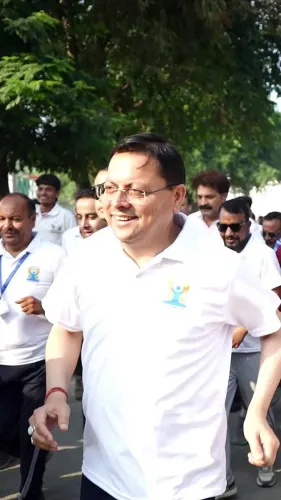
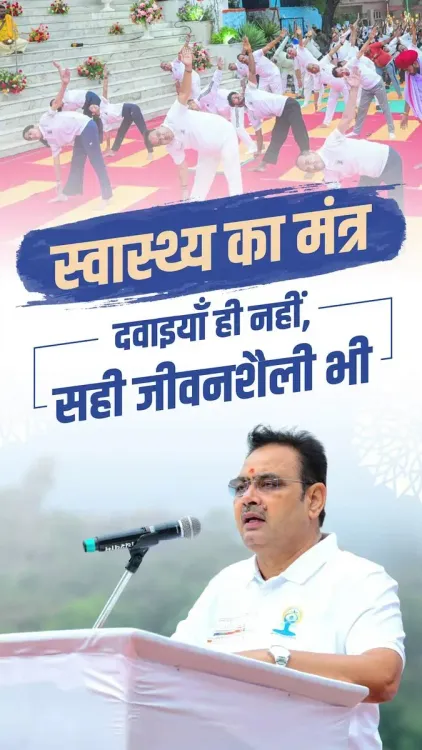
CM Bhajanlal addresses Yoga Day event at Nakki Lake, Sirohi
Synopsis
Chief Minister Bhajanlal Sharma addressed Rajasthan's International Yoga Day event at Nakki Lake in Sirohi on 21 June 2026, invoking the classical saying 'Pehla sukh nirogi kaya' to argue that yoga is the simplest and most effective path to good health, complementing rather than replacing modern medicine.
Key Takeaways
CM Bhajanlal Sharma addressed the International Yoga Day event at Nakki Lake, Sirohi on 21 June 2026 .
He stated that health can be achieved through the right lifestyle, not only through medicine.
He quoted the classical Indian proverb 'Pehla sukh nirogi kaya' — 'The first happiness is a healthy body.' He described yoga as 'the simplest, most natural, and most effective' means of attaining good health.
International Yoga Day was established by the UN General Assembly in December 2014 on India's initiative.
Rajasthan's event was held at Nakki Lake , the prominent freshwater lake in Mount Abu , Rajasthan's only hill station.
Chief Minister Bhajanlal Sharma addressed the International Yoga Day event held at Nakki Lake in Sirohi, Rajasthan, on 21 June 2026, emphasising that good health can be achieved not only through medicine but through the right way of living.
Speaking at the lakeside gathering, CM Sharma quoted the classical Indian saying 'Pehla sukh nirogi kaya' ('The first happiness is a healthy body'), and described yoga as 'the simplest, most natural, and most effective means' of attaining that health. He said yoga has proven that wellness is as much a product of lifestyle as it is of pharmaceutical intervention.
Context
International Yoga Day is observed every year on 21 June, a date designated by the United Nations General Assembly through Resolution 69/131 in December 2014, following a proposal by Prime Minister Narendra Modi. The day has since become one of the most widely observed UN observances, with mass yoga sessions held across India and in over 190 countries. Nakki Lake, a natural freshwater lake in Mount Abu, the only hill station in Rajasthan, provided a scenic backdrop for the state's flagship event this year.
Policy Backdrop
Since 2014, the Government of India has used Yoga Day to promote traditional wellness practices as a complement to modern public health systems, channelled primarily through the Ministry of AYUSH. State governments have followed suit, organising mass events that connect yoga to preventive health messaging drawn from classical texts. CM Sharma's invocation of the Sanskrit proverb 'Pehla sukh nirogi kaya' is consistent with this national pattern of anchoring lifestyle-health advocacy in India's textual heritage. Rajasthan, with its large rural and tribal population in districts such as Sirohi, has particular reason to promote low-cost, accessible wellness practices alongside formal healthcare infrastructure.
Stakeholders and Impact
The event at Nakki Lake brought together residents of Sirohi district, yoga practitioners, and government officials for a public demonstration of the practice. For ordinary citizens, the Chief Minister's message reinforces a preventive-health narrative: that daily yoga can reduce dependence on medication and lower the long-term burden on the public health system. The setting — a prominent tourist and recreational site — also amplifies the state government's visibility on a globally recognised occasion.
What's Next
Observers will watch whether Rajasthan follows up the Yoga Day address with concrete policy steps, such as incorporating structured yoga modules into state school curricula or integrating yoga sessions into government-run health and wellness centres. CM Sharma's public framing of yoga as a mainstream health tool — rather than a purely cultural or spiritual practice — signals an intent to position lifestyle-based approaches at the centre of the state's preventive health agenda going forward.
Point of View
The Chief Minister frames yoga not as ritual but as policy — subtly positioning the state government as a steward of low-cost, culturally resonant public health. The choice of Nakki Lake in Sirohi, a district with significant tribal and rural populations, also carries a strategic dimension: it signals outreach beyond urban centres. If the rhetoric translates into formal integration of yoga into school or primary-health programmes, it could mark a meaningful shift in Rajasthan's preventive health architecture.
NationPress
20 Sept 2026
Frequently Asked Questions
Why did CM Bhajanlal Sharma visit Nakki Lake on 21 June 2026?
CM Bhajanlal Sharma attended and addressed the International Yoga Day event organised at Nakki Lake in Sirohi, Rajasthan, on 21 June 2026, as part of the state government's observance of the global occasion.
What did CM Bhajanlal Sharma say about yoga and health?
He said yoga has proven that good health can be achieved through the right lifestyle, not only through medicine, and quoted the classical Indian saying 'Pehla sukh nirogi kaya' — meaning 'The first happiness is a healthy body' — calling yoga the simplest and most effective path to wellness.
Where is Nakki Lake and why is it significant?
Nakki Lake is a natural freshwater lake located in Mount Abu, the only hill station in Rajasthan, situated in Sirohi district. It is a popular recreational and tourist site and has been used for large public events.
When was International Yoga Day established and by whom?
International Yoga Day is observed on 21 June every year. It was established by the UN General Assembly through Resolution 69/131 in December 2014, following a proposal by Prime Minister Narendra Modi.
What is the meaning of 'Pehla sukh nirogi kaya'?
'Pehla sukh nirogi kaya' is a classical Sanskrit-derived Indian proverb meaning 'The first and greatest happiness is a body free from disease.' CM Sharma cited it to underscore the importance of yoga as a preventive health practice.