CM Bhupendra Patel backs Gujarat's 181 Abhayam helpline on Navratri
Synopsis
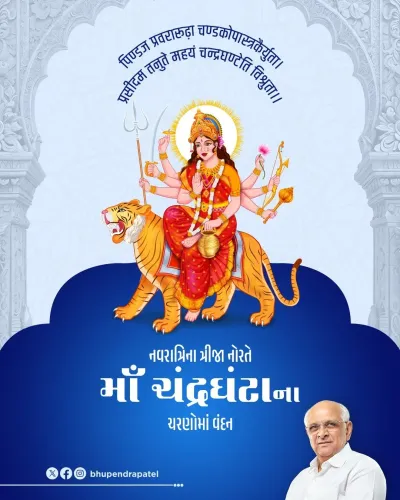
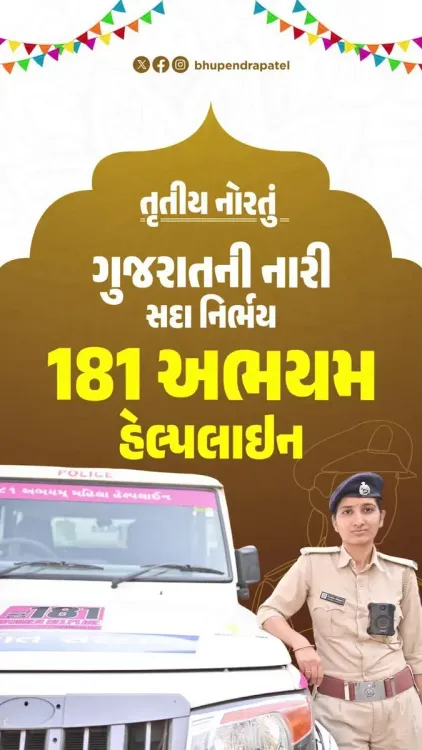
On Navratri's third day, Gujarat CM Bhupendra Patel spotlighted the '181 Abhayam Mahila Helpline' as a shield of women's self-confidence, tying the state's women's safety infrastructure to the spirit of Maa Chandraghanta, the goddess of courage and protection.
Key Takeaways
Gujarat CM Bhupendra Patel posted on 13 October 2026 , the third day of Navratri, highlighting the 181 Abhayam Mahila Helpline .
The helpline is Gujarat's locally branded adaptation of the national 181 women's distress number launched by the Government of India in 2015 . 'Abhayam' means fearlessness — the branding ties the scheme's identity to its core promise of a safe, fear-free environment for women.
CM Patel invoked Maa Chandraghanta — the form of Goddess Durga symbolising courage, worshipped on Navratri's third night — to frame the helpline as a cultural and civic commitment.
The campaign reflects a broader national pattern of anchoring women's welfare messaging to culturally significant festivals for greater public reach.
The helpline connects women in distress to emergency response, counselling, and police coordination across Gujarat.
On the third day of Navratri — the day Hindus venerate Maa Chandraghanta, goddess of courage and protection — Gujarat Chief Minister Bhupendra Patel used the occasion to renew a public pledge: every daughter and woman in Gujarat deserves honour, safety, and fearlessness. His message, posted on Tuesday, 13 October 2026, put the state's 181 Abhayam Mahila Helpline at the centre of that commitment.
Writing in Gujarati, CM Patel framed the post around a striking idea: 'સાહસ અને નિર્ભયતા એ જ સાચા અર્થમાં શક્તિની ઓળખ છે' — 'Courage and fearlessness are the true marks of strength.' The helpline, he said, serves as 'a shield of women's self-confidence, providing them a fearless and safe environment in every situation.'
What the 181 Abhayam helpline does
Gujarat's 181 Abhayam Mahila Helpline is the state's locally branded version of the national women's distress number that the Government of India rolled out in 2015 under the Ministry of Women and Child Development. The national framework was itself a post-2012 response to growing pressure on states to build dedicated, round-the-clock support infrastructure for women facing violence or distress. Gujarat adopted and branded the service as 'Abhayam' — meaning fearlessness — giving it a distinct identity within the state's welfare architecture.
The helpline connects women in distress to emergency response, counselling, and coordination with police and support services. Its single-number design lowers the barrier to seeking help, particularly for women in rural or semi-urban areas who may lack other resources.
Navratri as a platform for a welfare message
The timing is deliberate and part of a recognisable pattern across Indian states: anchoring welfare messaging to culturally significant moments amplifies reach. Chandraghanta — the fierce, bell-bearing form of Goddess Durga worshipped on the third night of Navratri — is explicitly associated with courage and the vanquishing of fear. Invoking her alongside a women's safety helpline is a pointed act of symbolic alignment, translating a government scheme into a language millions of Gujarati households are already tuned into during the festival.
CM Patel's call — 'Let us, while paying obeisance to Maa Chandraghanta, the symbol of courage, take a resolve for the honour, protection, and fearlessness of every daughter and woman in the state' — frames the helpline not as bureaucratic provision but as a shared social contract.
A state-level model within a national safety grid
Gujarat's approach fits a broader national effort to weave together administrative infrastructure and cultural engagement on gender safety. The 181 number is now operational across multiple states, but local branding and festival-linked campaigns vary by government. Gujarat's 'Abhayam' identity gives the helpline a distinct recall value — the word itself is a promise. Whether that promise is backed by adequate staffing, response times, and NGO coordination is a question that usage data, if and when the state releases it, will answer.
For now, on the third night of Navratri, the Chief Minister has made the helpline the centrepiece of a statewide resolve. The goddess of courage is the hook; the phone number is the policy.
Point of View
The deity of courage, to frame a women's distress helpline is symbolically tight and politically low-risk, reinforcing the BJP's long-running effort to position women's welfare within a Hindu cultural framework. The deeper question the post leaves open is whether Gujarat's Abhayam branding has translated into measurable improvements in helpline capacity, response quality, and survivor outcomes — metrics that festival campaigns celebrate but rarely detail.
NationPress
13 Oct 2026
Frequently Asked Questions
What is the 181 Abhayam Mahila Helpline in Gujarat?
The 181 Abhayam Mahila Helpline is Gujarat's state-branded women's distress service, built on the national 181 helpline framework launched in 2015, offering emergency support, counselling, and police coordination for women in distress.
Why did CM Bhupendra Patel mention the helpline on Navratri?
CM Patel posted on the third day of Navratri, when Maa Chandraghanta — the goddess symbolising courage — is worshipped, using the cultural moment to pledge honour, safety, and fearlessness for every woman and daughter in Gujarat.
Who can call the 181 helpline in Gujarat?
Any woman in Gujarat facing distress, violence, or an unsafe situation can call 181 to access emergency response, guidance, and coordination with authorities.
What does 'Abhayam' mean?
'Abhayam' is a Sanskrit and Gujarati word meaning fearlessness, reflecting the helpline's stated goal of providing women a fear-free and safe environment in all situations.
Is 181 a Gujarat-specific number or a national helpline?
The number 181 is a national women's helpline introduced by the Government of India in 2015; Gujarat has adapted it under the 'Abhayam' brand, giving it a state-specific identity and outreach focus.