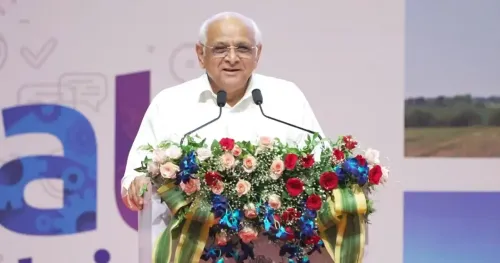
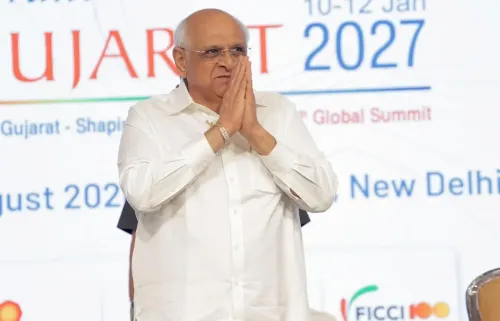
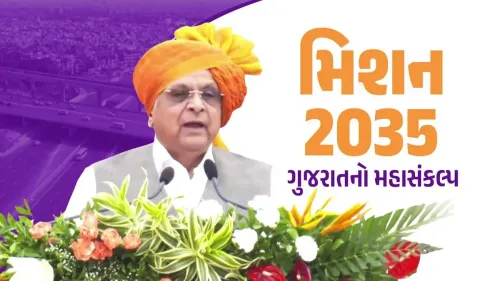
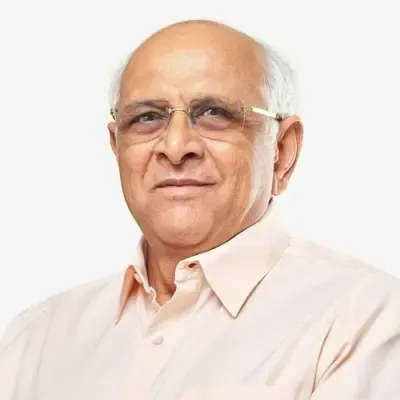
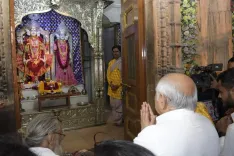
CM Bhupendra Patel greets Gujarat on Vikram Samvat 2083

Synopsis
Gujarat Chief Minister Bhupendra Patel marked Vikram Samvat 2083 with a new-year message to Gujaratis worldwide, anchoring cultural greetings to the 'Viksit Gujarat se Viksit Bharat' vision and calling for support to local artisans, small industries and Atmanirbhar Bharat goals.
Key Takeaways
CM Bhupendra Patel extended new-year greetings on 10 November 2026 for Vikram Samvat 2083 to Gujaratis in India and abroad.
He invoked the 'Viksit Gujarat se Viksit Bharat' pledge, linking state development to the national Viksit Bharat 2047 vision.
The message explicitly called for strengthening Vocal for Local and Atmanirbhar Bharat through support to local artisans and small industries.
Patel emphasised last-mile inclusion — reaching chhevadano manavi , the person at the furthest edge of society.
The address follows a consistent BJP pattern of using cultural and festive occasions to reinforce economic policy messaging.
A new year begins — not on the Gregorian calendar, but on the ancient Vikram Samvat, the lunisolar clock that has marked Gujarati life for millennia. On Tuesday, 10 November 2026, Gujarat Chief Minister Bhupendra Patel extended new-year greetings to every Gujarati citizen and diaspora family worldwide, weaving a message of cultural warmth with an unmistakable call to economic purpose.
Writing in Gujarati, CM Patel opened with a prayer: 'નવા વર્ષનો મંગલ ઉજાસ' — 'may the auspicious light of the new year carry happiness, peace, prosperity, good health and fresh hope into every life.' The tone was devotional, the register familiar to any Gujarati household that marks Vikram Samvat 2083 with rangoli, sweets and temple visits.
From new-year prayer to 'Viksit Gujarat, Viksit Bharat'
The greeting did not stop at blessings. Patel folded in a pointed political-economic compact, calling on Gujaratis to unite around the pledge of 'Viksit Gujarat se Viksit Bharat' — a Developed Gujarat as the engine of a Developed India. That phrase is the state-level extension of the central government's Viksit Bharat 2047 vision, which sets developed-nation benchmarks as the country approaches the centenary of its independence.
He specifically invoked two of Prime Minister Narendra Modi's signature economic doctrines: Vocal for Local — the campaign to steer consumer choice toward domestically made goods — and Atmanirbhar Bharat, the self-reliance mission announced in May 2020 as a comprehensive post-pandemic economic overhaul. Patel called on citizens to 'strengthen local artisans, small industries and the Vocal for Local mantra' and to carry prosperity to the last person — 'છેવાડાના માનવી', the person at the furthest edge of society.
Gujarat as the BJP's development template
The framing is deliberate and well-worn. Gujarat has served as the BJP's proof-of-concept for over two decades: a state whose industrial corridors, ease-of-doing-business scores and infrastructure investments are regularly cited as a model for national replication. By linking a cultural moment — the new-year dawn — to Atmanirbhar targets and last-mile inclusion, Patel reprises a pattern familiar from previous festive addresses: cultural occasions double as platforms for policy reinforcement.
The emphasis on local artisans and small industries carries particular resonance. Gujarat's cottage-industry belt — from Kutch's handloom weavers to Surat's power-loom clusters — sits at the intersection of heritage and economic output. Any state-level push on Vocal for Local schemes in the coming fiscal year will be watched as a test of whether the new-year commitment translates into procurement policy, trade-fair support, or credit access for micro-enterprises.
Mutual affection, social harmony and hard work, Patel concluded, are the three pillars on which Gujarat will 'conquer new peaks of development.' It is a compact the state's leadership has offered before — but each Vikram Samvat, the renewal of that compact is itself the news.
Point of View
CM Patel signals that Gujarat's cultural calendar is inseparable from its economic narrative — a fusion that has been the BJP's governing mode since the state's 'Gujarat model' was elevated to national policy vocabulary. The reference to 'Viksit Gujarat se Viksit Bharat' positions the state not merely as a beneficiary of central schemes but as their primary demonstrator. The deliberate mention of last-mile artisans suggests the party is alert to criticism that self-reliance messaging has bypassed informal-sector workers, and is pre-emptively reclaiming that space ahead of local body and assembly cycles.
NationPress
10 Nov 2026
Frequently Asked Questions
What is Vikram Samvat 2083 and when does it start?
Vikram Samvat is the traditional Hindu lunisolar calendar widely followed in Gujarat and several other Indian states. Samvat 2083 began in November 2026 and is marked with cultural rituals, family celebrations and exchange of new-year greetings.
What did Gujarat CM Bhupendra Patel say on Vikram Samvat 2083?
CM Patel wished all Gujarati citizens and the global diaspora a prosperous new year, praying for happiness, peace, health and new hope. He also called on people to unite around the 'Viksit Gujarat se Viksit Bharat' vision and support local artisans, small industries and Atmanirbhar Bharat.
What is 'Viksit Gujarat se Viksit Bharat'?
It is a state-level adaptation of the central government's Viksit Bharat 2047 vision — the goal of achieving developed-nation benchmarks by India's centenary of independence — with Gujarat positioned as the leading development model.
What is Vocal for Local and why did CM Patel mention it?
Vocal for Local is a central government initiative encouraging consumers to buy domestically produced goods, thereby strengthening local manufacturing and artisans. Patel invoked it to reinforce the idea that individual purchasing choices contribute to national self-reliance goals.
What is Atmanirbhar Bharat?
Atmanirbhar Bharat, or Self-Reliant India, is an economic mission announced by Prime Minister Narendra Modi in May 2020. It aims to boost domestic production, reduce import dependence, and build long-term economic resilience across sectors.