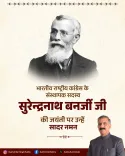
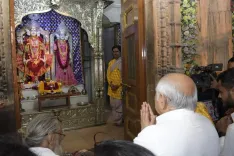
CM Sukhu pays tribute to Surendranath Banerjee on birth anniversary
Synopsis
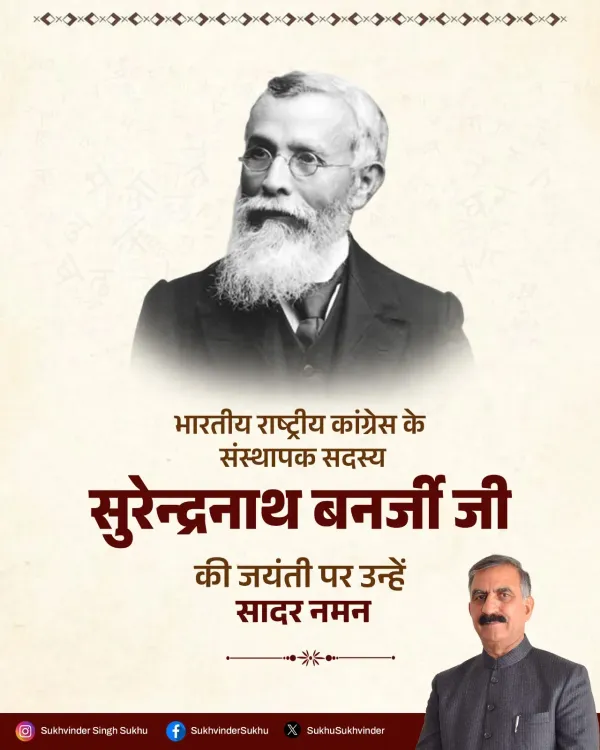
Himachal Pradesh CM Sukhvinder Singh Sukhu marked the birth anniversary of Indian National Congress founding member Surendranath Banerjee on 10 November 2026, honouring his legacy of national consciousness, self-governance advocacy, and constitutional reform under British rule.
Key Takeaways
Himachal Pradesh Chief Minister Sukhvinder Singh Sukhu paid tribute to Surendranath Banerjee on his birth anniversary on 10 November 2026 .
Surendranath Banerjee was a founding member of the Indian National Congress , established in 1885 .
Banerjee championed constitutional reforms, self-governance, and the spread of national consciousness during India's colonial period.
CM Sukhu credited Banerjee with strengthening the demand for self-rule and raising his voice for Indian civil and political rights.
The tribute is part of a broader Congress tradition of publicly commemorating the party's pre-independence founding figures.
A founding voice of modern India's political conscience, Surendranath Banerjee is remembered on his birth anniversary — and Himachal Pradesh Chief Minister Sukhvinder Singh Sukhu was among the first to offer a public tribute on Tuesday, 10 November 2026, honouring the nationalist leader's enduring legacy.
Posting in Hindi, CM Sukhu saluted Banerjee as a founding member of the Indian National Congress, writing: 'He raised his voice for the spread of national consciousness in the country, strengthening the demand for self-governance, and advocating constitutional reforms. His contribution to the nation will always be remembered.'
Who was Surendranath Banerjee — and why he still matters
Surendranath Banerjee stands as one of the towering moderate-phase nationalists of colonial India. A co-founder of the Indian National Congress — established in 1885 — he championed constitutional methods at a time when organised political resistance to British rule was still taking shape. His decades-long campaign for civil service reform, representative institutions, and Indian self-governance planted seeds that later generations of freedom fighters would carry to fruition.
Banerjee's approach was deliberate and lawyerly: use the colonial system's own logic to argue for Indian rights. That made him a bridge figure — respected by moderates who believed in gradual reform, and acknowledged even by later radicals as the man who first gave the independence movement an organisational spine.
Congress leaders and the ritual of remembrance
Tributes like CM Sukhu's are part of a well-established pattern across India's political landscape — leaders of all parties pause on the birth anniversaries of pre-independence figures to publicly reaffirm their connection to the nationalist tradition. For the Congress in particular, remembering early founders such as Banerjee is an act of institutional identity: a reminder that the party's roots stretch back to the very first organised push for Indian self-rule.
No new policy or legislative action is attached to today's tribute. It is, at its core, an act of historical acknowledgement — but one that keeps alive the memory of the moderate constitutionalists whose patient, persistent work shaped the democratic framework India inherited at independence.
Point of View
And they position current leaders within a lineage of democratic constitutionalism. For CM Sukhu, invoking Banerjee's name on the birth anniversary is as much a statement of ideological identity as it is an act of historical commemoration. At a time when parties across the spectrum contest the ownership of nationalist symbols, keeping moderate constitutionalists in public memory is itself a quiet political act. It underscores the Congress argument that its reformist, institution-building tradition — not just mass agitation — built the foundations of Indian democracy.
NationPress
10 Nov 2026
Frequently Asked Questions
Who was Surendranath Banerjee?
Surendranath Banerjee was a prominent Indian nationalist leader and one of the founding members of the Indian National Congress, established in 1885. He advocated constitutional reforms, self-governance, and civil service reform during India's colonial period using moderate, lawful methods.
Why did CM Sukhu pay tribute to Surendranath Banerjee?
Himachal Pradesh Chief Minister Sukhvinder Singh Sukhu paid tribute to Surendranath Banerjee on his birth anniversary, 10 November 2026, acknowledging Banerjee's role in spreading national consciousness and advocating for Indian self-rule as a founder of the Indian National Congress.
When was Surendranath Banerjee born?
Surendranath Banerjee was born on 10 November 1848. His birth anniversary is observed annually as an occasion to remember his contributions to India's independence movement.
What was Surendranath Banerjee's contribution to India's independence?
Surendranath Banerjee contributed to India's independence movement by co-founding the Indian National Congress, campaigning for constitutional reforms and Indian representation in civil services, and advocating for self-governance through legal and constitutional means under British rule.
What is Sukhvinder Singh Sukhu's connection to the Indian National Congress?
Sukhvinder Singh Sukhu is the Chief Minister of Himachal Pradesh and a senior leader of the Indian National Congress, the same party that Surendranath Banerjee helped found in 1885.