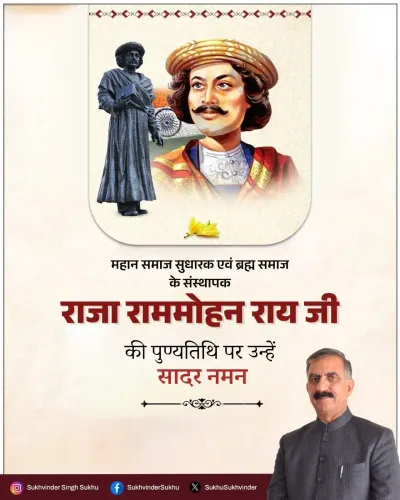
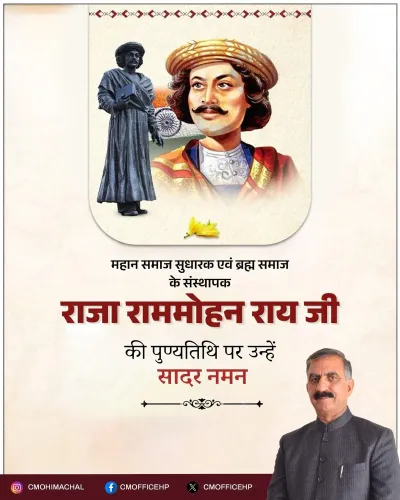
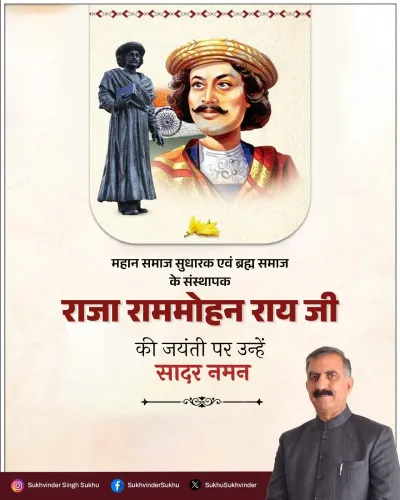
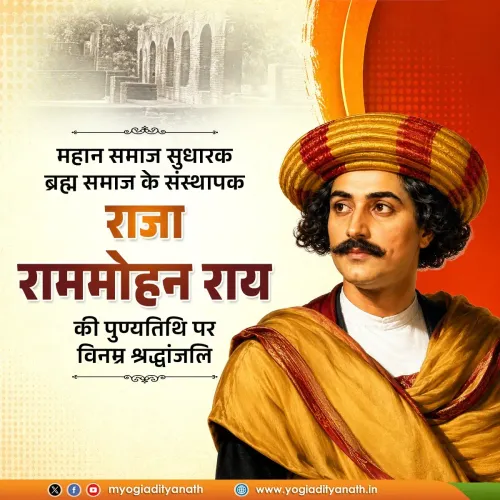
CM Sukhu Pays Tribute to Raja Ram Mohan Roy on Birth Anniversary
Synopsis
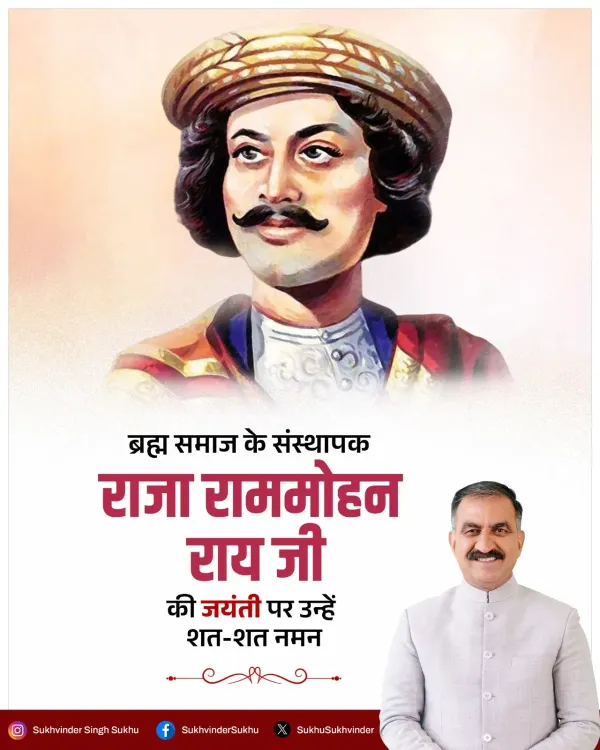
Himachal Pradesh Chief Minister Sukhvinder Singh Sukhu on May 22, 2026, paid tribute to Raja Ram Mohan Roy on his birth anniversary, honouring the Brahmo Samaj founder's campaigns against Sati, child marriage, and the purdah system as the bedrock of India's social awakening.
Key Takeaways
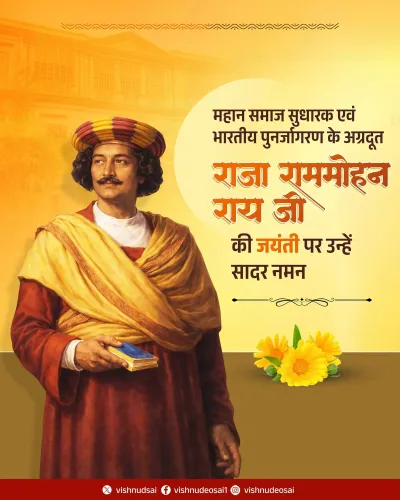
CM Sukhvinder Singh Sukhu posted a tribute to Raja Ram Mohan Roy on May 22, 2026 , the reformer's birth anniversary.
Roy was described as the 'harbinger of the Indian Renaissance' and founder of the Brahmo Samaj , established in 1828 .
Sukhu specifically highlighted Roy's opposition to Sati , child marriage , and the purdah system .
Roy's advocacy directly led to the Bengal Sati Regulation of 1829 , banning the practice of Sati.
The tribute follows a recurring pattern of Indian political leaders invoking 19th-century reformers to affirm constitutional values of equality and social justice.
Himachal Pradesh Chief Minister Sukhvinder Singh Sukhu on Friday, May 22, 2026, paid tribute to Raja Ram Mohan Roy on the reformer's birth anniversary, honouring him as a pioneer of the Indian Renaissance and founder of the Brahmo Samaj.
Context
In his post, CM Sukhu described Raja Ram Mohan Roy as 'भारतीय पुनर्जागरण के अग्रदूत' ('harbinger of the Indian Renaissance') and a 'great social reformer.' He specifically acknowledged Roy's struggles against social evils including Sati, child marriage, and the purdah system, calling these efforts the foundation of awareness and new consciousness in Indian society. The Chief Minister added that Roy's progressive thinking and life dedicated to social reform 'will always inspire the people of the country.'
Policy Backdrop
Raja Ram Mohan Roy, born on May 22, 1772, founded the Brahmo Samaj in 1828 as an institutional platform advocating monotheism, women's education, and the abolition of discriminatory customs. His sustained advocacy directly contributed to the enactment of the Bengal Sati Regulation of 1829, which formally banned the practice of Sati — one of the most consequential legislative outcomes of 19th-century social reform in India. The Brahmo Samaj went on to shape the intellectual and moral framework of India's independence movement and its constitutional values.
Roy's work on child marriage and women's rights laid early groundwork for legal protections that would be codified over subsequent decades. His insistence on rational inquiry and religious reform positioned him as a bridge between classical Indian thought and Enlightenment ideals, earning him the title 'Father of the Indian Renaissance.'
Stakeholders and Impact
Annual commemorations of Raja Ram Mohan Roy's birth anniversary on May 22 draw tributes from political leaders across party lines, women's rights organisations, and social reform bodies. These statements serve as public affirmations of constitutional commitments to equality, gender justice, and education. CM Sukhu's tribute aligns with this broader pattern, in which state and national leaders invoke 19th-century reformers to signal continuity with India's progressive social heritage.
For Himachal Pradesh, a state with active government programmes on women's welfare and education, such commemorations reinforce the political messaging around social equity without constituting a new policy announcement.
What's Next
Annual tributes on May 22 are expected to continue as a fixture of official political communication across India. Observers of Himachal Pradesh governance will watch for any state-level events, curriculum updates, or policy initiatives referencing 19th-century reform movements that may follow in the weeks ahead. Roy's legacy remains a touchstone for contemporary debates on gender rights, education access, and religious reform in India.
Point of View
Aligning the Congress-led Himachal Pradesh government with India's progressive reform tradition. By foregrounding Roy's battles against Sati and child marriage, Sukhu implicitly frames his administration within a lineage of social justice advocacy — a narrative useful amid ongoing debates on women's welfare policy at the state level. Such commemorations rarely translate into immediate legislative action, but they function as ideological signalling to core constituencies including women's rights advocates and educators. The consistency of this practice across party lines underscores how 19th-century reformers have become shared symbolic capital in Indian democratic politics.
NationPress
7 Oct 2026
Frequently Asked Questions
Who was Raja Ram Mohan Roy and why is he celebrated on May 22?
Raja Ram Mohan Roy was born on May 22, 1772 , and is celebrated as the founder of the Brahmo Samaj and a pioneer of the Indian Renaissance. He led campaigns against Sati, child marriage, and the purdah system, and his advocacy contributed to the Bengal Sati Regulation of 1829 .
What did CM Sukhu say about Raja Ram Mohan Roy?
CM Sukhvinder Singh Sukhu called Roy the 'harbinger of the Indian Renaissance' and praised his struggle against social evils like Sati , child marriage , and the purdah system , saying Roy's progressive thinking will always inspire the people of India.
When was the Brahmo Samaj founded and what did it stand for?
The Brahmo Samaj was founded in 1828 by Raja Ram Mohan Roy . It advocated monotheism, women's education, and the abolition of discriminatory social customs, becoming a key institutional force in 19th-century Indian reform.
What was the Bengal Sati Regulation of 1829?
The Bengal Sati Regulation of 1829 was a law that formally banned the practice of Sati — the immolation of widows on their husbands' funeral pyres. It was enacted following sustained advocacy by Raja Ram Mohan Roy .
Why do Indian politicians pay tribute to Raja Ram Mohan Roy?
Indian political leaders across parties routinely issue tributes on May 22 to honour Roy's legacy as a social reformer. These statements signal commitment to constitutional values of equality and social justice, connecting contemporary governance to India's 19th-century reform heritage.