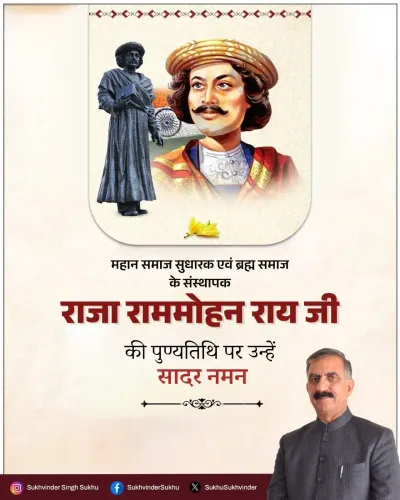
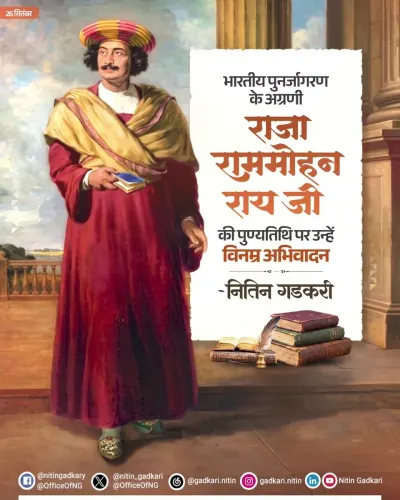
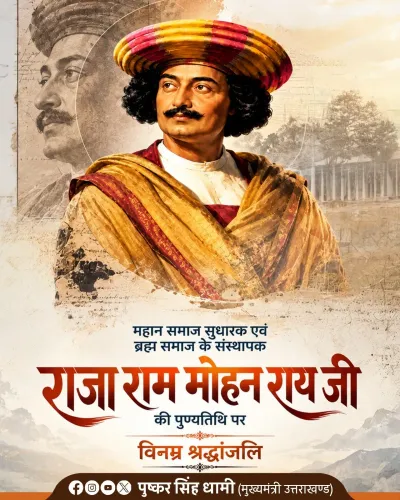
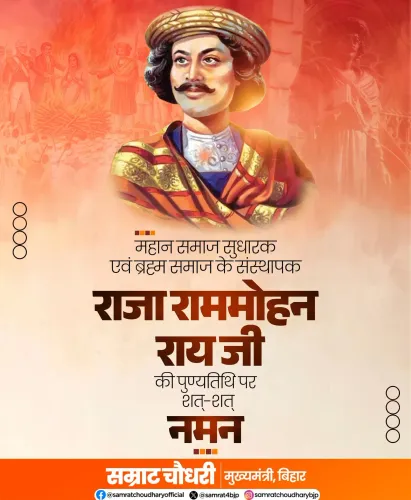
CM Dhami pays tribute to Raja Ram Mohan Roy on birth anniversary
Synopsis
Uttarakhand Chief Minister Pushkar Singh Dhami paid tribute to 19th-century social reformer Raja Ram Mohan Roy on his birth anniversary on 22 May 2026, honouring Roy's campaigns against social evils and his historic contributions to women's education and equality in India.
Key Takeaways
Uttarakhand Chief Minister Pushkar Singh Dhami posted a tribute to Raja Ram Mohan Roy on his birth anniversary on 22 May 2026 .
Raja Ram Mohan Roy founded the Brahmo Samaj in 1828 and was a leading campaigner against sati, child marriage, and for women's education.
Roy's advocacy contributed directly to the Sati Regulation Act of 1829 , a landmark in Indian social reform.
CM Dhami credited Roy's efforts with giving 'a new direction to the building of modern India' in education, equality, and women's rights.
The tribute aligns with a broader pattern among BJP-governed states of invoking 19th-century reformers to reinforce current women's empowerment messaging.
Stakeholders in Uttarakhand — particularly women and students — remain the primary audience for state-level social reform communications.
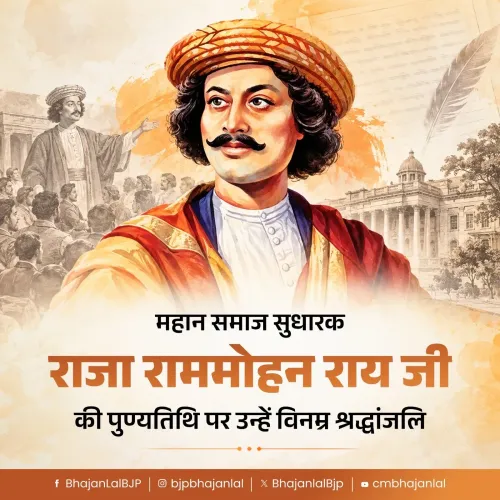
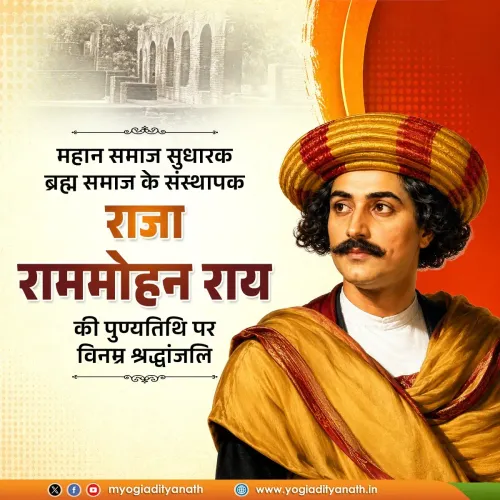
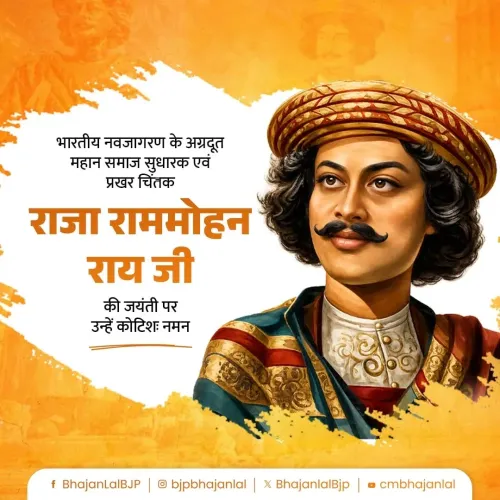
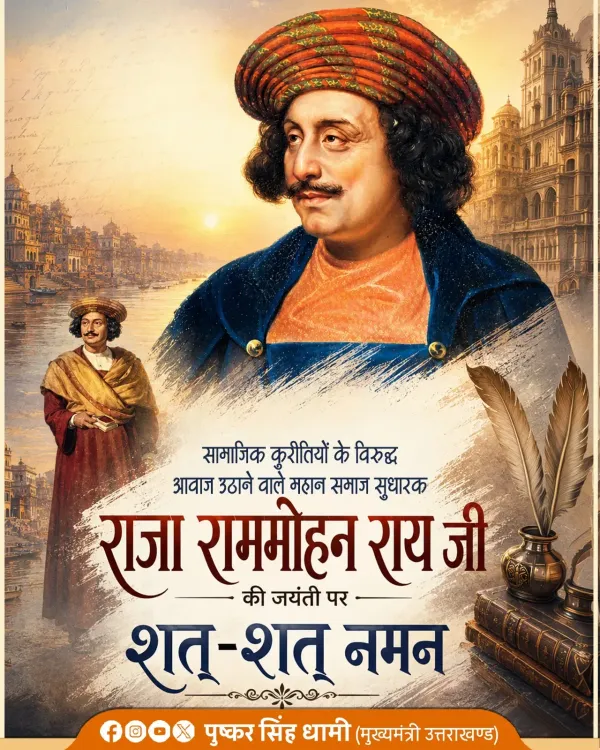
Uttarakhand Chief Minister Pushkar Singh Dhami on Friday, 22 May 2026 paid tribute to Raja Ram Mohan Roy on the reformer's birth anniversary, honouring his foundational role in shaping modern India through campaigns for women's education and social equality.
In his post, Chief Minister Dhami wrote: 'सामाजिक कुरीतियों के विरुद्ध सशक्त आवाज बुलंद करने वाले' ['one who raised a powerful voice against social evils'], saluting Roy's legacy with the words 'शत्-शत् नमन' — a traditional Hindi expression of deep reverence. He noted that Roy's 'historical efforts for education, equality and women's rights gave a new direction to the building of modern India.'
Context
Raja Ram Mohan Roy (1772–1833) is widely regarded as the father of the Bengal Renaissance and one of the most consequential social reformers in Indian history. He founded the Brahmo Samaj in 1828, a reformist movement that advocated monotheism, opposed idol worship, and pushed for social equality at a time when orthodox practices dominated public life. His sustained advocacy directly contributed to the passage of the Sati Regulation Act of 1829, which outlawed the practice of widow immolation.
Roy championed women's education and access to Western learning decades before these ideas entered mainstream policy discourse. The principles of gender equality and universal education access that he promoted found their way into the framework of the Indian Constitution adopted in 1950.
Policy Backdrop
Indian political leaders across parties routinely mark the birth anniversaries of 19th-century reformers to signal alignment with values of social progress and modern education. In BJP-governed states, such tributes frequently appear alongside state-level messaging on women's empowerment and the removal of regressive social customs.
Uttarakhand, the northern Himalayan state that Chief Minister Dhami leads, has highlighted historical reformers in its public communications on education and women's rights. The tribute connects Roy's 19th-century legacy to contemporary state priorities without introducing new legislation or policy measures in the post itself.
Stakeholders and Impact
Roy's legacy is particularly relevant to two groups that remain central to state policy discussions: women and students. His campaigns against child marriage and for girls' access to formal schooling laid an ideological foundation that later reformers and constitutional framers built upon.
By publicly invoking Roy's memory, Chief Minister Dhami reinforces the state government's stated commitment to girls' education and social awareness — themes that resonate with both urban and rural constituencies across Uttarakhand.
What's Next
Observers will watch for any follow-up state announcements on girls' education schemes or social awareness drives in Uttarakhand that may be timed around reformist anniversaries. At the national level, commemorations of figures like Roy often precede or accompany broader messaging campaigns on women's empowerment from the central government.
The tribute underscores a continuing political tradition of anchoring present-day governance priorities to the moral authority of historical reform movements — a pattern that is likely to persist as India approaches significant policy milestones in education and gender equity.
Point of View
Insulating the tribute from political contestation. The timing and framing connect Uttarakhand's stated policy priorities to a 19th-century moral authority, lending historical weight to present-day commitments. It is part of a wider pattern in which ceremonial tributes function as soft policy signalling rather than standalone gestures.
NationPress
6 Oct 2026
Frequently Asked Questions
Who was Raja Ram Mohan Roy and why is he remembered?
Raja Ram Mohan Roy (1772–1833) was a pioneering Indian social reformer who founded the Brahmo Samaj in 1828, campaigned successfully against sati and child marriage, and championed women's education and Western learning, earning him the title 'father of the Bengal Renaissance.'
Why did CM Dhami pay tribute to Raja Ram Mohan Roy?
Uttarakhand Chief Minister Pushkar Singh Dhami posted a tribute on 22 May 2026 to mark Raja Ram Mohan Roy's birth anniversary, honouring his contributions to social reform, women's education, and the shaping of modern India.
What was the Sati Regulation Act and what role did Raja Ram Mohan Roy play?
The Sati Regulation Act of 1829 outlawed the practice of widow immolation in British India. Raja Ram Mohan Roy's sustained public advocacy and petitioning of colonial authorities was a decisive factor in persuading the administration to pass the legislation.
What is the Brahmo Samaj founded by Raja Ram Mohan Roy?
The Brahmo Samaj, founded by Raja Ram Mohan Roy in 1828, was a reformist socio-religious movement that promoted monotheism, opposed idol worship and caste discrimination, and advocated for social equality and women's rights in 19th-century India.
How does Pushkar Singh Dhami's tribute connect to Uttarakhand's policies?
By honouring Raja Ram Mohan Roy's legacy in women's education and social equality, CM Dhami reinforces Uttarakhand's stated government priorities around girls' schooling and the removal of regressive social practices, aligning historical reform values with current state messaging.