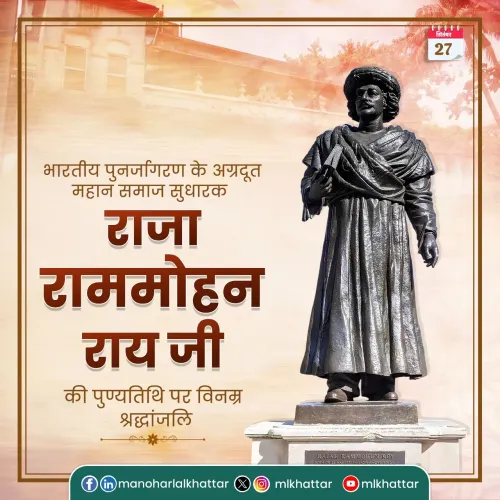
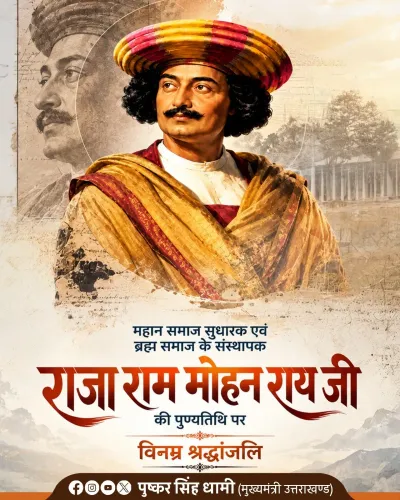
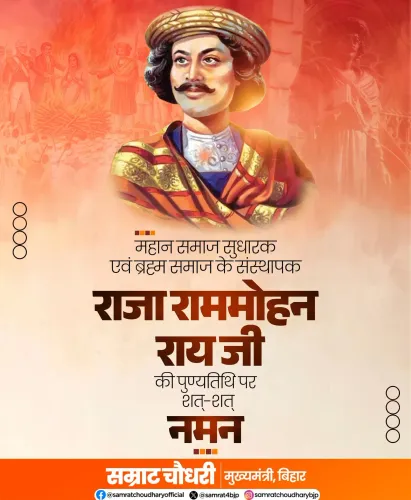
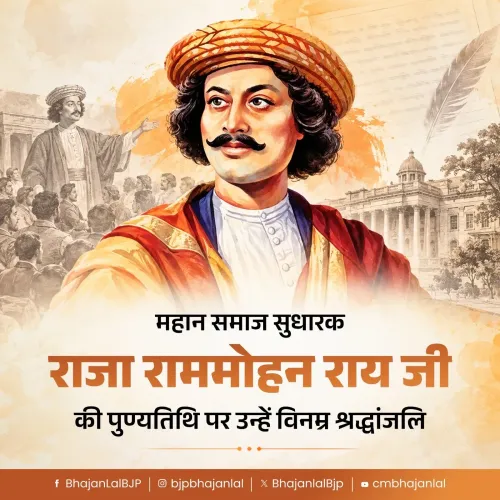
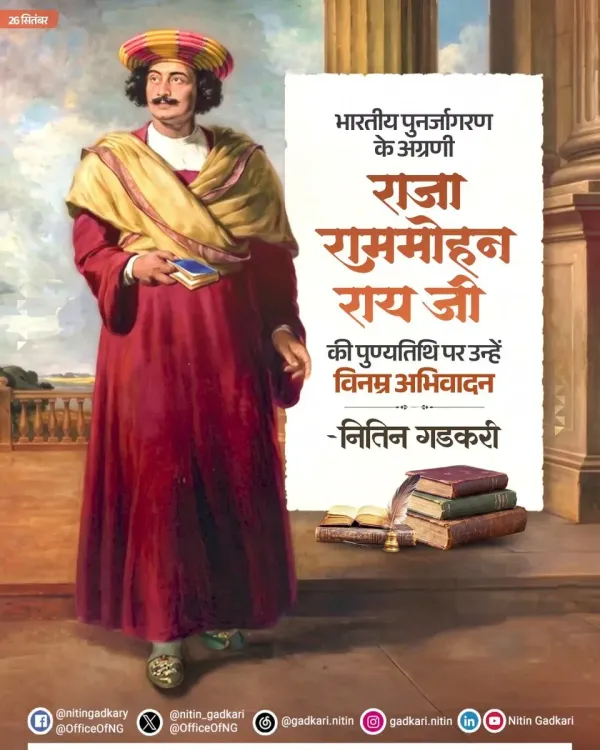
Gadkari pays tribute to Raja Ram Mohan Roy on death anniversary
Synopsis
Union Minister Nitin Gadkari marked Raja Ram Mohan Roy's death anniversary on September 27, 2026, honouring the 19th-century reformer's role in India's social renaissance and his journalism that helped shape the independence movement.
Key Takeaways
Nitin Gadkari paid tribute to Raja Ram Mohan Roy on his death anniversary, September 27, 2026 .
Roy is celebrated as the father of the Indian Renaissance and founder of the Brahmo Samaj .
Gadkari highlighted Roy's journalism as a guiding force for the Indian freedom struggle.
Roy's campaign against sati led to its abolition under the Bengal Sati Regulation of 1829 .
Tributes to Roy are a cross-party tradition in Indian political culture, linking social reform to national liberation.
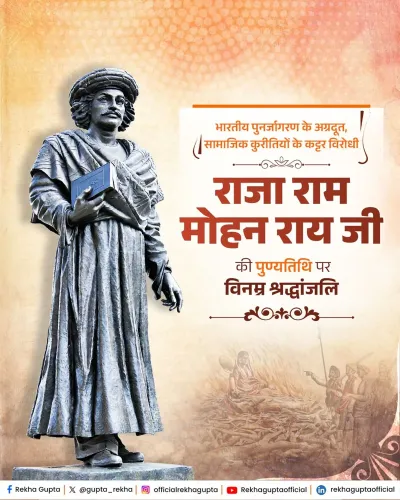
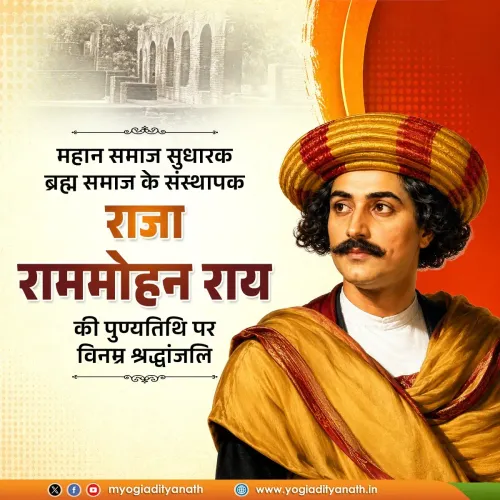
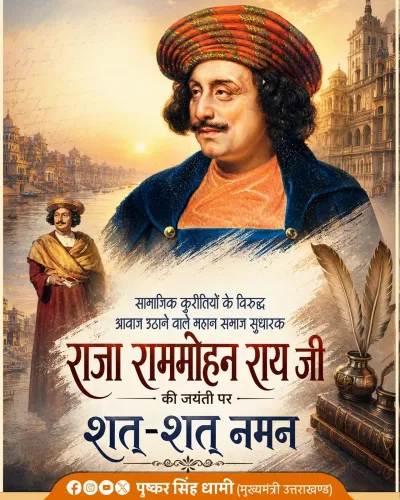
On the death anniversary of one of India's most consequential reformers, Union Road Transport and Highways Minister Nitin Gadkari offered a public tribute to Raja Ram Mohan Roy on Sunday, September 27, 2026, calling him a singular force in India's social and religious renaissance.
Posting in Hindi on X, Gadkari wrote: 'भारत के सामाजिक और धार्मिक पुनर्जागरण के क्षेत्र में सुधारक राजा राममोहन राय जी का विशिष्ट स्थान है' — 'Reformer Raja Ram Mohan Roy holds a distinguished place in India's social and religious renaissance.' He further noted that Roy's journalism helped steer the Indian freedom struggle in the right direction, before offering a respectful salutation on the occasion of his memorial day.
A 19th-century reformer who reshaped a civilisation
Raja Ram Mohan Roy's place in Indian history is foundational. Born in 1772 in Bengal, he mounted a fierce campaign against the practice of sati — the immolation of widows — which culminated in its legal abolition in 1829 under the Bengal Sati Regulation. He was the founder of the Brahmo Samaj, a reformist socio-religious movement that challenged orthodoxy, promoted monotheism, and advocated the education of women at a time when both were radical propositions. His contribution to journalism was equally far-reaching. Roy established some of the earliest vernacular and English-language periodicals in India, using the press as a platform to build public opinion, spread Enlightenment ideas, and lay an intellectual foundation that later nationalist leaders would build upon. Gadkari's tribute specifically acknowledges this dimension — that Roy's pen helped orient the independence movement before the movement had even fully formed.Why ministers across parties mark this day
Tributes to Roy cut across party lines and are a standard feature of the Indian political calendar. The broader pattern is telling: by publicly honouring 19th-century reformers, political figures draw a direct line from social renewal to national liberation — a narrative that resonates with citizens of every ideological stripe. Roy's legacy is considered the headwaters of modern India's reformist tradition, making him a figure of near-universal reverence. For a senior BJP leader of Gadkari's standing, marking Roy's anniversary also underscores a continuity of purpose — the idea that the work of building a just society did not begin with independence but with the reformers who made independence imaginable.Point of View
Lending moral continuity to modern parties. By specifically citing Roy's journalism rather than only his social campaigns, the minister gestures toward the power of public communication in nation-building — a frame with quiet contemporary resonance. For the BJP, honouring figures like Roy broadens the party's ideological canvas beyond its core cultural touchstones. Such commemorative posts rarely shift policy but do shape the terms of civic memory.
NationPress
27 Sept 2026
Frequently Asked Questions
Why is September 27 observed as Raja Ram Mohan Roy's death anniversary?
Raja Ram Mohan Roy passed away on September 27, 1833 , in Bristol, England, and the date is observed annually in India as his memorial day.
Who was Raja Ram Mohan Roy?
Raja Ram Mohan Roy was a 19th-century Bengali social reformer , founder of the Brahmo Samaj, who campaigned against sati, championed women's education, and is often called the father of the Indian Renaissance.
What was Raja Ram Mohan Roy's contribution to journalism?
Roy founded some of India's earliest vernacular and English periodicals, using them to spread Enlightenment ideas and shape public opinion in ways that later influenced the independence movement.
What did Nitin Gadkari say about Raja Ram Mohan Roy?
Gadkari said Roy holds a distinguished place in India's social and religious renaissance and that his journalism helped guide the Indian freedom struggle in the right direction.
What is the Brahmo Samaj founded by Raja Ram Mohan Roy?
The Brahmo Samaj was a reformist socio-religious movement founded by Roy that challenged orthodox Hindu practices, promoted monotheism, and advocated the education and rights of women.