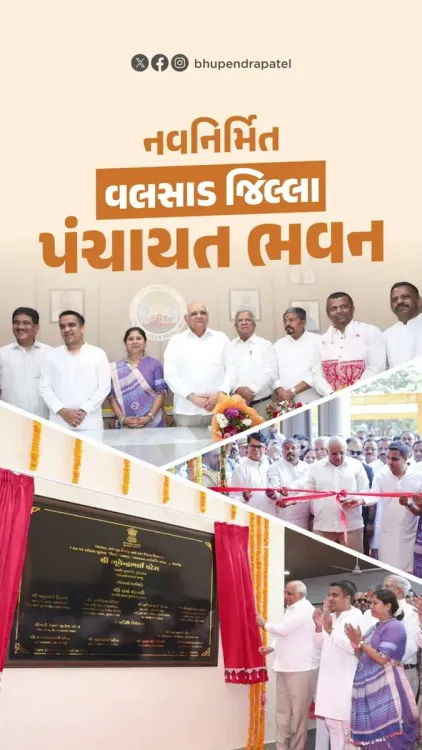
CM Bhupendra Patel Inaugurates ₹37.50 Cr Valsad District Panchayat
Synopsis
Gujarat Chief Minister Bhupendra Patel inaugurated the new ₹37.50 crore District Panchayat Bhavan in Valsad on 3 November 2026, unifying multiple government offices under one roof to speed up citizen services and improve accessibility, including for persons with disabilities.
Key Takeaways
Gujarat CM Bhupendra Patel inaugurated the Valsad District Panchayat Bhavan on 3 November 2026 .
The building was constructed at a cost of ₹37.50 crore .
Multiple District Panchayat offices are now consolidated under a single roof for the first time.
The facility is designed to be accessible for divyangjan (persons with disabilities).
The inauguration is framed under Gujarat's Nagrik Devo Bhav citizen-service campaign.
The move continues Gujarat's broader push to upgrade district administrative infrastructure for faster, single-window governance.
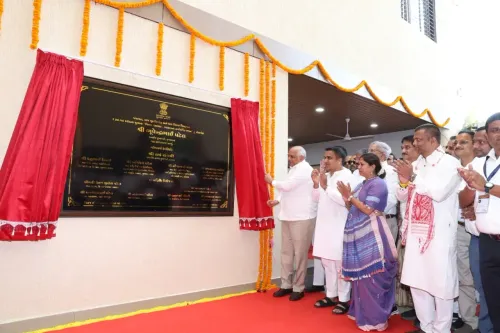
A southern Gujarat district just got a new civic nerve centre. Gujarat Chief Minister Bhupendra Patel on Tuesday, 3 November 2026 inaugurated the newly constructed District Panchayat Bhavan in Valsad, built at a cost of ₹37.50 crore — a pre-New Year development gift, as the Chief Minister put it, for the people of the district.
Posting in Gujarati on X, CM Patel described the building as a 'vikas ni sogaat' (gift of development) for Valsad, expressing the wish that it become a centre of efficient public service guided by the principle 'Nagrik Devo Bhav' — 'the citizen is God.' The inauguration brings multiple District Panchayat offices under a single roof for the first time, a move the Chief Minister said would sharpen coordination between departments, speed up delivery, and give residents access to various government services at one location.
One Roof, Faster Governance for Valsad
The consolidation model is straightforward in intent but significant in practice. Previously, citizens navigating panchayat services — land records, welfare schemes, rural development clearances — often had to trek across dispersed offices. The new Valsad District Panchayat Bhavan collapses that friction into a single building, a model Gujarat has pursued across several districts as part of its administrative modernisation push under successive BJP governments.
CM Patel specifically highlighted accessibility for divyangjan (persons with disabilities), signalling that the design incorporates barrier-free features. The building's framing as a 'Jan Seva Kendra' — a people's service hub — aligns directly with the state government's Nagrik Devo Bhav campaign, which mandates time-bound, accessible public service delivery across Gujarat.
Panchayati Raj Roots and Gujarat's Infrastructure Push
The District Panchayat as an institution carries constitutional weight: the 73rd Constitutional Amendment of 1992 formally enshrined Panchayati Raj bodies as the third tier of Indian democracy, tasking them with district-level development. Upgrading their physical infrastructure is, in that sense, an investment in the institutional architecture the Constitution intended. Valsad, a district at Gujarat's southern edge bordering Maharashtra, has a mixed profile — tribal communities, agricultural belts, and industrial corridors — making accessible governance particularly consequential for its more remote populations.
Gujarat has periodically upgraded district administrative buildings to consolidate offices and improve coordination, a pattern that has accelerated under the BJP's governance. The Valsad inauguration fits neatly into that arc, and the watch now is whether comparable bhavans are announced for other districts in the coming months.
A ₹37.50 crore building is a line in the budget. A single window where a tribal farmer or a wheelchair user can resolve a government query without losing a day to multiple offices — that is what the number is meant to become.
Point of View
Brand the exercise under a citizen-first slogan, and tie the ribbon just before a festive season for maximum political optics. For CM Bhupendra Patel, who has leaned heavily on delivery-focused governance since taking office in 2021, such district-level infrastructure moments build a cumulative narrative of visible development. The Nagrik Devo Bhav framing is particularly deliberate — it positions the state's bureaucratic upgrades not as routine capital expenditure but as a civic compact. The real test, however, will be whether single-roof consolidation translates into measurable gains in service turnaround times for Valsad's tribal and rural communities.
NationPress
3 Nov 2026
Frequently Asked Questions
What is the Valsad District Panchayat Bhavan?
The Valsad District Panchayat Bhavan is a newly constructed administrative building in Valsad, Gujarat, built at a cost of ₹37.50 crore to house multiple district panchayat offices under one roof, inaugurated by CM Bhupendra Patel on 3 November 2026.
How much did the Valsad District Panchayat building cost?
The building was constructed at a cost of ₹37.50 crore, as stated by Chief Minister Bhupendra Patel at the inauguration.
What is Nagrik Devo Bhav in Gujarat?
Nagrik Devo Bhav — meaning 'the citizen is God' — is a Gujarat government campaign and governing motto focused on ensuring accessible, time-bound public service delivery to every resident of the state.
Who inaugurated the Valsad District Panchayat Bhavan?
Gujarat Chief Minister Bhupendra Patel inaugurated the new District Panchayat Bhavan in Valsad on Tuesday, 3 November 2026.
How does the new Valsad panchayat building help citizens?
By bringing all District Panchayat offices under one roof, citizens can access multiple government services at a single location, reducing travel time and waiting, with the building also designed to be accessible for persons with disabilities.